Multistage CBAM-enhanced deep learning for three-class classification of radiographically derived bone mass status labels on knee radiographs
Abstract
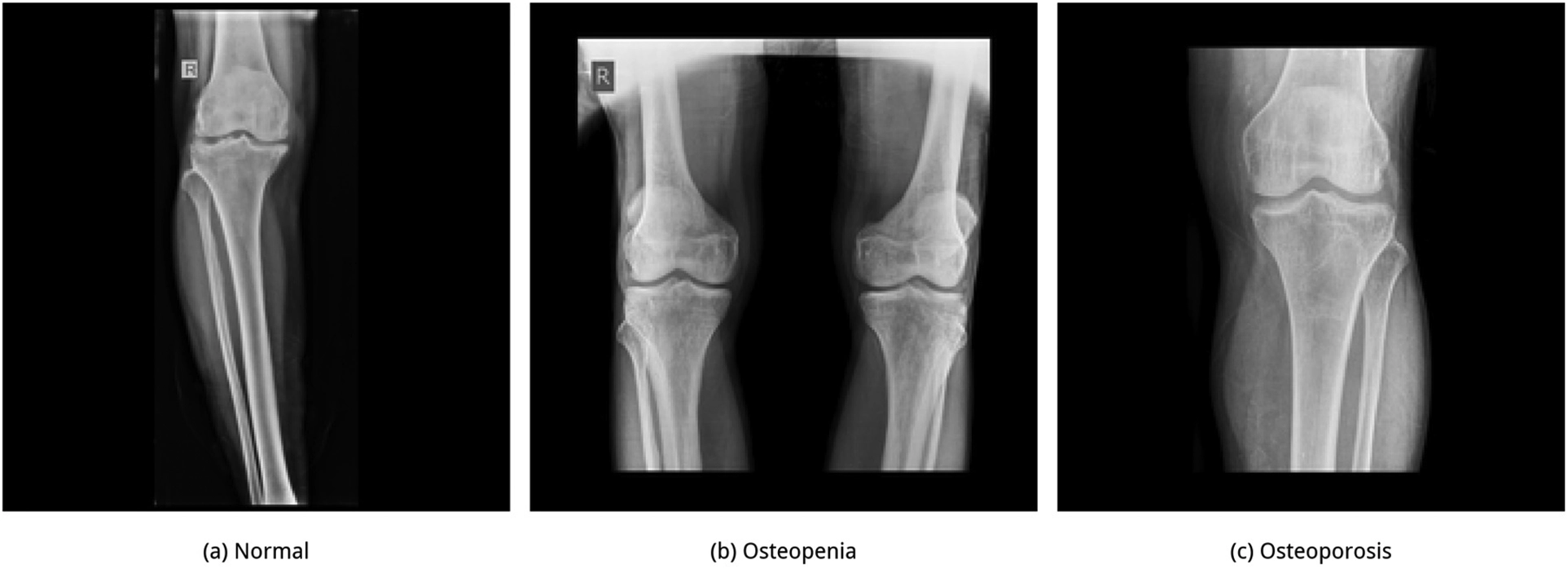
Objective To develop and validate a deep learning model incorporating multistage convolutional block attention modules (CBAMs) for classifying the radiographically derived bone-mass labels (normal bone mass, osteopenia, and osteoporosis) of a public knee radiograph dataset, and to investigate the potential of knee radiography for opportunistic screening of abnormal bone mass. Methods This study used the publicly available Multi-Class Knee Osteoporosis x-Ray Dataset, which was released on Kaggle and compiled from multiple publicly accessible knee radiograph sources. The class labels (normal bone mass, osteopenia, and osteoporosis) were assigned by the dataset provider on the basis of radiographic features and were not verified against dual-energy x-ray absorptiometry (DXA) T-scores; the model therefore classifies the dataset's radiographic labels rather than DXA-defined bone mass status. After assessing image integrity, label consistency, and data usability, a total of 1,947 knee radiographs were included, comprising 780 images labeled as normal bone mass, 374 as osteopenia, and 793 as osteoporosis. The dataset was stratified into training, validation, and test sets at a ratio of 70:20:10. All images were resized to 224 × 224 pixels and normalized using the ImageNet mean and standard deviation. A multi-stage convolutional block attention module (CBAM)-enhanced classification model was developed based on a VGG19-style convolutional neural network and compared with the ResNet50, EfficientNet-B0, DenseNet121, and VGG19 baseline models, as well as several attention-based ablation models. Model performance was evaluated using overall accuracy, class-wise precision, recall, and F1-score, together with confusion matrices and one-vs.-rest receiver operating characteristic curves. Gradient-weighted class activation mapping (Grad-CAM) was further used to visualize and assess the image regions contributing to model predictions. Results On the independent test set, the multistage CBAM model achieved the highest overall accuracy of 90.77% (177/195), outperforming VGG19, ResNet50, EfficientNet-B0, DenseNet121, and a reproduced model from the literature. The area under the ROC curve (AUC) was 0.982 for normal bone mass, 0.991 for osteopenia, and 0.981 for osteoporosis. The confusion matrix showed 68/78, 34/38, and 75/79 correctly classified images in the three categories, respectively, with most errors occurring between adjacent bone-mass states. Ablation experiments showed that multistage CBAM outperformed attention-free VGG19, SE-VGG19, ECA-VGG19, and stacked CBAM. Grad-CAM highlighted primarily the distal femur, proximal tibia, and periarticular osseous structures. All results were obtained from a single stratified split and a single random seed (42); because of limited computational resources, repeated runs over multiple seeds and k-fold cross-validation could not be performed. Conclusion The multistage CBAM-enhanced model effectively distinguished the radiographically derived bone-mass labels (normal bone mass, osteopenia, and osteoporosis) of this public knee radiograph dataset. Because the labels were not verified against DXA, the model should be regarded as a classifier of the dataset's radiographic labels rather than of DXA-defined bone mass status. It may serve as an adjunctive tool for opportunistic screening of abnormal bone mass and provide imaging-based prompts for subsequent DXA assessment and fracture-risk evaluation, subject to further validation against DXA-derived ground truth, de-duplication and patient-level partitioning, and external data.
From the paper
- Limitation
First, it used a publicly available imaging dataset in which the original labels were assigned by the data provider according to radiographic features and were not uniformly verified against DXA-derived T-scores as the reference standard.
Quoted word for word from the full text on frontiersin.org.
The paper
Hubei University of Chinese Medicine; Xianning Central Hospital
Frontiers in Medicine, 15 Oct 2026, Open access, CC BY


