The association between frequent pain and fall risk: exploratory roles of abnormal sleep duration and grip strength in middle-aged and older adults—a prospective study based on CHARLS
Abstract
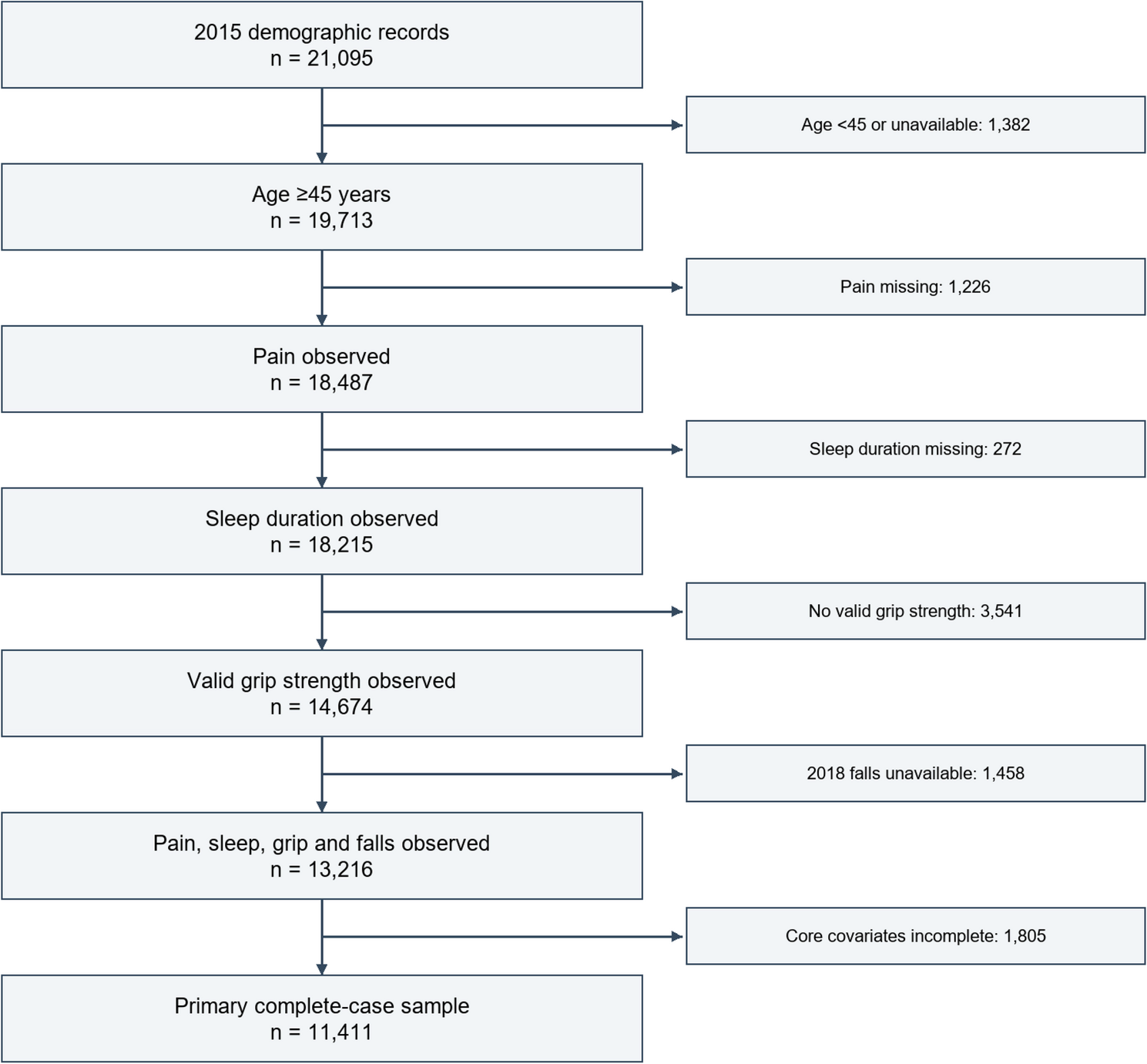
Frequent pain has been associated with falls in middle-aged and older adults, yet the possible contributions of sleep disturbance and muscle weakness remain unclear. Using data from the China Health and Retirement Longitudinal Study (CHARLS), we aimed to examine the association between frequent pain and subsequent falls, and to explore the joint contribution of abnormal sleep duration and grip strength. We included 11,411 participants aged ≥ 45 years from the 2015 baseline survey with complete primary-analysis data. Frequent pain was assessed via self-report. Abnormal sleep duration was defined as < 6 h or > 9 h per night. Grip strength was measured using a dynamometer. Falls were identified during the 2018 follow-up. Logistic and linear regression models used community-clustered variance estimates. Exploratory probability standardization was used to estimate joint association contrasts, with 95% confidence intervals obtained from 1,000 whole-community bootstrap resamples. Models were adjusted for sociodemographic characteristics, lifestyle factors, and BMI; expanded models additionally included depression, chronic conditions, and baseline fall history. At baseline, 30.6% reported frequent pain. After core adjustment, frequent pain was significantly associated with abnormal sleep duration (OR = 1.869, 95% CI: 1.713–2.038), lower grip strength (β = −1.641, 95% CI: −1.956 to − 1.326), and subsequent falls conditional on sleep and grip (OR = 1.624, 95% CI: 1.460–1.805). Abnormal sleep duration was associated with higher odds of falls (OR = 1.254, 95% CI: 1.132–1.388), while each 1-kg increase in grip strength was associated with 2.0% lower odds (OR = 0.980, 95% CI: 0.972–0.988). The primary joint indirect association contrast was 1.265% points (95% CI: 0.880–1.672). In the same 10,281-person subset, it was 1.247 (95% CI: 0.829–1.681) with core adjustment and 0.370 (95% CI: 0.169–0.603) with additional health adjustment. Frequent pain was associated with subsequent falls among middle-aged and older Chinese adults. Abnormal sleep duration and reduced grip strength jointly contributed to an exploratory model-based association, but independent or sequential causal mediation was not established. Sleep management and muscle-strengthening interventions warrant further evaluation; their fall-prevention benefits are not demonstrated by this study.
The paper
Shanxi Medical University
BMC Public Health, 14 Oct 2026, Open access, CC BY-NC-ND