Subjective sleep regularity, frailty, and self-reported health loss in later life: evidence from a multisite study of older adults in China
Multicentre
Abstract
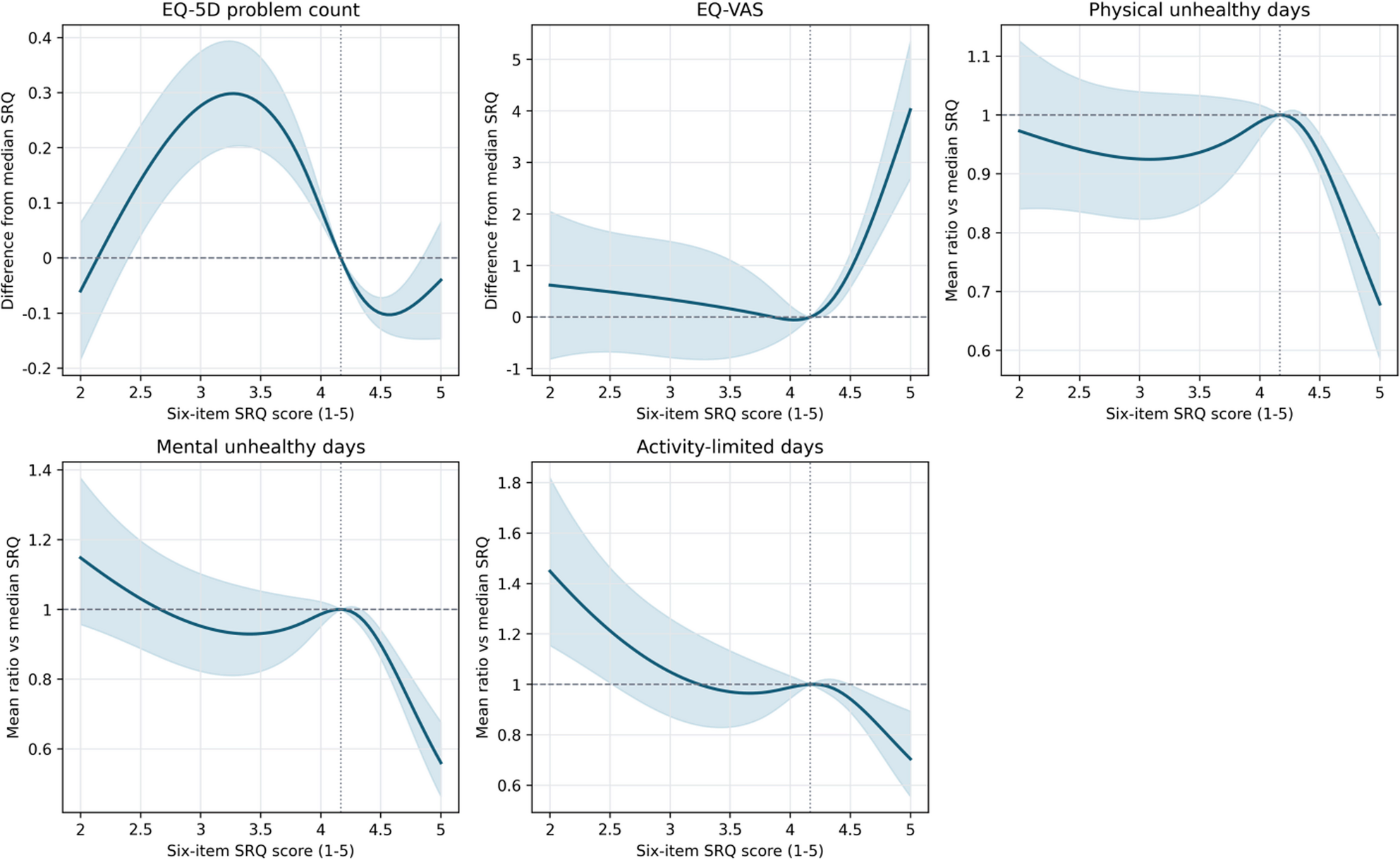
To examine the association between subjective sleep regularity and self-reported health loss among older adults, and to assess whether this association differs by frailty status. This multisite cross-sectional study included 6,770 adults aged 60–100 years from four Chinese sites surveyed from June to August 2024. Sleep regularity was assessed using the six-item Sleep Regularity Questionnaire (SRQ). Primary outcomes were EuroQol five-dimension (EQ-5D) problem count, EQ-Visual Analogue Scale (EQ-VAS), and physical, mental, and activity-limited unhealthy days. Frailty was classified as robust, prefrail, or frail using the FRAIL scale. Multiple imputation, linear and negative-binomial regression, two-part models, restricted cubic splines, and frailty interaction analyses were used with false discovery rate correction. Each 1-SD higher SRQ score was associated with fewer EQ-5D problems (β = −0.041, 95% CI − 0.079 to − 0.004), higher EQ-VAS (β = 0.64, 95% CI 0.19 to 1.08), and fewer physical (IRR = 0.94, 95% CI 0.90 to 0.99), mental (IRR = 0.88, 95% CI 0.83 to 0.92), and activity-limited unhealthy days (IRR = 0.85, 95% CI 0.80 to 0.91). Absolute differences in unhealthy days were each less than half a day per 30 days. Four outcomes showed evidence of nonlinearity, and two-part models indicated that unhealthy-day associations were concentrated mainly in the occurrence of any unhealthy day. Associations differed by frailty status for EQ-VAS and all three unhealthy-day outcomes after FDR correction, with inverse associations generally more evident among robust or prefrail participants. After separate adjustment for insomnia severity or sleep quality, mental and activity-limited unhealthy days remained significant, whereas other associations were attenuated. Greater subjective sleep regularity was associated with modestly lower multidimensional self-reported health loss, with heterogeneity across frailty states. Sleep regularity may provide complementary information within multidimensional sleep assessment in later life.
- Subjective sleep regularity
- Activity-limited unhealthy days
- EQ-5D problem count
- EQ-VAS
- FRAIL Scale
- Humans
The paper
Hubei Provincial Department of Education; Shanxi Medical University
BMC Geriatrics, 13 Oct 2026, Open access, CC BY-NC-ND