Rodent safety archives flag compounds linked to better survival
In rodent pesticide studies, 27 of 154 substances were linked to survival increases of at least 10% at study termination.
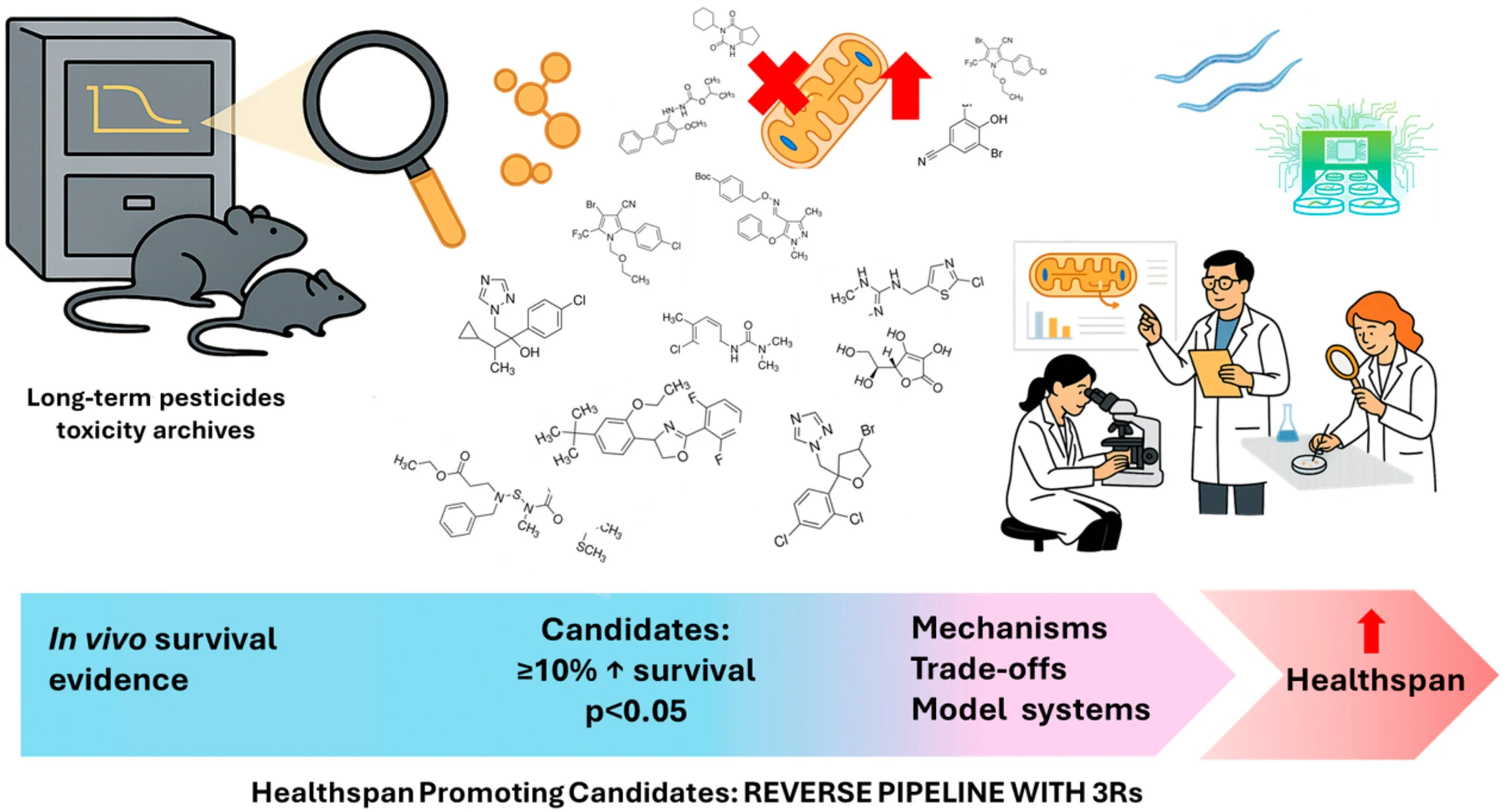
Limit: Survival at study termination, rather than total lifespan, drove candidate selection
Edited by Boris Djordjevic · AgingResearch.News
Researchers analyzed long-term pesticide safety experiments in rodents, with at least 50 animals per dose and sex. They searched a random subset of the German Federal Institute for Risk Assessment’s electronic archive. Studies covering 154 substances met their criteria; 27 substances were linked to increased survival at study termination.
The team examined 15 substances whose identities could be disclosed publicly. In mammalian cells grown in the lab, roughly half altered oxygen consumption by mitochondria, the structures that produce usable energy. Bromoxynil acted as a mitochondrial uncoupler, separating fuel use from energy production. In separate experiments in Caenorhabditis elegans worms, bromoxynil improved several measures of healthy lifespan without compromising overall health.
Why it matters
Mild stress can trigger adaptive responses that improve resilience, a rationale for testing compounds in healthy-aging research. The authors propose using toxicity archives to help select candidates for further experiments in mammals.
Caveats
The archive analysis identified candidates based on survival at study termination; the authors call for rigorous preclinical follow-up. The findings do not establish safety or benefits in people.
Where the evidence stands
Oxidative phosphorylation
- 304 independent labs in 48 countries
- 45 findings against
- Funders: National Institutes of Health and others
- 66 of 619 findings with company ties
- 27 substances
- Bromoxynil
- Oxidative phosphorylation
- Mitochondrion
- Mitochondrial oxygen consumption rate
- rodents
The paper
Faculty of Medical Sciences Newcastle University Newcastle upon Tyne UK
Aging Cell, Nov 1, 2026, CC BY

Comments
Be the first to comment.