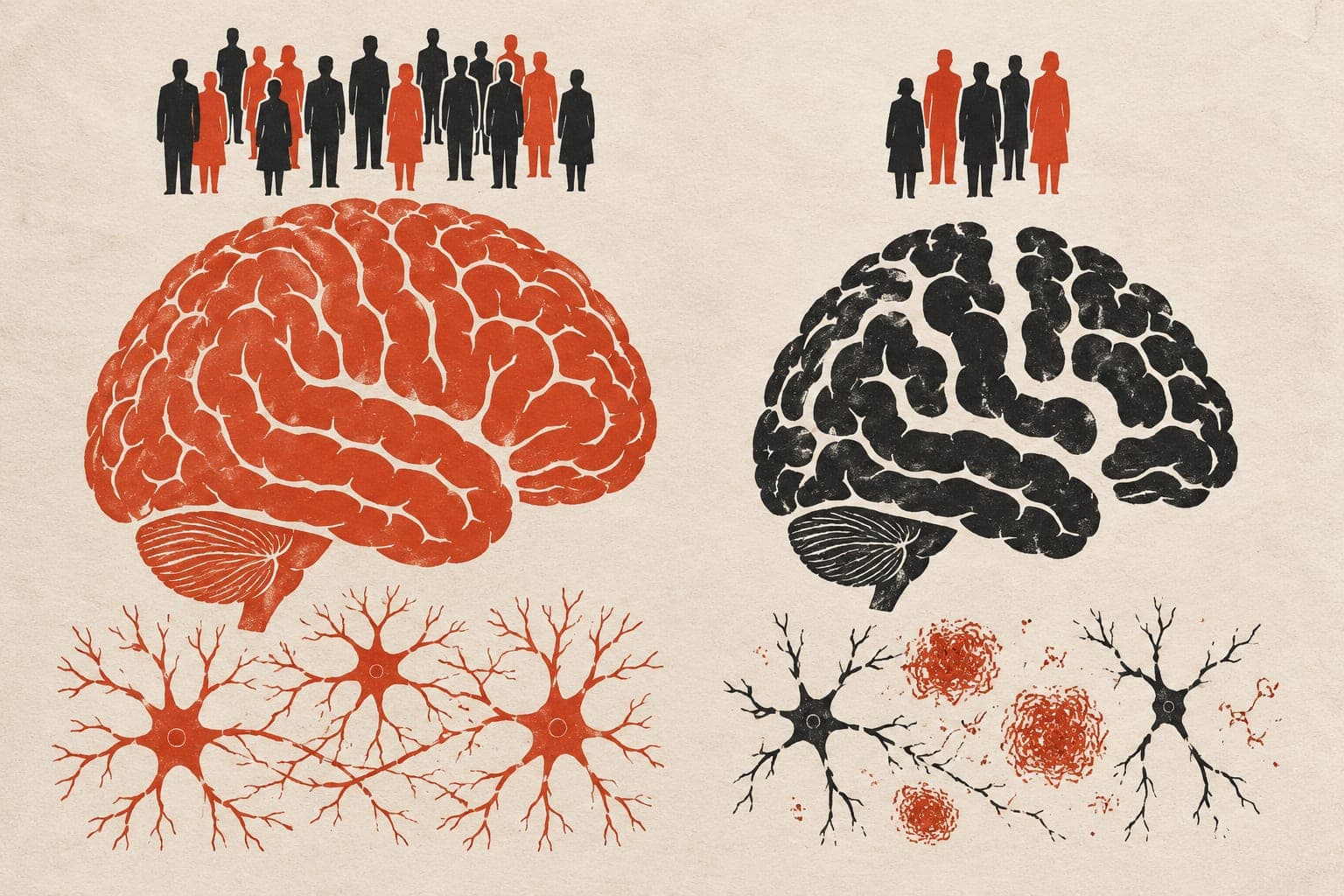
Cognitively Healthy Centenarians are genetically protected against Alzheimer’s disease specifically in immune and endo-lysosomal systems
By Tesi N, van der Lee SJ, Hulsman M et al.
Abstract
Abstract BACKGROUND Alzheimer’s Disease (AD) prevalence increases with age, yet a small fraction of the population reaches ages beyond 100 years without cognitive decline. We aimed to uncover the genetic factors associated with such resilience against AD. METHODS Genome-Wide-Association-Studies (GWAS) identified 86 single-nucleotide-polymorphisms (SNPs) associated with AD-risk. We studied each SNP in 2,281 AD-cases, 3,165 middle-aged population controls, and 346 cognitively healthy centenarians, and we combined SNPs into Polygenic Risk Scores (PRS) for each individual. Finally, we investigated the functional properties of the SNPs enriched/depleted in centenarians using snpXplorer . RESULTS Centenarians were depleted with risk-increasing AD-SNPs and enriched with protective AD-SNPs. The PRS was more than 5-fold lower in centenarians compared to AD cases ( p =7.69×10 −71 ) and almost 2-fold lower compared to middle-aged population controls ( p =5.83×10 −17 ). The strongest protection was found in ANKH, GRN, TMEM106B, SORT1, EPDR1, PLCG2, RIN3, CD2AP , and APOE associated alleles. As expected, the genetic protection was diluted in the offspring of the centenarians. DISCUSSION Becoming a cognitively healthy centenarian is associated with a complex genetic protection against AD, which concentrates on an advantageous functioning of the endo-lysosomal and immune systems, and their effect on amyloid-clearance.
- Immune response
- Proteostasis
- Lysosome
- Alzheimer's disease
- Alzheimer's disease polygenic risk score
- Humans
The paper
Tesi N, van der Lee SJ, Hulsman M et al.
medRxiv, 17 May 2023, Open access, CC BY-NC-ND, Preprint, not peer-reviewed