A nerve signal helps protect aging neurons in worms
In worm experiments, increasing a nerve-signaling molecule reduced excessive branching in aging sensory neurons without extending lifespan.

Our read
Mechanisms- Studied:
- Experiments in aging Caenorhabditis elegans worms
- What changed:
- Increasing NLP-12 reduced excessive branching in aged worms
- The catch:
- Neuronal healthspan was assessed through sensory-cell branching and body-position-guided movement
- In the record:
- One of 8 papers on cholecystokinin on record: 1 with results in people, 4 in animals.
- Why it’s aging research:
- Lifespan, survival or healthspan.
Editor of record: Boris Djordjevic · AgingResearch.News
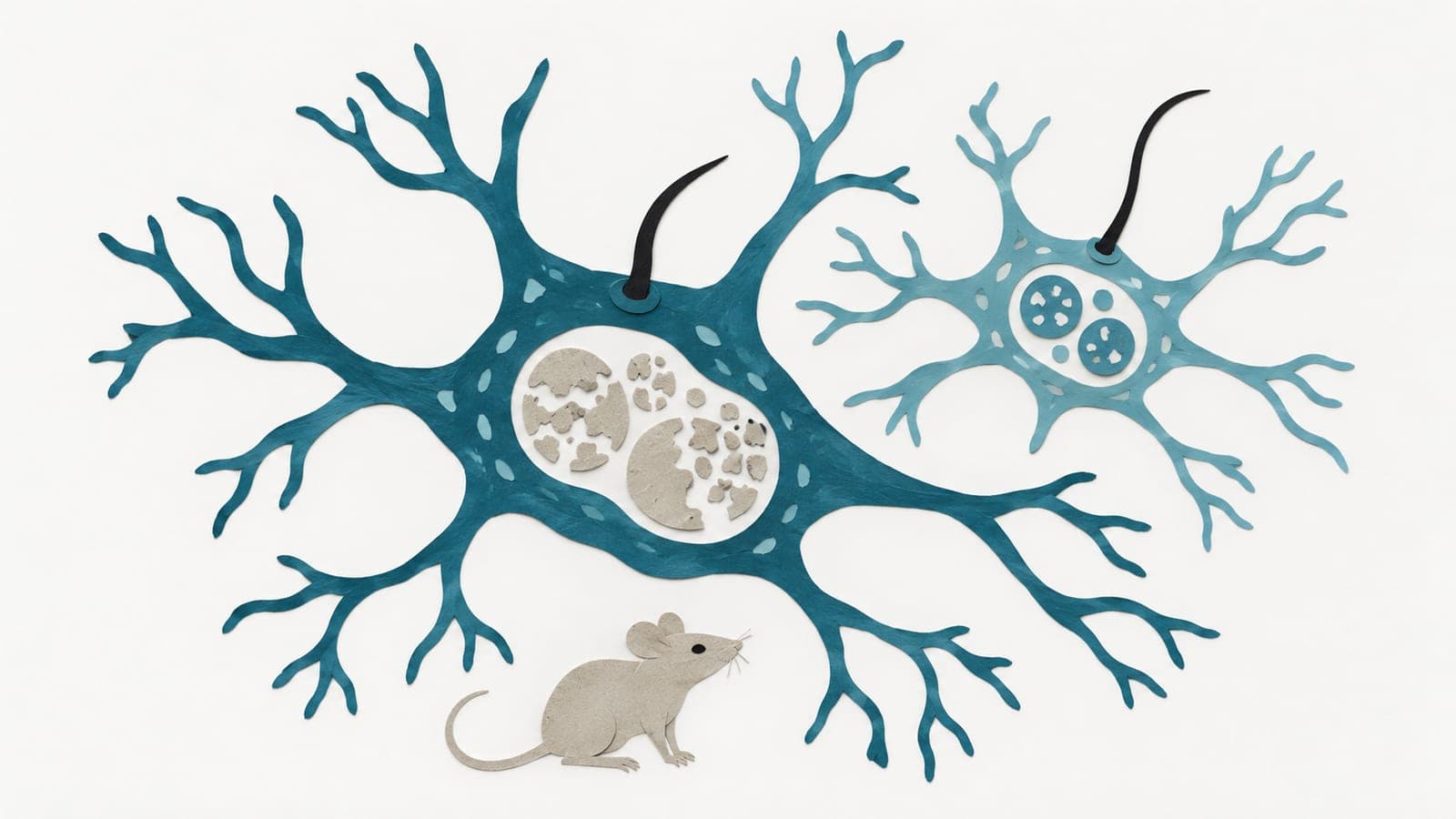
Caenorhabditis elegans worms developed excessive branches on a sensory nerve cell as they aged, alongside declines in movement guided by body-position sensing. Experiments identified NLP-12, a small nerve-signaling molecule, as a protective signal for this cell’s structure across adulthood. Worms lacking functional NLP-12 developed excessive branching and movement problems earlier. Increasing NLP-12 reduced excessive branching in aged worms but did not extend lifespan.
As worms aged, less NLP-12 reached the space outside cells, while more remained inside the nerve cell that mainly produced it. Silencing that cell during adulthood also accelerated excessive branching. Two receptor proteins were required for NLP-12’s protective effects. Human cholecystokinin, a related signaling molecule, rescued the branching defect and partly improved body-position-guided movement patterns in worms lacking functional NLP-12.
Why it matters
Age-related deterioration of nerve cells makes adult maintenance signals relevant to understanding how long nervous systems remain healthy, not just how long organisms live.
Caveats
The researchers assessed neuronal healthspan through sensory-cell branching and body-position-guided movement in worms. They tested human cholecystokinin in mutant worms, not human neurons or people.



Comments
Be the first to comment.