A protein helps cells build and maintain tiny projections
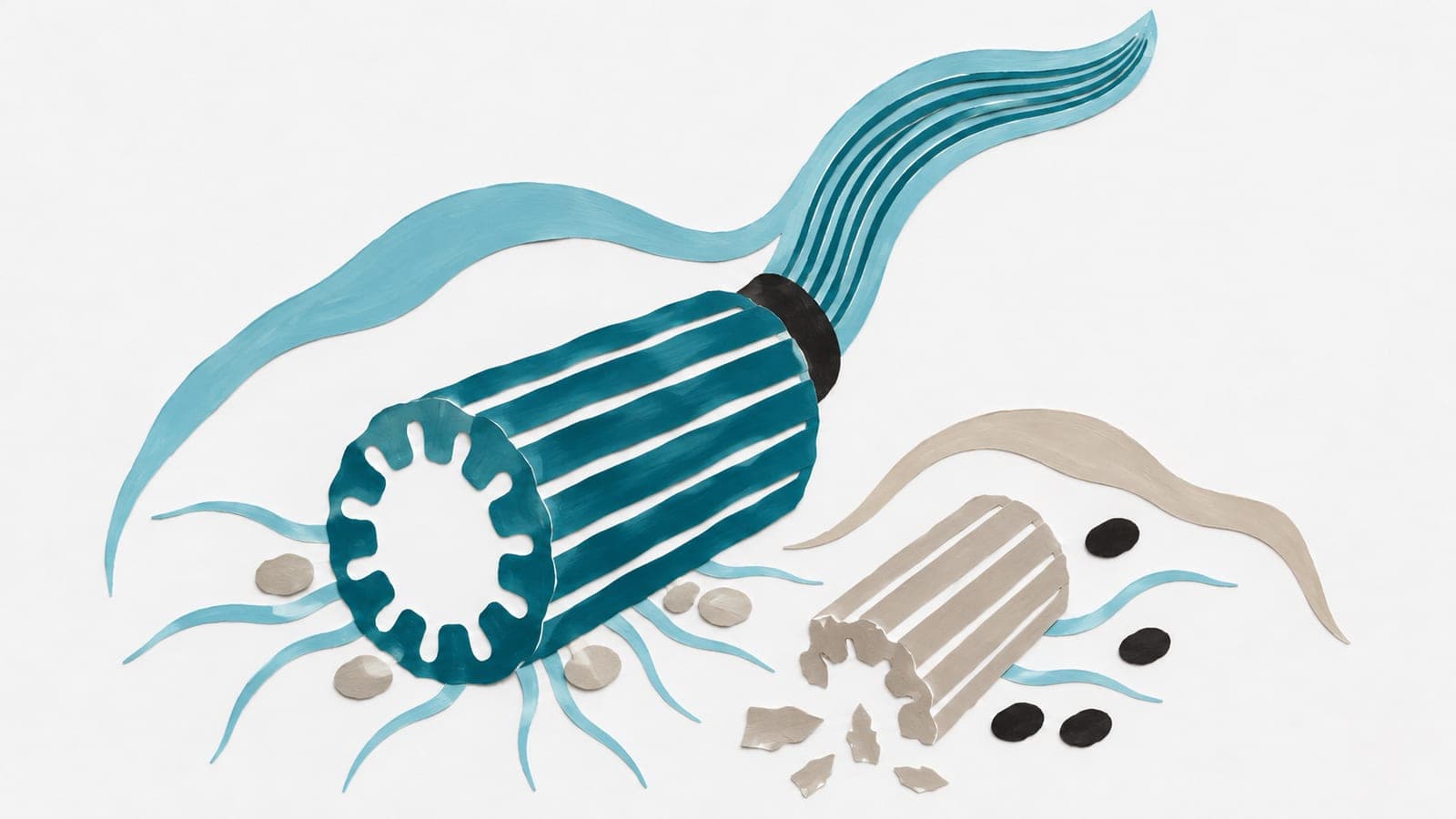
Cells lacking the protein ALMS1 had short, frequently broken centrioles, structures that help build cilia, the tiny projections on cell surfaces.
Edited by Boris Djordjevic · AgingResearch.News
Cell experiments examined ALMS1, a protein affected by mutations that cause the inherited disorder Alström syndrome. The researchers studied centrioles, structures that help organize a cell’s internal framework and build cilia, tiny surface projections. Without ALMS1, centrioles were short and frequently broke at one end. Broken centrioles were less able to organize that framework.
Loss of ALMS1 also impaired protein delivery to the centrosome, the cell’s organizing center. These proteins included components of the transition zone, a boundary at the base of a cilium. ALMS1 was important for assembling this boundary, building cilia and controlling their membrane composition. In mice, disrupting ALMS1 caused progressive, age-dependent loss of cilia in the retina, kidney and brain. The authors concluded that disrupted centriole integrity and protein delivery caused Alström syndrome by compromising cilia assembly and maintenance.
Why it matters
The findings bear on how an inherited defect can compromise the long-term upkeep of cell structures in Alström syndrome.
Caveats
The reported findings came from cell and mouse experiments, not observations of aging in people. The abstract does not identify the cell types studied.
The paper
ALMS1 stabilizes the proximal centriole to drive transition zone assembly and ciliogenesis
University of California
The Journal of Cell Biology, Nov 2, 2026


Comments
Be the first to comment.