Blood protein model better predicts future diabetes risk
In about 20,000 UK Biobank participants, the model scored 0.86 for ranking diabetes risk, versus 0.74 for a blood-fat ratio.
Our read
Biomarkers- Studied:
- Cohort study of 20,612 UK Biobank participants, up to 10 years (Independent replication, registered NCT03500016)
- What changed:
- Diabetes prediction was more accurate with the protein model: concordance index 0.86 versus 0.74 for the triglyceride-to-HDL ratio
- The catch:
- Medication effects on blood proteins were not systematically examined
- In the record:
- The 3,965th paper on exercise with results in people; 10,146 on record in all.
Editor of record: Boris Djordjevic · AgingResearch.News
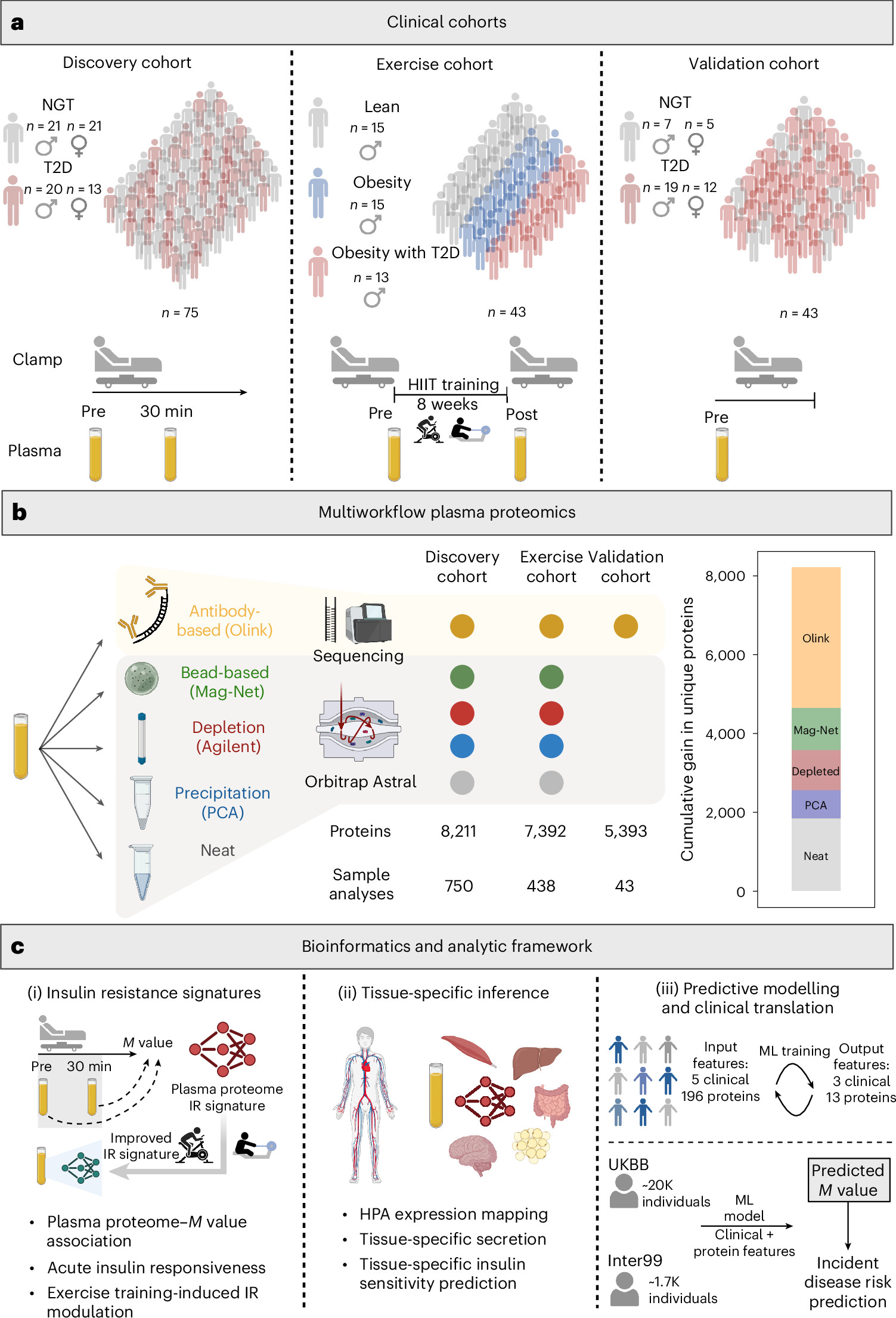
Blood samples from 161 men and women with or without type 2 diabetes were analyzed across three cohorts. One cohort included 43 men who underwent eight weeks of high-intensity interval training. Laboratory testing measured insulin sensitivity—how well the body responds to insulin, a hormone that regulates blood sugar. The researchers identified 488 proteins linked to insulin sensitivity. They built a model combining 13 proteins with sex, a longer-term blood sugar measure and a blood-fat ratio.
In prospective data from about 20,000 UK Biobank participants, the model predicted type 2 diabetes better than the blood-fat ratio alone. Its concordance index was 0.86 versus 0.74; this score measures how well a model ranks people by risk. The model also outperformed fasting blood-test measures of insulin resistance in an independent cohort of 1,700 people.
Why it matters
Assessing insulin resistance could help tailor risk assessment for age-related conditions such as type 2 diabetes and cardiovascular disease.
Caveats
The authors note that the insulin-testing cohorts were modest in size and primarily included people of European ancestry, which may limit how well the findings apply to other populations.
Where the evidence stands
Exercise
- 1,447 independent labs in 89 countries
- 808 findings against
- 296 trials, 25 with no results posted
- Funders: National Institutes of Health and others
- 385 of 8,055 findings with company ties
Insulin/IGF-1 signaling
- 105 independent labs in 28 countries
- 5 findings against
- Funders: National Institutes of Health and others
- 8 of 155 findings with company ties
From the paper
- Participants
In brief, the study included 15 middle-aged men with obesity and T2D carefully matched to glucose-tolerant men with obesity (n = 15) and lean men (n = 18), all sedentary.
- Follow-up
In brief, associations between 2,920 Olink plasma proteins and 660 incident disease outcomes were evaluated in 53,026 UK Biobank participants, with a median follow-up of 14.8 years.
- Limitation
The cohorts in the hyperinsulinaemic–euglycaemic clamp studies were modest in size and primarily included individuals of European ancestry, which may limit generalizability.
Quoted word for word from the full text on nature.com.
Exercise is part of Bryan Johnson's Blueprint
The paper
Nature Metabolism, Nov 16, 2026, Open access, CC BY
Comments
Be the first to comment.