Composite inflammatory indices and incident lung cancer risk in an exploratory statistical mediation analysis
Abstract
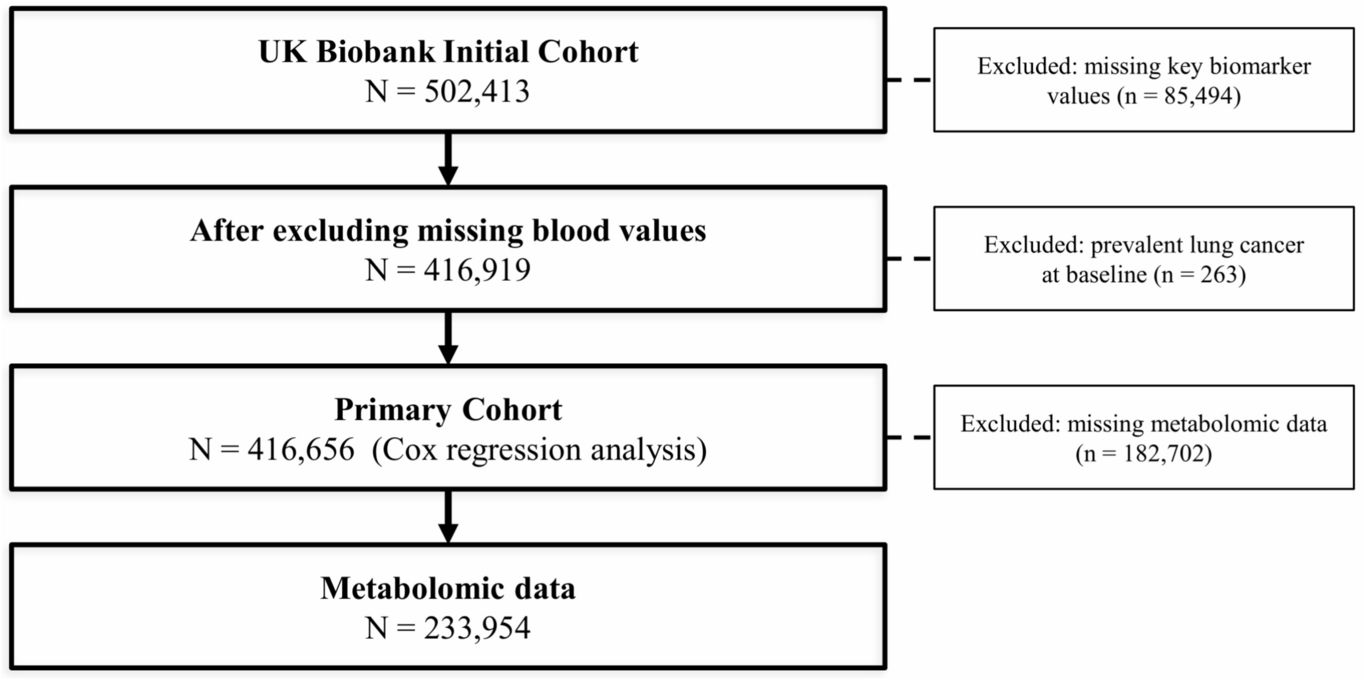
This study aims to assess the prospective associations between six composite inflammatory indices and incident lung cancer risk and to identify plasma metabolites that may statistically mediate the observed association. Based on the UK Biobank, we derived six composite inflammatory indices, including platelet-to-lymphocyte ratio (PLR), lymphocyte-to-monocyte ratio (LMR), platelet-to-albumin ratio (PAR), C-reactive protein-to-albumin ratio (CAR), C-reactive protein-to-lymphocyte ratio (CLR), and neutrophil-to-lymphocyte ratio (NLR). Multivariable Cox proportional hazards regression was used to evaluate their associations with incident lung cancer risk. Time-dependent ROC curves compared discriminative ability among the significant indices in clinical models. Restricted cubic spline (RCS) analysis tested the nonlinear relationship. A two-step screening and directionality filter procedure identified candidate mediators from 169 plasma metabolites, which were entered into an exploratory statistical mediation analysis. Among 416,656 participants, 4,105 developed lung cancer during follow-up. Increased PAR, CAR, CLR, and NLR were significantly associated with higher lung cancer risk across all three adjusted models. CAR showed the largest magnitude of association (HR = 1.289, 95% CI: 1.247—1.332 per 1-SD increment in Model 3). RCS analysis revealed a significant nonlinear association between CAR and lung cancer risk. The screening procedure identified 16 candidate mediators. Glycoprotein acetyls (GlycA) showed the largest statistical contribution (proportion mediated = 13.0%), while several lipid-related metabolites and fatty acid measures showed smaller contributions. Elevated baseline CAR was prospectively associated with a higher incidence of lung cancer. Several baseline metabolic biomarkers statistically accounted for a portion of this association; however, the findings are exploratory and may be influenced by residual confounding, reverse causation, and the concurrent measurement of exposure and mediators.
The paper
Renmin Hospital of Wuhan University
Scientific Reports, 13 Oct 2026, Open access, CC BY-NC-ND