Association of sarcopenia with 9-year trajectories of depressive symptoms in middle-aged and older Chinese adults
Abstract
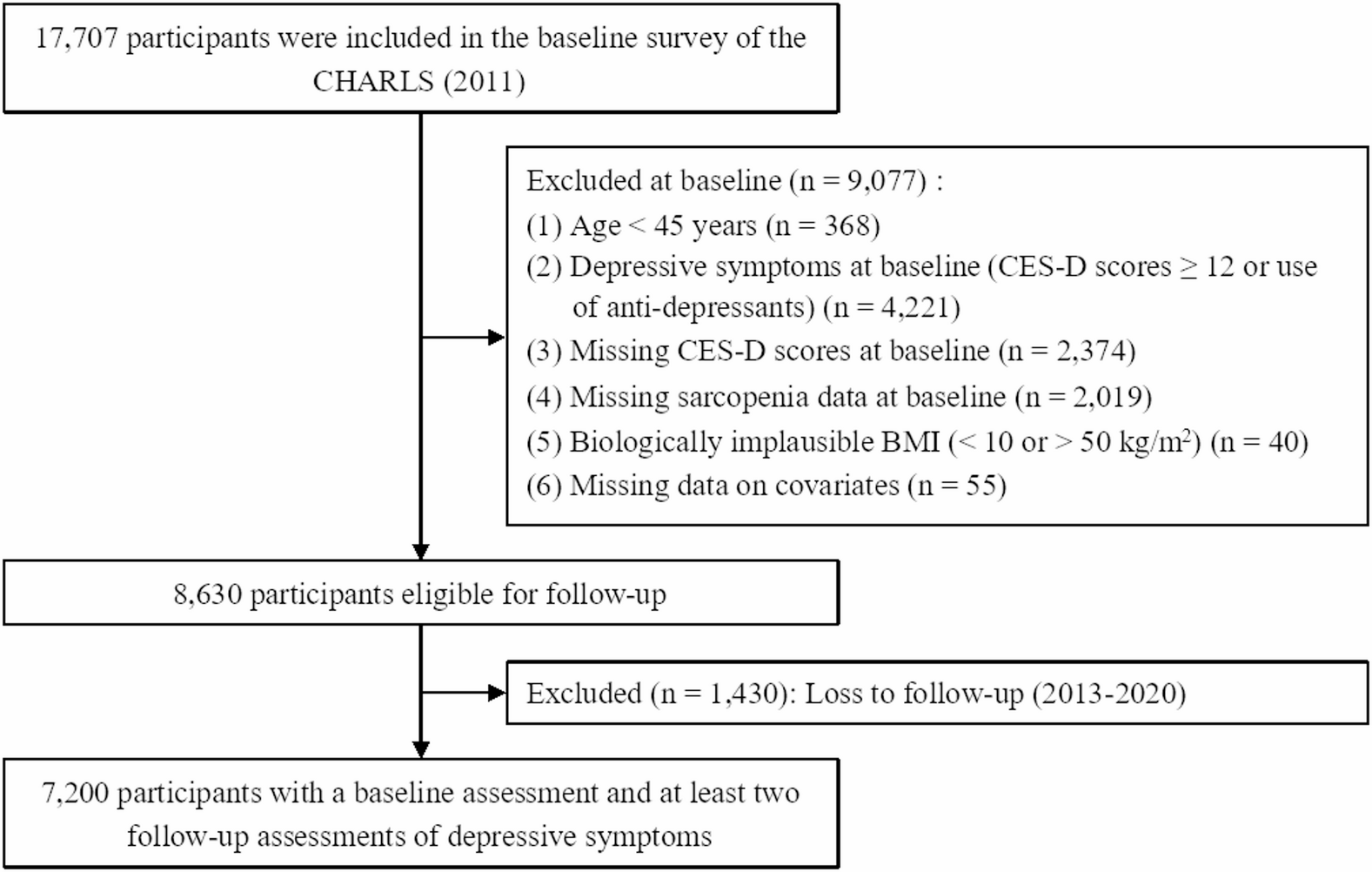
Sarcopenia is linked to depressive symptoms, but its long-term impact on the trajectories of depressive symptoms in middle-aged and older Chinese adults is unclear. We analyzed five waves of longitudinal data (2011–2020) from the China Health and Retirement Longitudinal Study (CHARLS), involving 7,200 adults aged ≥ 45. Sarcopenia status was classified as none, possible, or sarcopenia, according to the Asian Working Group for Sarcopenia (AWGS) 2019 criteria. Depressive symptoms were assessed using the Center for Epidemiologic Studies Depression Scale (CES-D). Group-based trajectory modeling (GBTM) identified distinct depressive symptom trajectories over 9 years. Multinomial logistic regression analyzed associations between sarcopenia status and its core indicators (muscle mass, muscle strength, and physical performance) with these trajectories. Four depressive symptom trajectories were identified: low and stable, low-moderate and stable, high and rapidly increasing, and moderate and increasing. In the fully adjusted model, compared with the non-sarcopenia group, possible sarcopenia was associated with higher odds of belonging to the high-rapidly increasing trajectory (OR = 1.59, 95% CI: 1.30–1.95), the moderate-increasing trajectory (OR = 1.55, 95% CI: 1.32–1.81), and the low-moderate stable trajectory (OR = 1.18, 95% CI: 1.01–1.38). Similarly, sarcopenia was associated with higher odds of belonging to the high-rapidly increasing (OR = 2.18, 95% CI: 1.52–3.13), moderate-increasing (OR = 1.84, 95% CI: 1.35–2.49), and low-moderate stable (OR = 1.39, 95% CI: 1.03–1.89) trajectories compared with the low-stable group. Among the sarcopenia components, poor physical performance was associated with all adverse trajectories, whereas low muscle strength and low muscle mass were associated with only some of these trajectories. Sarcopenia and its core components are associated with adverse depressive symptom trajectories over a 9-year span. Incorporating physical function assessments into geriatric care may help identify individuals at higher risk of chronic mental distress during the aging process.
- Sarcopenia
- Depressive symptoms
- Possible sarcopenia
- Center for Epidemiologic Studies Depression Scale
- Muscle mass
- Humans
The paper
Wuhan University; Nanchong Central Hospital
Scientific Reports, 14 Oct 2026, Open access, CC BY-NC-ND