A systematic review and dose-response meta-analysis of prospective cohort studies on body mass index and leukemia incidence and mortality
Dose-response
Abstract
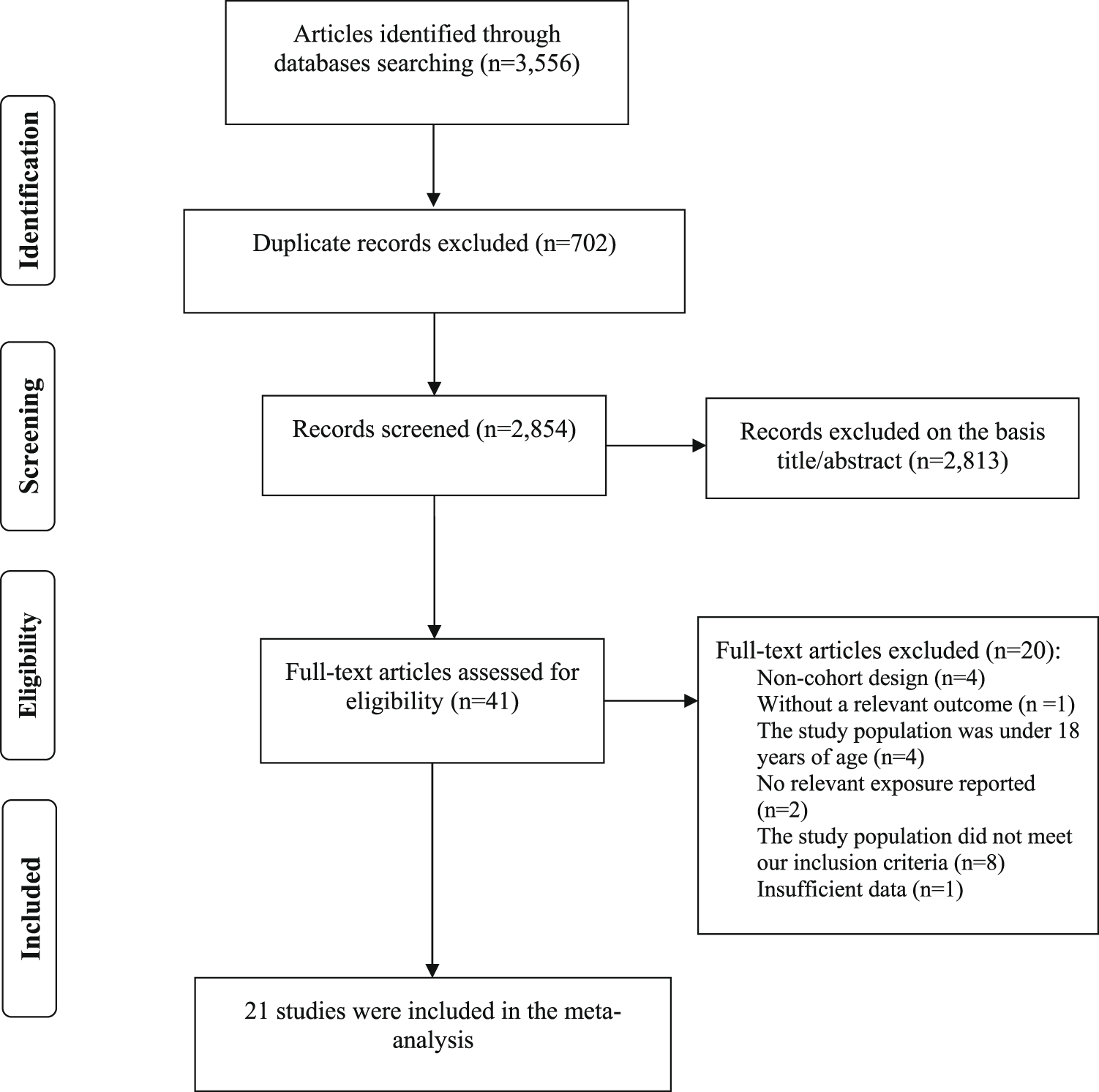
The relationship between body mass index (BMI) and leukemia is still unclear, especially across various leukemia subtypes and mortality. We conducted an updated systematic review and dose-response meta-analysis of prospective cohort studies to quantify categorical, linear, and nonlinear associations between BMI and leukemia incidence and mortality. PubMed, Scopus, and Web of Science were searched for eligible prospective cohort studies. Twenty-one prospective cohort studies were included, of which 18 contributed leukemia incidence outcomes and three contributed leukemia mortality outcomes. To prevent duplicate counting, only one independent cohort-level risk estimate was included for each outcome, and pooled relative risks (RRs) were estimated using random-effects models fitted by restricted maximum likelihood (REML). Linear dose-response associations were standardized to a 5-kg/m² increment in BMI, and nonlinear associations were modeled using restricted cubic splines. Risk of bias was assessed using ROBINS-I, and the certainty of evidence was evaluated using GRADE. Higher BMI was associated with higher overall leukemia incidence in both categorical analyses comparing the highest available estimable BMI category with the study-specific reference category (9 studies; RR = 1.235, 95% CI 1.084–1.408; I²=49.8%) and linear dose-response analyses (10 studies; RR per 5 kg/m²=1.098, 95% CI 1.053–1.144; I²=82.4%). In categorical analyses, higher BMI was associated with higher incidence of ALL, AML, and CML, whereas the association with CLL was not statistically significant. In linear analyses, higher BMI was associated with higher incidence of AML and ALL; however, the ALL estimate was based on only two independent studies and should be considered exploratory. The associations for CML and CLL were not statistically significant. Higher BMI was also associated with leukemia-related mortality in both categorical (3 studies; RR = 1.870, 95% CI 1.372–2.550) and linear analyses (3 studies; RR per 5 kg/m²=1.329, 95% CI 1.121–1.575), although these estimates were derived from general-population cohorts with mortality linkage and should not be interpreted as evidence of higher post-diagnosis mortality among patients with leukemia. Restricted cubic spline analyses provided no evidence of nonlinear associations within the supported BMI ranges. The certainty of evidence was rated as low for overall leukemia incidence and very low for leukemia mortality. Higher BMI was associated with a modestly higher overall leukemia incidence and with leukemia-related mortality in prospective cohort studies. However, subtype-specific and mortality estimates were limited by the small number of independent studies, residual confounding, and between-study heterogeneity. No evidence of nonlinear associations was observed within the BMI ranges supported by the available data. These findings should be interpreted as epidemiological associations rather than evidence of causality.
- Body mass index
- Leukemia
- Acute lymphoblastic leukemia
- Acute myeloid leukemia
- Chronic lymphocytic leukemia
- Humans
The paper
National Nutrition and Food Technology Research Institute
Scientific Reports, 14 Oct 2026, Open access, CC BY-NC-ND