Eye-photo model maps individual patterns of death risk
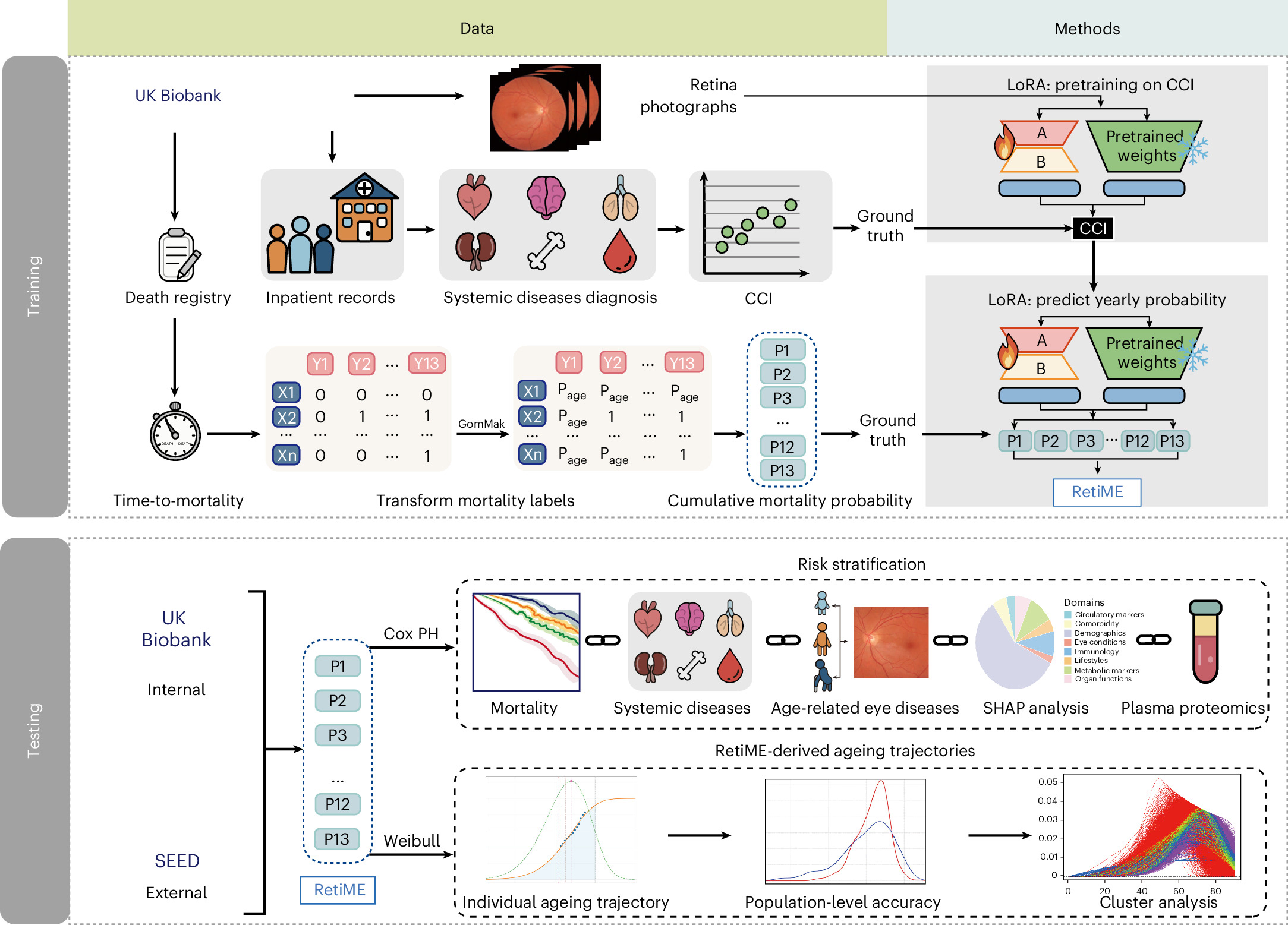
Trained in a European cohort and tested in three others, the model estimated lifespan trajectories associated with observed mortality outcomes.
Our read
Biomarkers- Studied:
- Cohort study of people across multiple geographic regions (Independent replication)
- What changed:
- Personalized lifespan trajectories modeled from retinal photographs were associated with observed mortality outcomes, including age of death
- The catch:
- Health improvements and survival gains from using the model for screening were not measured
- Why it’s aging research:
- It builds or tests a tool for aging research.
Editor of record: Boris Djordjevic · AgingResearch.News
In a European cohort, researchers trained an artificial intelligence model to estimate individual death risk from photographs of the retina, the light-sensing tissue at the back of the eye. This observational study also tested the model in three independent cohorts spanning Southeast Asia, Eurasia and North America.
The model reconstructed personalized lifespan trajectories—estimated patterns of death risk over time. These were associated with observed mortality outcomes, including age at death. The retinal measure was also associated with deaths from all causes and from specific causes. It predicted new cases of a range of diseases affecting the body and eyes.
Why it matters
Preventive care in aging populations needs affordable ways to assess health risks. The authors supported further evaluation of retinal imaging and trajectory modeling as one component of a comprehensive mortality-risk assessment.
Caveats
Observational associations do not establish that using the model for screening would improve health or extend life. The abstract does not report participant numbers, ages or the strength of the associations.
The paper
Re-timing mortality risk through individualized modelling of lifespan trajectories
National University of Singapore
Nature Biomedical Engineering, Nov 2, 2026


Comments
Be the first to comment.