Face-photo predictions linked to mortality in cancer patients
In patients with cancer, the survival model’s highest-risk quarter had more than triple the relative mortality risk of the lowest-risk quarter.
Limit: The study assessed prediction, not whether using the models improves care or survival
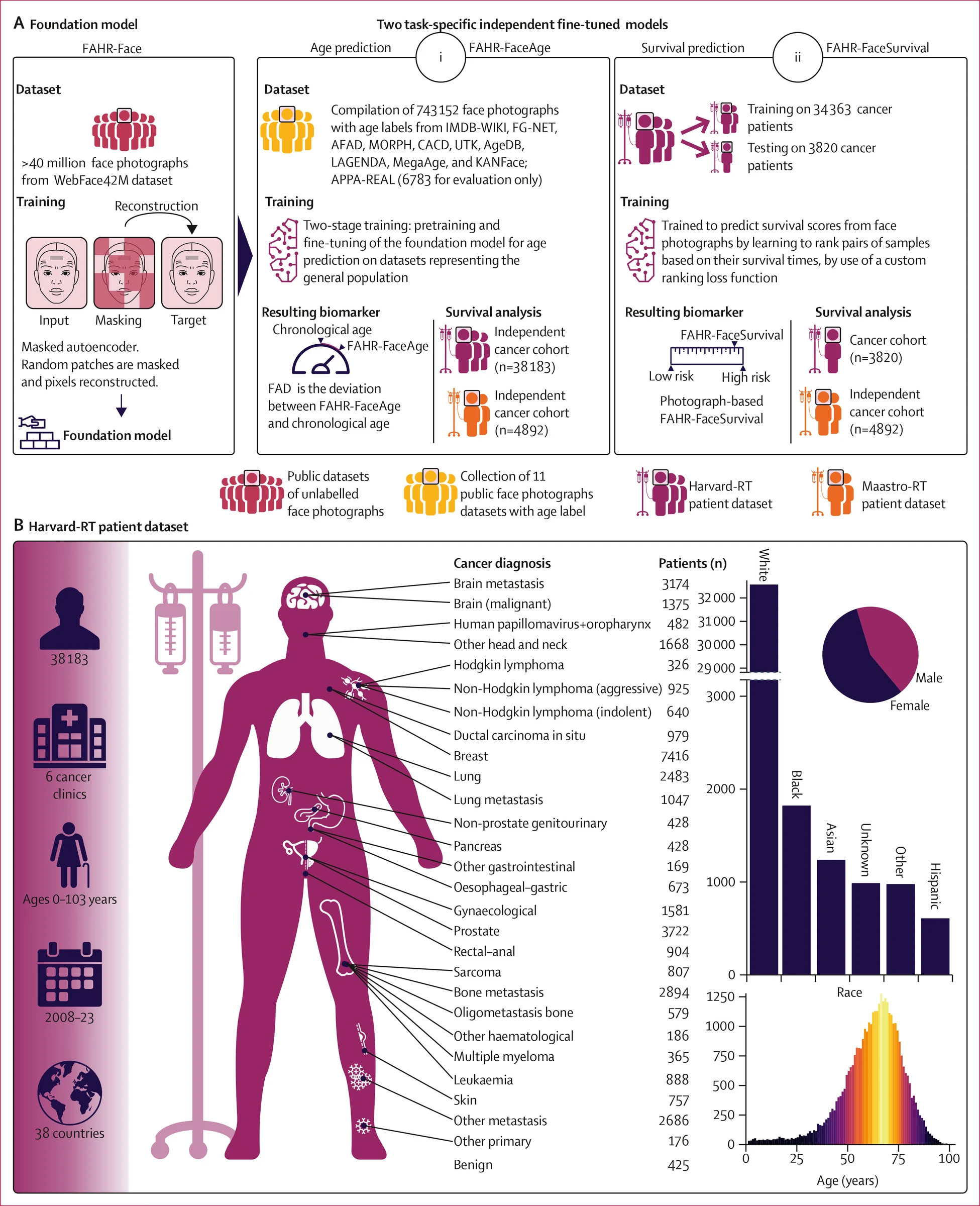
Researchers tested two face-photo models in patients with cancer in an observational model development and validation study. They trained a shared artificial intelligence model on more than 40 million facial photographs. They then adapted it for age estimation using ten public image datasets and for survival prediction using 34,363 photographs of patients with cancer.
Both models underwent clinical testing in two independent cancer datasets. The survival model’s link with mortality remained after accounting for clinical factors used to predict outcomes. The age model outperformed an earlier age-estimation model in predicting survival in patients with cancer. Combining the models improved the accuracy of survival predictions. On public image datasets, the age model’s estimates were off by an average of 5.1 years, outperforming benchmark models.
Why it matters
The authors suggested that facial measurements could offer an inexpensive, scalable way to assess biological aging and disease-related mortality risk when traditional biological measurements are unavailable.
Caveats
This observational validation study assessed prediction, not whether using the models improves care or survival. Clinical testing involved patients with cancer, so these results do not establish performance in people without cancer.
The paper
Mass General Brigham Cancer Institute
The Lancet Digital Health, Oct 20, 2026