Gene silencing lasts and partly reverses in human blood stem cells
Silencing of a platelet-related gene remained stable four months after human stem cells were transplanted into mice.
Our read
Interventions- Studied:
- Experiments in primary human hematopoietic stem cells, 4 months
- What changed:
- ITGB3 silencing persisted for 4 months after transplantation and partly reversed with targeted demethylation
- The catch:
- Silencing stability after transplantation was followed for only 4 months
- Why it’s aging research:
- It studies how the body can be repaired or renewed.
Editor of record: Boris Djordjevic · AgingResearch.News
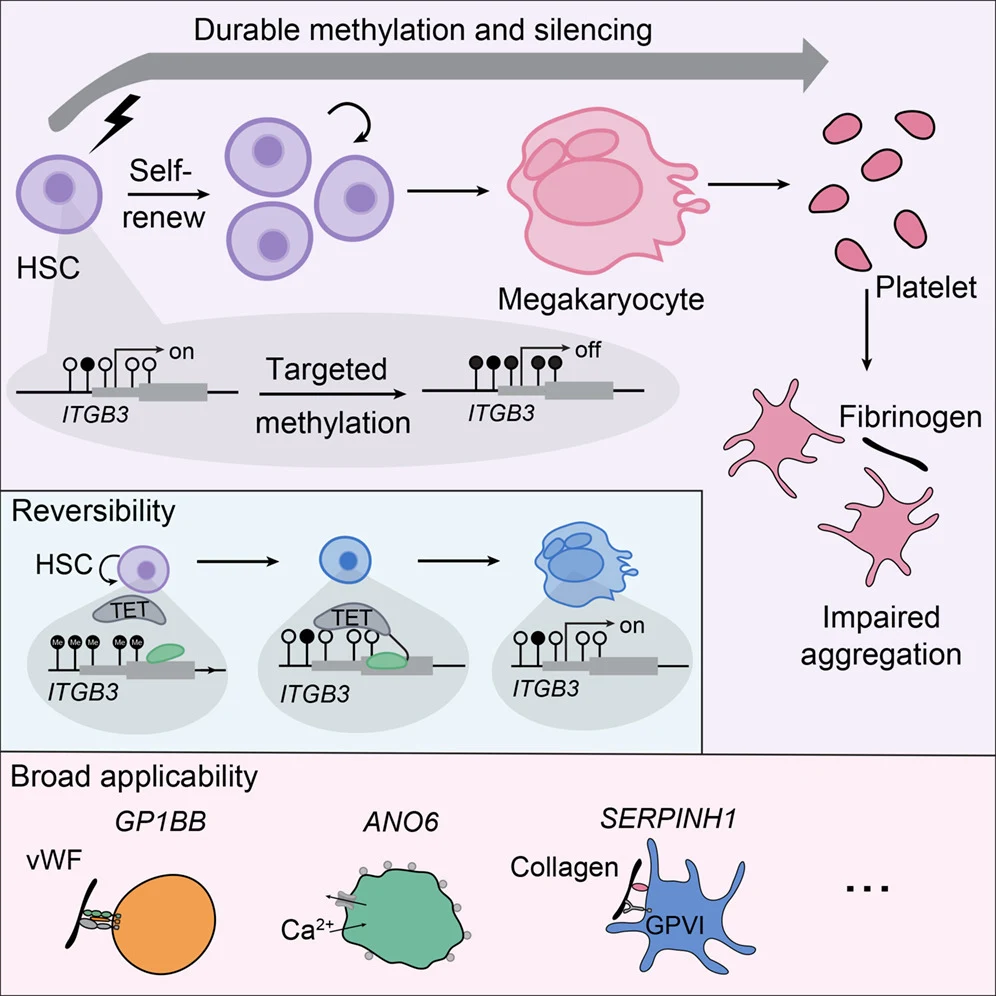
Primary human hematopoietic stem cells, which give rise to blood cells, received RNA-delivered tools for controlling gene activity in a laboratory experiment. These tools used DNA methylation—chemical marks on DNA—to silence genes without changing the DNA sequence.
Targeting ITGB3, a gene for a platelet surface protein, produced silencing that persisted as the stem cells renewed themselves and developed into platelet-producing cells. Platelets made in the lab showed reduced aggregation, or clumping together. Targeted removal of DNA methylation partly reversed the silencing. Silencing also remained stable in human stem cells four months after transplantation into mice. Targeting other platelet-associated genes showed that the approach could work beyond ITGB3.
Why it matters
Stem-cell renewal is one process studied in aging biology. The platform offers a way to explore lasting but adjustable changes in the function of blood cells produced by these stem cells.
Caveats
The platelet-function result came from platelets made in the lab. Stability after transplantation was tested in mice, not in people.
Where the evidence stands
DNA methylation
- 196 independent labs in 38 countries
- 18 findings against
- Funders: National Institutes of Health and others
- 42 of 393 findings with company ties
ITGB3
- 13 independent labs in 4 countries
- 1 trial
- Funders: National Institutes of Health and others
- 1 of 20 findings with company ties
- 1 of 1 trial sponsored by developers of drugs aimed at it

Comments
Be the first to comment.