Sight and hearing impairments linked to higher dementia risk
After accounting for initial thinking skills and other factors, combined sight and hearing impairment had a hazard ratio—a relative measure of dementia risk—of 2.21.
Limit: Medical records and death registries can miss undiagnosed dementia
Edited by Boris Djordjevic · AgingResearch.News
An observational cohort study followed 51,584 UK Biobank participants aged 60–70 for a mean of 12.1 years. Researchers objectively measured vision and hearing and assessed memory and reaction time at the start. They identified dementia diagnoses through linked medical records and death registries.
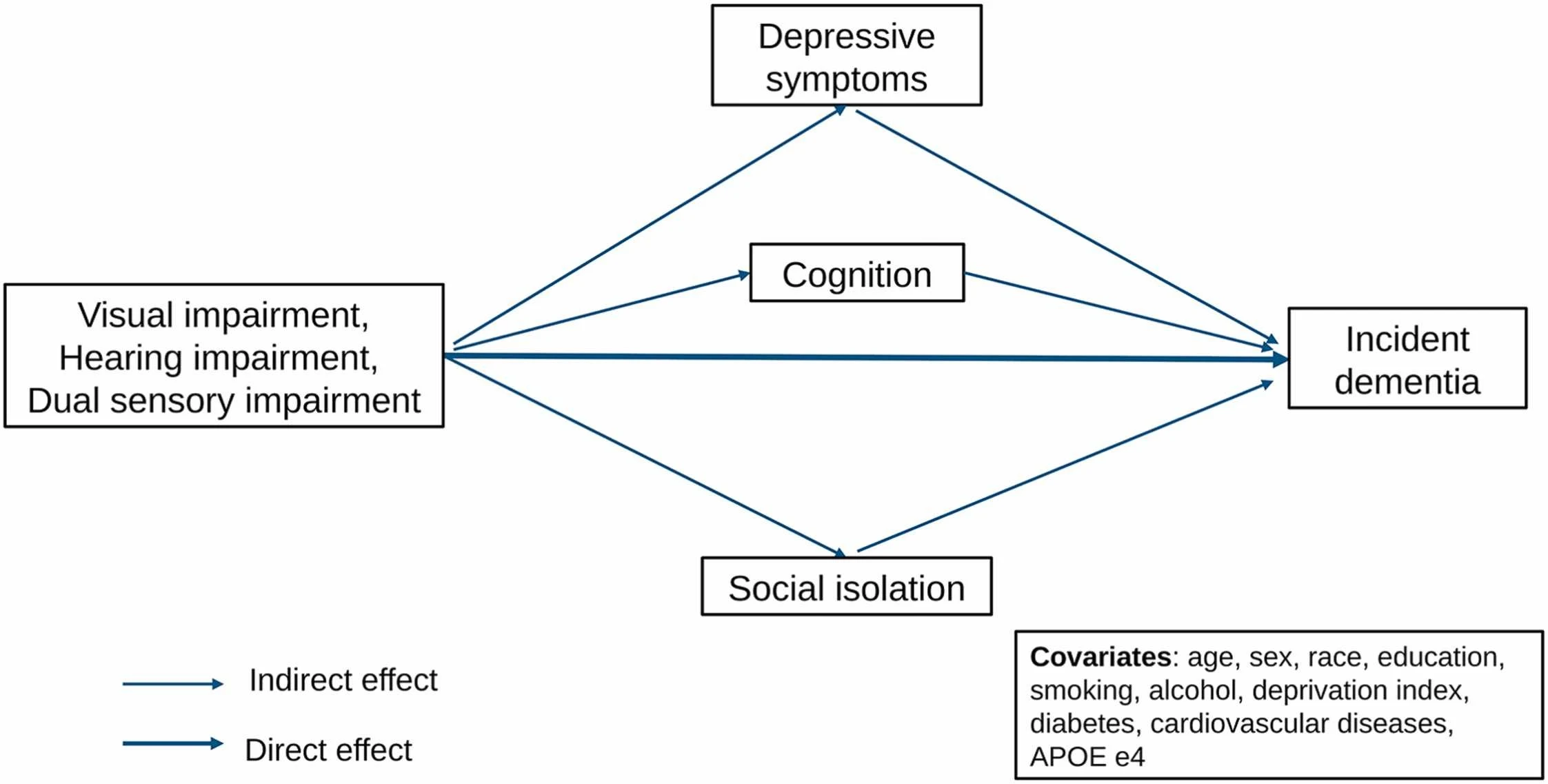
Visual impairment, hearing impairment and having both remained associated with higher dementia risk after accounting for initial thinking skills and other factors. The reported direct-effect hazard ratios were 1.33 for visual impairment, 1.37 for hearing impairment and 2.21 for both. The analysis also identified indirect associations involving depressive symptoms, social isolation and thinking skills.
Why it matters
The authors identified vision and hearing impairment as potentially modifiable dementia risk factors, highlighting approaches to healthy aging that combine sensory care, thinking skills, mental health and social connections.
Caveats
This observational study cannot establish that sensory impairment caused dementia or that treating it would prevent dementia. The indirect pathways were statistical associations, not proof of how dementia developed.
The paper
International Psychogeriatrics, Nov 2026, CC BY


Comments
Be the first to comment.