AI predicts elevated heart-failure markers from heart recordings
Scores for distinguishing patients above and below heart-failure blood-marker thresholds ranged from 0.84 to 0.86 in a separate testing set.
Our read
Biomarkers- Studied:
- Computational study of 237,686 patients in the Houston Methodist Health System (Independent replication)
- What changed:
- The model distinguished elevated from lower BNP levels with scores of 0.84 to 0.86
- The catch:
- Performance with wearable recordings in everyday screening was not measured
Editor of record: Boris Djordjevic · AgingResearch.News
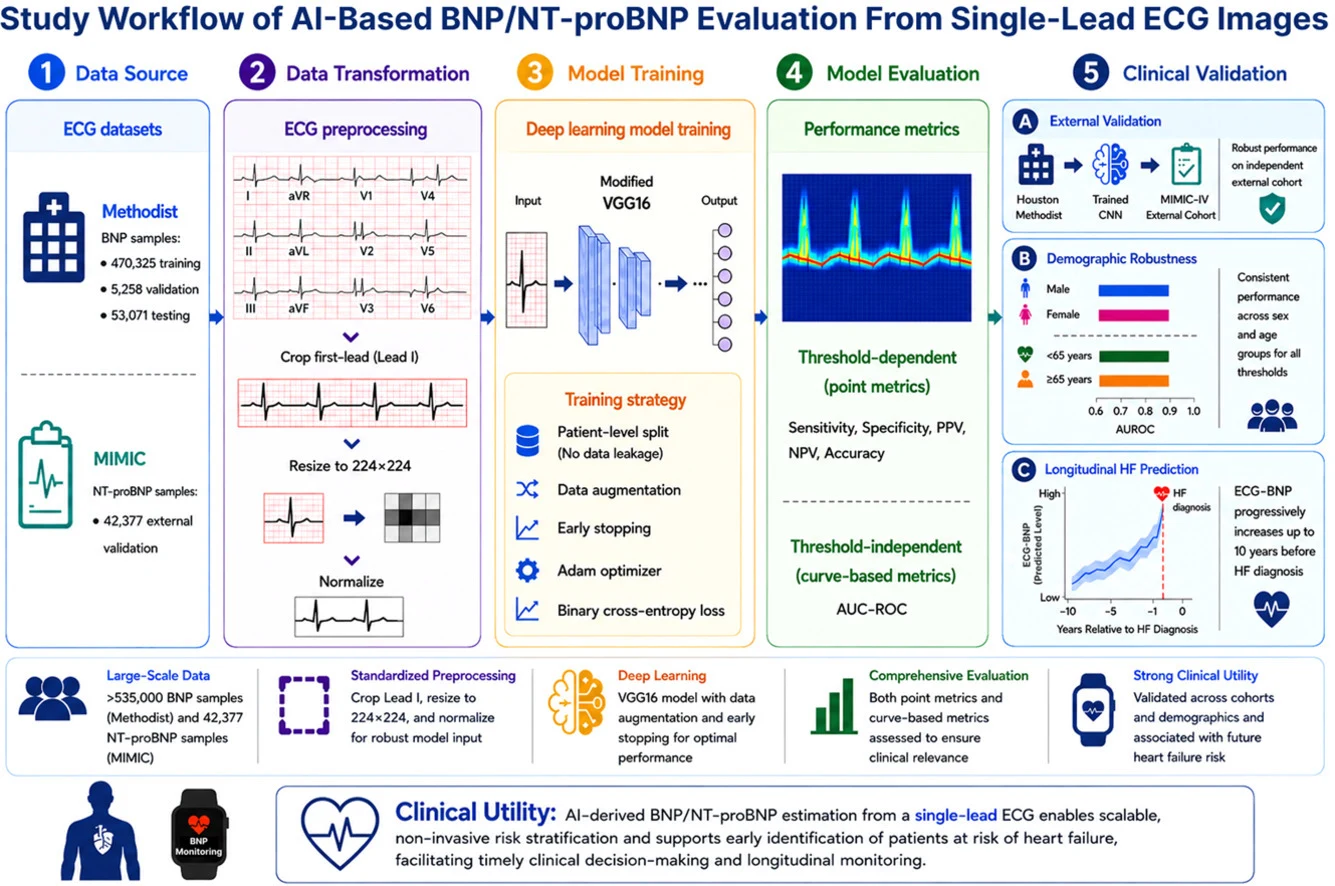
Records from 237,686 patients in the Houston Methodist Health System supplied 528,654 single-lead electrocardiograms, or ECGs—recordings of the heart’s electrical activity—for a model-development and validation study. Each ECG was paired with a blood measurement of BNP, a marker used to assess heart failure, obtained within 24 hours. Training and testing used different patients.
The model classified BNP levels against three thresholds. Its area under the receiver operating characteristic curve—a score measuring how well it separated groups—ranged from 0.84 to 0.86. Accuracy for distinguishing normal from elevated BNP was 0.76. An external test used 42,377 ECGs from 18,549 patients with measurements of NT-proBNP, another heart-failure blood marker. Scores for distinguishing patients above and below that marker’s thresholds ranged from 0.79 to 0.85.
Why it matters
Heart-failure screening is relevant to health in later life. The findings support further investigation of this approach for scalable cardiovascular screening and risk assessment.
Caveats
Testing used existing ECG images, leaving open how well the model would perform with wearable recordings in everyday screening.


Comments
Be the first to comment.