Model predicts tau protein scan measurements from brain images
In external tests, the average absolute error between predicted and measured tau scan ratios was 0.14 for both groups of brain regions.
Limit: Tau burden can be underestimated when MRI shows no structural or tissue-related changes
Edited by Boris Djordjevic · AgingResearch.News
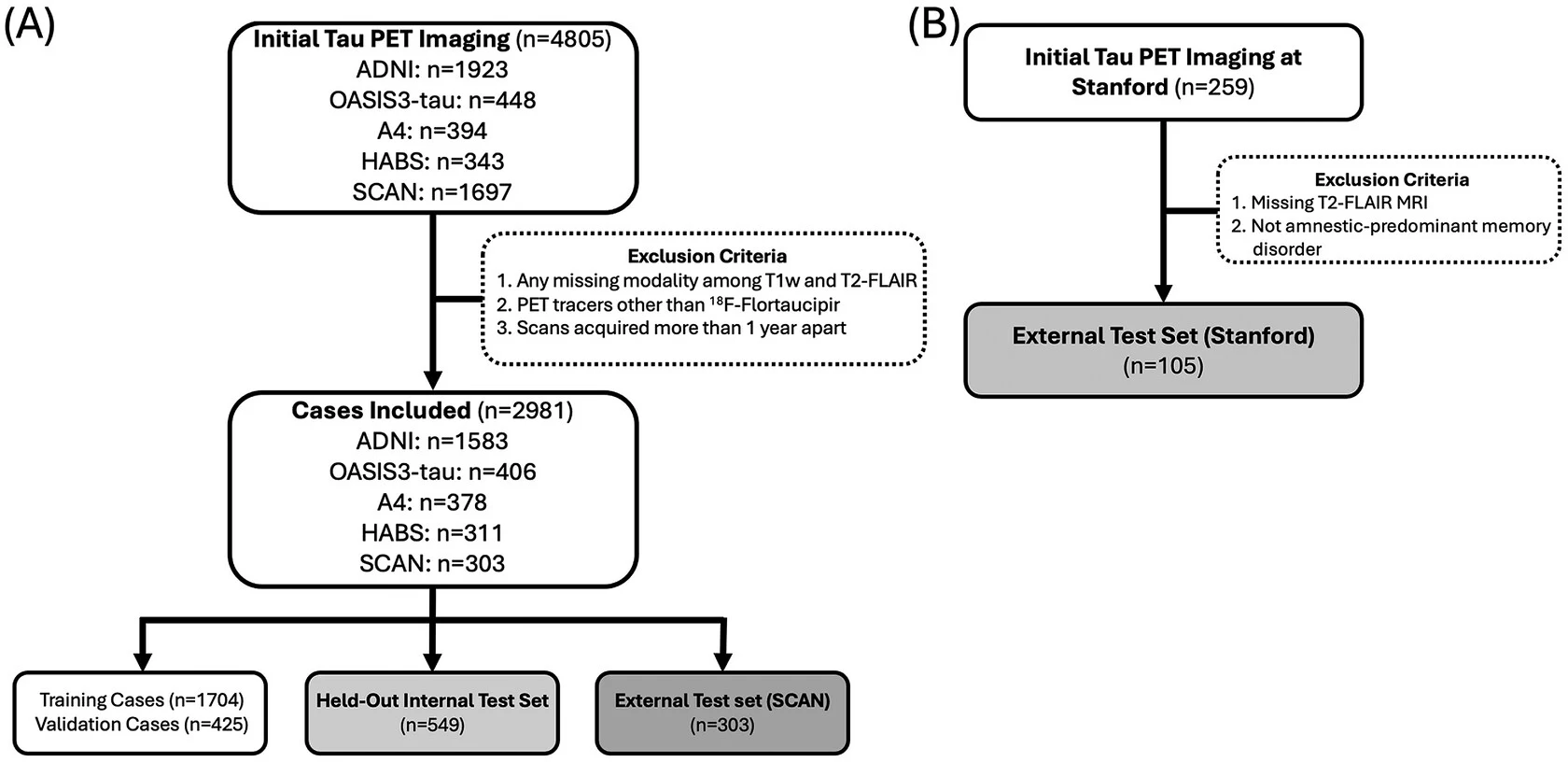
Using brain images from people in four public research cohorts, researchers trained a deep learning model—a computer system that learns patterns from data—to predict regional tau scan measurements. Tau is a protein strongly associated with Alzheimer’s disease symptoms. The model used magnetic resonance images, with or without basic demographic information, to predict measurements from positron emission tomography scans.
The researchers assessed the model in two external test datasets. Its average absolute prediction error was 0.14 in both groups of brain regions assessed, measured in ratios describing the scan signal. The authors concluded that predicting regional tau measurements from magnetic resonance images was feasible.
Why it matters
Scans measuring tau are not routinely available, limiting early assessment of Alzheimer’s risk. The authors suggested that predictions from magnetic resonance images may make tau-informed Alzheimer’s care more widely available.
Caveats
The results concern prediction accuracy, not demonstrated improvements in clinical care. The abstract does not report participant numbers or ages, limiting assessment of who the results apply to.
From the paper
- Participants
For training and internal testing, a total of 2678 subjects from publicly available datasets were included (mean age, 73.0 ± 9.7 years; 54.7% female).
- Limitation
First, the study population consisted of AD research cohorts, which differ from real-world clinical populations.
Quoted word for word from the full text on alz-journals.onlinelibrary.wiley.com.
The paper
Deep learning‐based prediction of regional brain Tau PET burden from MRI
Department of Radiology Stanford University Stanford California USA
Alzheimer's & Dementia, Oct 30, 2026, Open access, CC BY-NC-ND

