Brain scan model flags Alzheimer’s risk in Chinese adults
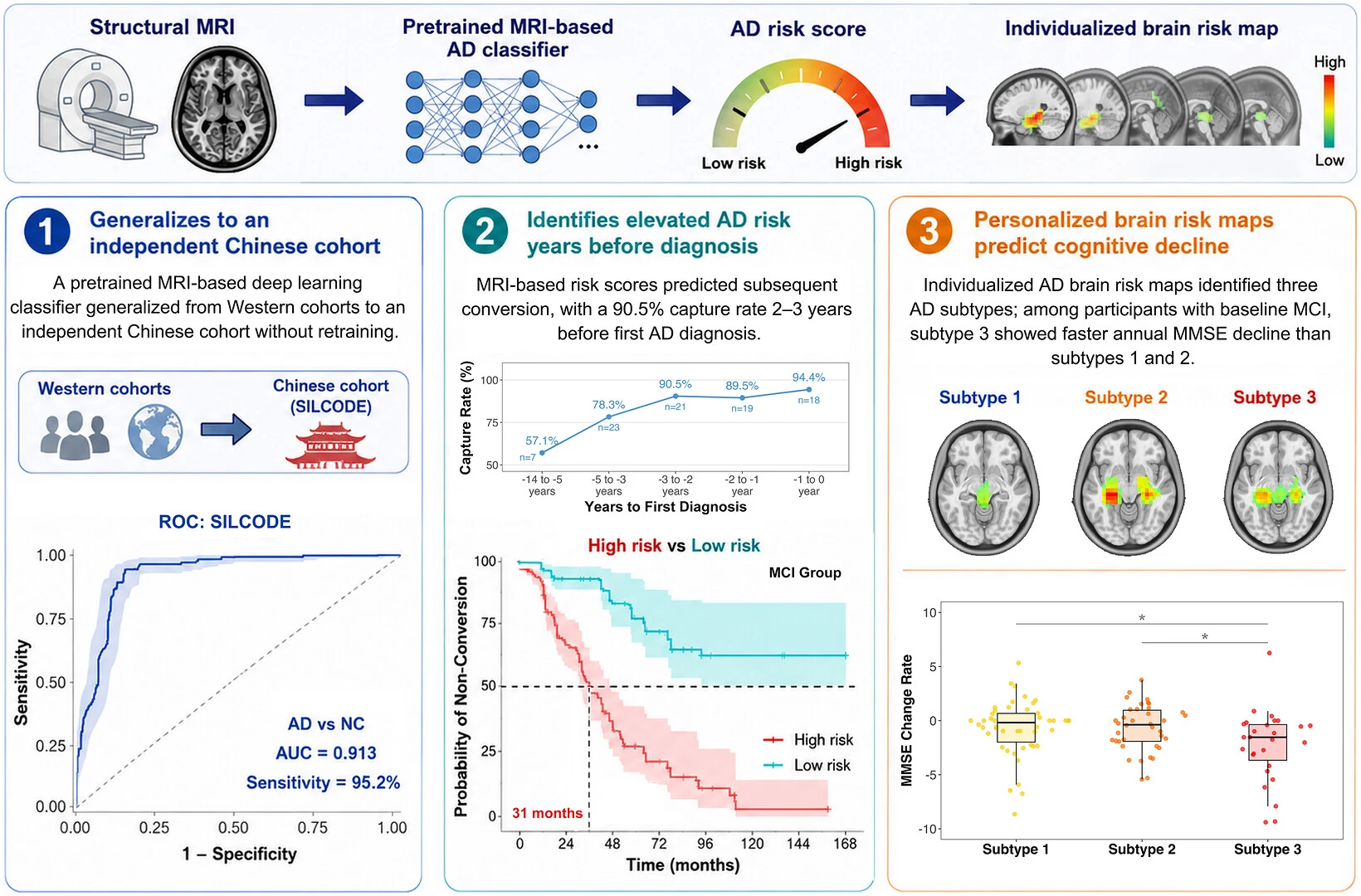
Without retraining, the model scored 0.913 for distinguishing Alzheimer’s from normal cognition and identified 95.2% of Alzheimer’s scans in the Chinese cohort.
Our read
Biomarkers- Studied:
- Cohort study of 474 Chinese adults without Alzheimer’s disease at baseline, 167-month follow-up (Independent replication, registered NCT02225964)
- What changed:
- Alzheimer’s developed in 52 of the 177 high-risk participants versus 8 of the 297 low-risk participants
- The catch:
- The high-risk cutoff was optimized on this cohort, risking overly favorable prediction estimates
- Why it’s aging research:
- It bears on staying healthy in midlife and later life.
Editor of record: Boris Djordjevic · AgingResearch.News
Among 722 Han Chinese adults over 50, a brain-scan model trained on Western samples distinguished Alzheimer’s disease from normal cognition in an observational study. Participants averaged 66.1 years old, and 60.8% were women. Their diagnoses ranged from normal cognition to Alzheimer’s. Researchers analyzed 1,105 magnetic resonance imaging scans collected at one hospital without retraining the model.
The model identified 95.2% of Alzheimer’s scans and correctly classified 85.6% of scans from people with normal cognition. Among participants who later developed Alzheimer’s, it flagged 90.5% of scan sessions two to three years before diagnosis. In a progression analysis of 474 participants without Alzheimer’s at baseline, 52 of 177 classified as high risk and 8 of 297 classified as low risk developed Alzheimer’s during the 167-month follow-up period. Higher risk scores were also associated with poorer cognitive performance and Alzheimer’s-related blood markers.
Why it matters
Early Alzheimer’s detection needs tools that work beyond the populations used to build them. The authors propose this model for early detection and grouping people by risk.
Caveats
Researchers selected the classification threshold in the same cohort used to assess accuracy; all scans came from one hospital in Han Chinese adults over 50. The early-warning figure counted scan sessions among people who later developed Alzheimer’s, not everyone screened.
From the paper
- Participants
A total of 474 participants, comprising 124 with MCI, 195 with SCD, and 155 with NC as diagnosed at their baseline visits, who completed at least two visit sessions, were included in the survival analysis.
- Follow-up
In the full sample, 60 participants converted to AD during the 167-month follow-up period, including 57 conversions from the baseline MCI group and 3 from the baseline SCD group.
- Result
In the full cohort, the risk score was significantly associated with the hazard of conversion in the unadjusted model (HR = 2.97, 95% CI [2.27–3.89], p = 2.27 × 10−), indicating that each 1 SD increase in baseline risk score was associated with approximately a 197% higher hazard of conversion.
Quoted word for word from the full text on advanced.onlinelibrary.wiley.com.
The paper
Deep Learning for AD Risk Screening and Progression Prediction
Radboud University Nijmegen; Chinese Academy of Sciences
Advanced Science, Nov 5, 2026, Open access, CC BY

Comments
Be the first to comment.