Brain age model performs more reliably on outside datasets
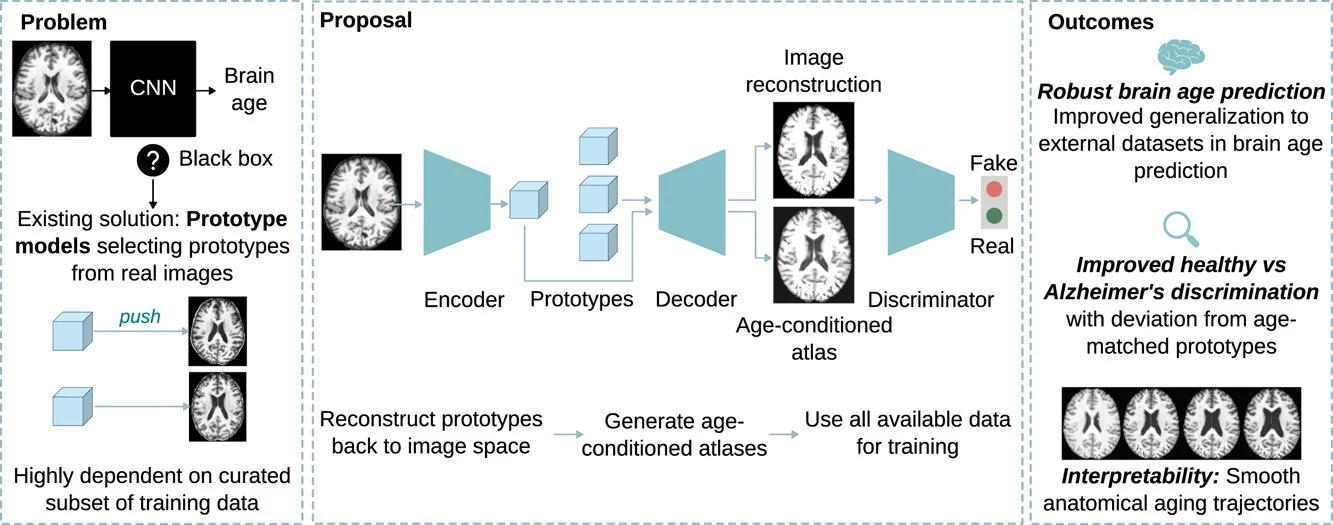
Tests across multiple large brain-imaging cohorts found that learned reference maps supported age predictions comparable to leading models and greater robustness on outside datasets.
Our read
Biomarkers- Studied:
- Computational study of people, against state-of-the-art convolutional models
- What changed:
- The model improved robustness under distribution shift in external datasets compared with state-of-the-art convolutional models
- The catch:
- Did not measure whether the model improves diagnosis in clinical practice
- Why it’s aging research:
- It builds or tests a tool for aging research.
Editor of record: Boris Djordjevic · AgingResearch.News
Researchers tested a computational model using structural magnetic resonance imaging scans from people in multiple large brain-imaging cohorts. Rather than selecting individual scans as references, the model learned age-specific patterns and converted them into reference brain maps.
Its brain age predictions were comparable to those of leading models on data similar to its training data. It performed more robustly on outside datasets. Differences between scans and age-matched references also improved the distinction between healthy people and people with Alzheimer’s disease, beyond the gap between predicted and actual age. The learned maps followed smoother, more biologically consistent aging patterns than references selected from real scans.
Why it matters
For Alzheimer’s disease, the work addresses whether departures from typical brain aging could provide useful diagnostic information beyond an estimated brain age.
Caveats
These were computational tests, not evidence that the model improves diagnosis in clinical practice. The abstract does not report cohort sizes or numerical measures of prediction accuracy or disease discrimination.
The paper
Learning age-conditioned brain atlases via free-prototype modeling for brain age prediction
Universitat de Girona
Artificial Intelligence in Medicine, Sep 17, 2026, Open access
Comments
Be the first to comment.