Blood markers show Alzheimer's-related signals across models
An observational analysis of blood measurements from 472 adults found Alzheimer's-related signals across three externally trained models, alongside substantial differences in agreement.
Stake: Eli Lilly and Company funded the study.
Edited by Boris Djordjevic · AgingResearch.News
In an observational analysis, researchers studied blood measurements from 472 participants in the Louisville Twins Study, a relatively healthy, community-based group with a mean age of 53.2 years. Women made up 57.4% of participants, and 99.4% were White. Researchers applied three machine-learning models—computer systems trained on data from other cohorts—to measurements from the 5ADCSI testing platform.
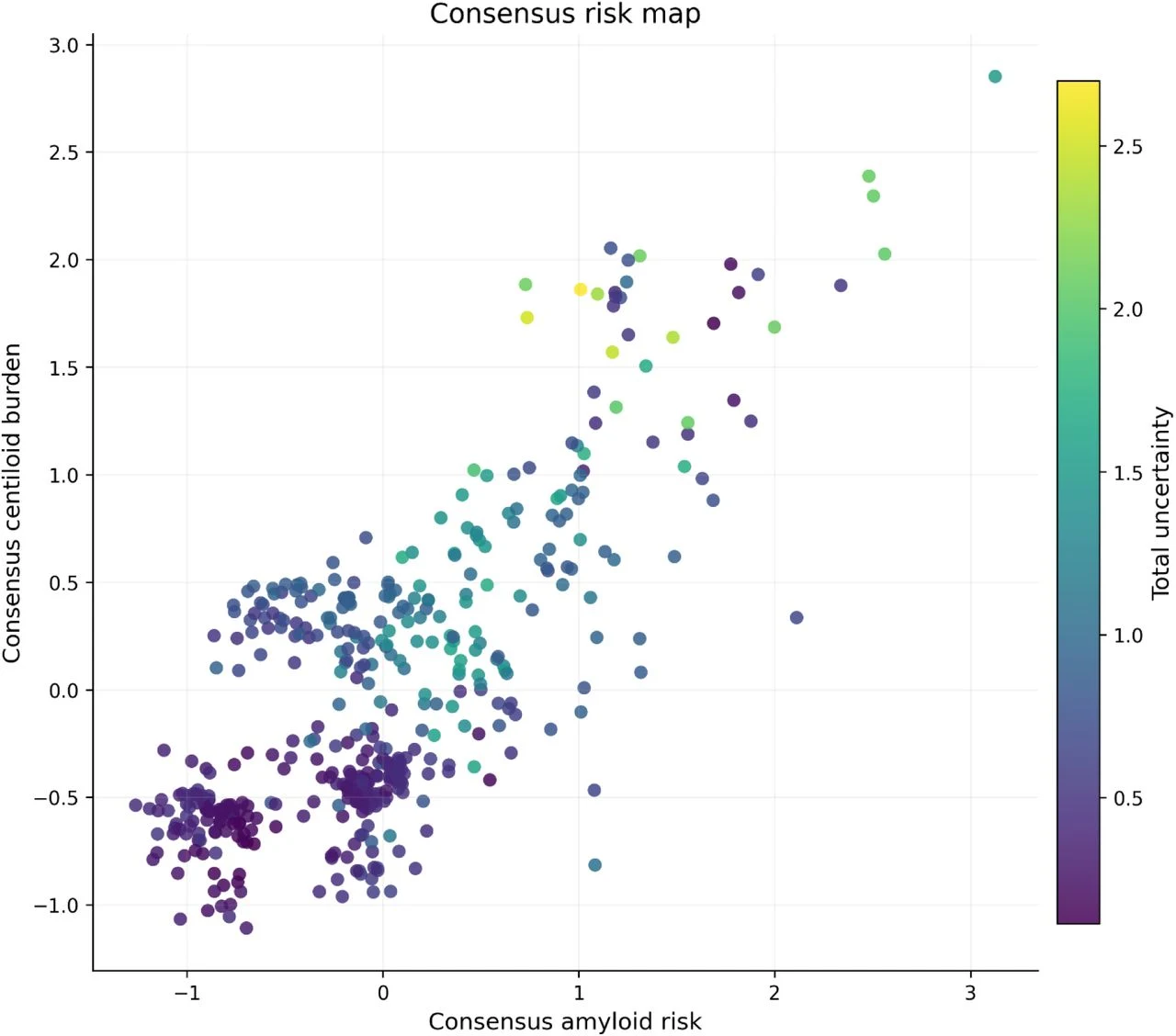
All three models recognized signals related to Alzheimer's disease, despite differences in their training populations and measurement methods. Agreement was strongest between two models and weaker for comparisons involving the third. Researchers combined predictions into risk scores and measured disagreement and differences in participants' risk rankings across models. Eleven participants (2.3%) met criteria for consistently high predicted risk. Other high-scoring participants showed much greater disagreement between models. The 20 highest-ranked participants also had higher levels of several Alzheimer's-related biological markers.
Why it matters
Blood testing for Alzheimer's disease, an age-related illness, raises questions about whether different methods capture the same underlying biology. The authors propose combining model predictions and reporting uncertainty to help evaluate emerging testing platforms.
Caveats
The analysis lacked direct validation against Alzheimer's disease pathology, so model agreement did not establish diagnostic accuracy. This preprint has not been peer-reviewed, and its findings came from a predominantly White, middle-aged community cohort rather than a dementia-enriched clinical sample.
- Machine learning
- Alzheimer's disease
- Composite consensus AD-risk scores
- Consensus amyloid risk
- Consensus centiloid burden
- Humans
The paper
University of Southern California
medRxiv, Aug 2, 2026, Open access, Preprint, not peer-reviewed


Comments
Be the first to comment.