Framework maps aging-related states in connective tissue cells
Tested across 20 independent fibroblast datasets, ECMExplainer used gene-activity comparisons to distinguish cell states and capture several processes related to aging.
Our read
AI & data- Studied:
- Preprint: computational study of fibroblast transcriptomes
- What changed:
- The framework mapped shared gene-activity patterns across fibroblast states that captured multiple aging-related processes
- The catch:
- Aging scores measure gene-activity patterns, not changes in tissue function
- In the record:
- One of 1,158 papers on rapamycin on record: 163 with results in people, 479 in animals.
Editor of record: Boris Djordjevic · AgingResearch.News
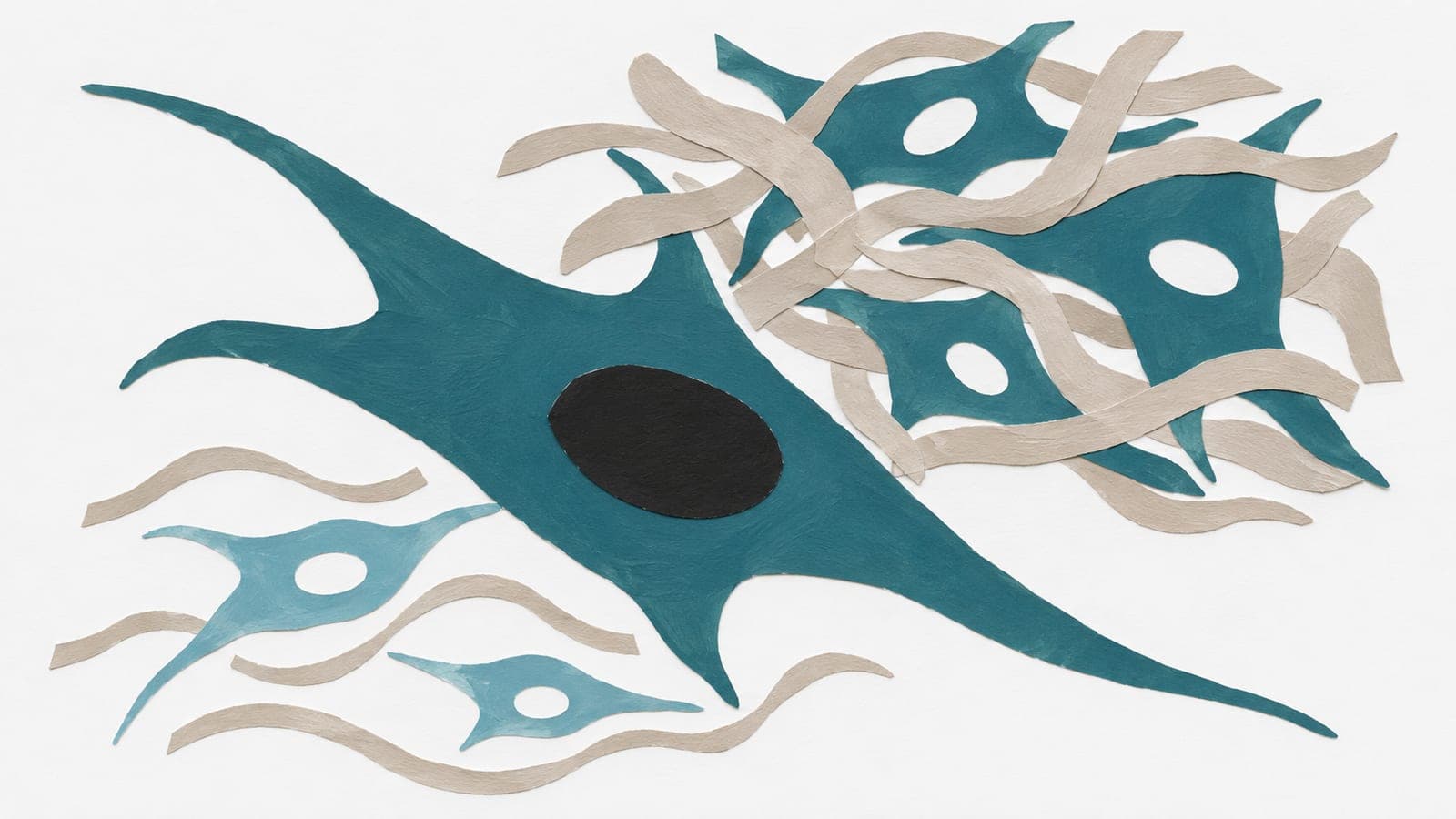
Fibroblasts, cells that help build connective tissue, were the focus of ECMExplainer, a computational framework tested across 20 independent gene-activity datasets. It compared activity within 180 pairs of genes involved in the extracellular matrix, the supporting material outside cells. Each comparison recorded only which gene was more active. The framework placed samples relative to six reference cell states rather than assigning each sample a single label.
The framework identified shared matrix-related patterns across fibroblast states that captured several aging-related processes. In fibroblast data for Hutchinson-Gilford progeria syndrome, a premature-aging condition, it found a pattern biased toward fibrosis, or tissue scarring, that differed from chronological aging. An aging score also distinguished successful from failed cell reprogramming without retraining the framework.
Why it matters
The extracellular matrix is implicated in age-related tissue dysfunction. The authors propose their framework as a way to interpret aging and fibrosis through matrix-related gene activity.
Caveats
The framework measures gene-activity patterns, so its aging scores do not establish whether tissue function changed. The work is a preprint and has not been peer-reviewed.
The paper
RIKEN Center for Biosystems Dynamics Research
bioRxiv, Nov 13, 2026, Open access, CC BY, Preprint, not yet peer-reviewed

Comments
Be the first to comment.