Boosting sugar breakdown increased bone mass in aged mice
Experiments linked reduced bone formation to impaired sugar breakdown, while genetic changes that enhanced the process improved bone-forming cell function in aged mice.
bioRxiv
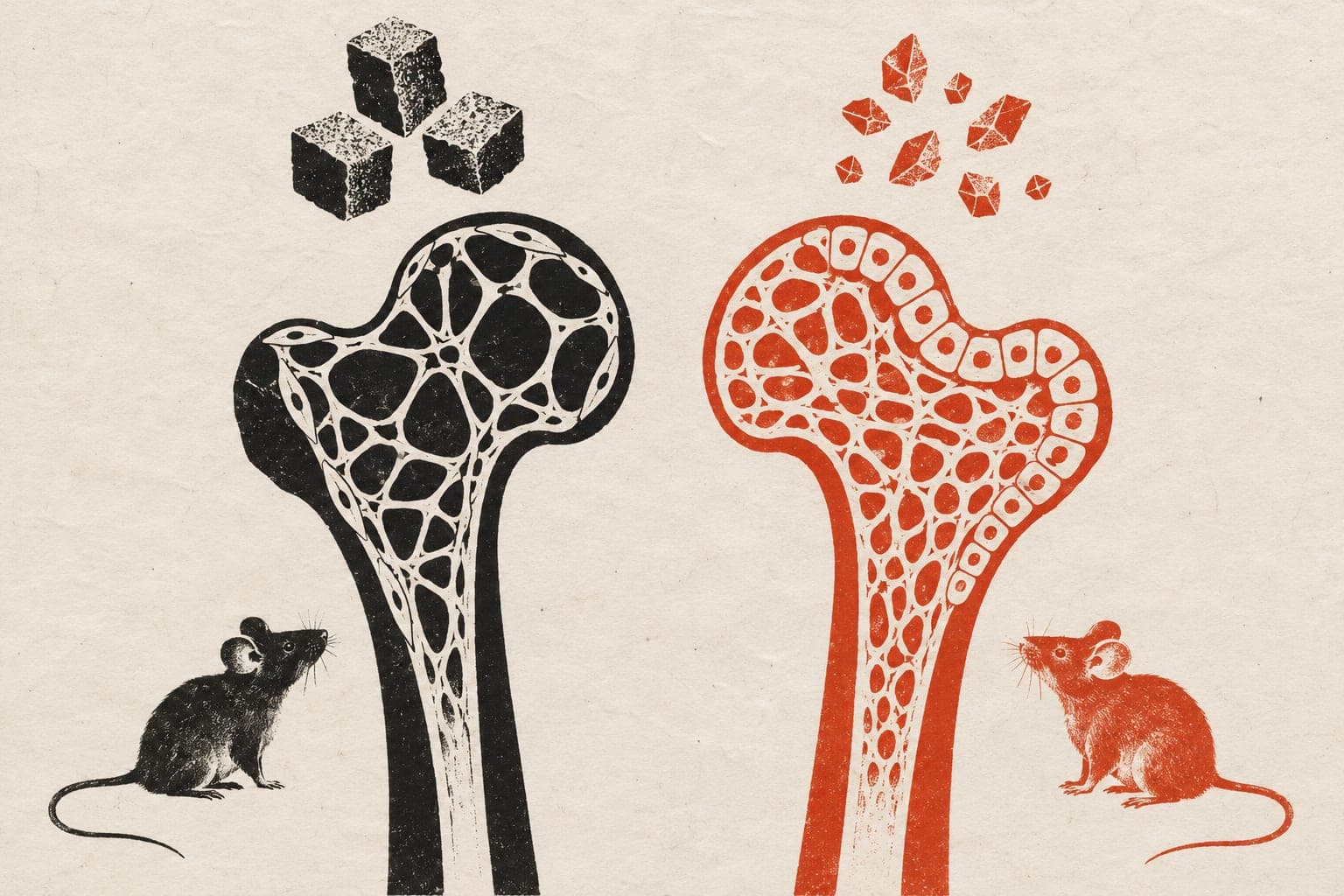
In experiments in aged mice, researchers examined glycolysis, the breakdown of sugar for energy, and bone formation. They used labelled molecules to track metabolism in living animals and analysed gene activity in bone. Reduced bone formation accompanied impaired glycolysis in bone tissue. Aged bone had lower levels of key proteins needed for this process. Gene activity for glycolysis increased, which the researchers described as a compensatory response.
Genetically enhancing glycolysis specifically in osteoblasts, the cells that form bone, improved their function and increased bone mass in aged mice. Long-term calorie restriction also prevented age-related loss of spongy bone.
Why it matters
Bone loss and metabolic problems often coexist in older adults. This work addresses whether changes in bone-cell metabolism contribute to declining bone formation with age.
Caveats
These were animal experiments, not tests in people. The paper is a preprint and has not yet been peer-reviewed.
The paper
Impaired glycolysis in bone underlies age-related bone loss in mice
Show 8 more authors
J. Koehnken Sawall, C. Song, X. Liao, X. Ji, K. Chellappa, M. R. McReynolds, J. A. Baur, C. Thom,The Children's Hospital of Philadelphia
bioRxiv · 6 Oct 2026 · CC BY · Preprint, not peer-reviewed