Foundation models

Papers on foundation models

308 papers39 new in 30 days

Friday, November 20

Wednesday, November 18

bioRxiv

GenVinci builds 3D tissue models from flat microscope images

The computational model predicted gene activity from tissue images and mapped states linked to senescence across 85.8 million cells.The computational model predicted gene activity from tissue images and mapped states linked to senescence across 85.8 million cells.

Layered skin tissue contains a cluster of large dark cells among smaller pale cells, with a thin tissue slice and scattered cells nearby.
Preprint: computational studyAI & data

Tuesday, November 17

Monday, November 16

Friday, November 13

Thursday, November 12

Wednesday, November 11

Tuesday, November 10

medRxiv

Combining measures improves prediction of Alzheimer’s markers

Combining two kinds of language analysis with thinking-test scores outperformed each approach alone across all eight tasks predicting genetic risk or brain protein…Combining two kinds of language analysis with thinking-test scores outperformed each approach alone across all eight tasks predicting genetic risk or brain protein buildup.

A brain cross-section with dense and sparse protein deposits is surrounded by small upright people and speech bubbles containing overlapping shapes.
Preprint: cross-sectional study of 1,541 peopleAlzheimer's disease

Monday, November 9

bioRxiv

Brain scan models show no consistent edge in aging research

An analysis of 3,103 scans from 1,653 participants found no consistent advantage over a conventional brain activity measure for assessing current cognition.An analysis of 3,103 scans from 1,653 participants found no consistent advantage over a conventional brain activity measure for assessing current cognition.

A large brain cross-section sits between smaller gray and blue-green sections with similar folds, beside a group of upright, faceless people.
Preprint: computational studyAI & data
arXiv

Researchers propose health coaching guided by wearable forecasts

Lifestyle coaches preferred forecast-informed plans in 71.4% of paired reviews over plans based on wearable history alone.Lifestyle coaches preferred forecast-informed plans in 71.4% of paired reviews over plans based on wearable history alone.

Faceless people form a large dark blue-green group beside a coach and large blank sheet, facing a small gray group beside a smaller sheet.
Preprint: computational studyAI & data

Saturday, November 7

Friday, November 6

Nature Medicine

Body movements helped predict health across 18 systems

In an observational study of 3,328 adults, a model using joint movements predicted 1,887 of 3,210 tested health measures.In an observational study of 3,328 adults, a model using joint movements predicted 1,887 of 3,210 tested health measures.

Overview of the gait foundation model, data acquisition and training pipeline.
Cross-sectional · 3,328 peopleAI & data

Thursday, November 5

Tuesday, November 3

medRxiv

Heart tracing models show age gaps that appear rooted in data

Median worst-group gaps in distinguishing outcomes were 0.028 by age, versus 0.004 by sex and 0.016 by race.Median worst-group gaps in distinguishing outcomes were 0.028 by age, versus 0.004 by sex and 0.016 by race.

A cutaway heart is surrounded by groups of upright, faceless people with dark or white hair and smaller hearts with varied chambers.
Preprint: computational studyPopulations

Monday, November 2

Nature Biomedical Engineering

Eye-photo model maps individual patterns of death risk

Trained in a European cohort and tested in three others, the model estimated lifespan trajectories associated with observed mortality outcomes.Trained in a European cohort and tested in three others, the model estimated lifespan trajectories associated with observed mortality outcomes.

Overview of the framework.
Cohort studyBiomarkers

Sunday, November 1

Saturday, October 31

Frontiers in Digital Health

Speech tool screened for cognitive impairment in older adults

Among 90 community participants, the speech tool achieved 85.6% accuracy against labels defined by cognitive screening.Among 90 community participants, the speech tool achieved 85.6% accuracy against labels defined by cognitive screening.

Older adults gather beneath speech bubbles containing dense or sparse fragments, with a photograph of people in a traditional courtyard nearby.
Accepted, not yet published: cross-sectional · 90 peopleMild cognitive impairment

Friday, October 30

arXiv

Health-record model predicted diagnoses across health systems

At a threshold that left 95% of disease-free patients unflagged, flagged patients were up to eight times more likely than unselected patients to receive diagnoses within…At a threshold that left 95% of disease-free patients unflagged, flagged patients were up to eight times more likely than unselected patients to receive diagnoses within a year.

Groups of upright people surround hearts and brains, with enlarged heart chambers and wider brain folds beside the black figures.
Preprint: cohort studyAI & data
arXiv

Model predicts disease from human gut microbe profiles

On excluded cohorts, disease-discrimination scores reached 0.838 for colorectal cancer, 0.736 for type 2 diabetes and 0.722 for inflammatory bowel disease.On excluded cohorts, disease-discrimination scores reached 0.838 for colorectal cancer, 0.736 for type 2 diabetes and 0.722 for inflammatory bowel disease.

A cutaway colon holds varied microbes and a dense dark cluster, beside separate communities dominated by round or curved cells.
Preprint: computational studyGut and microbiome

Thursday, October 29

Tuesday, October 27

NEJM AI

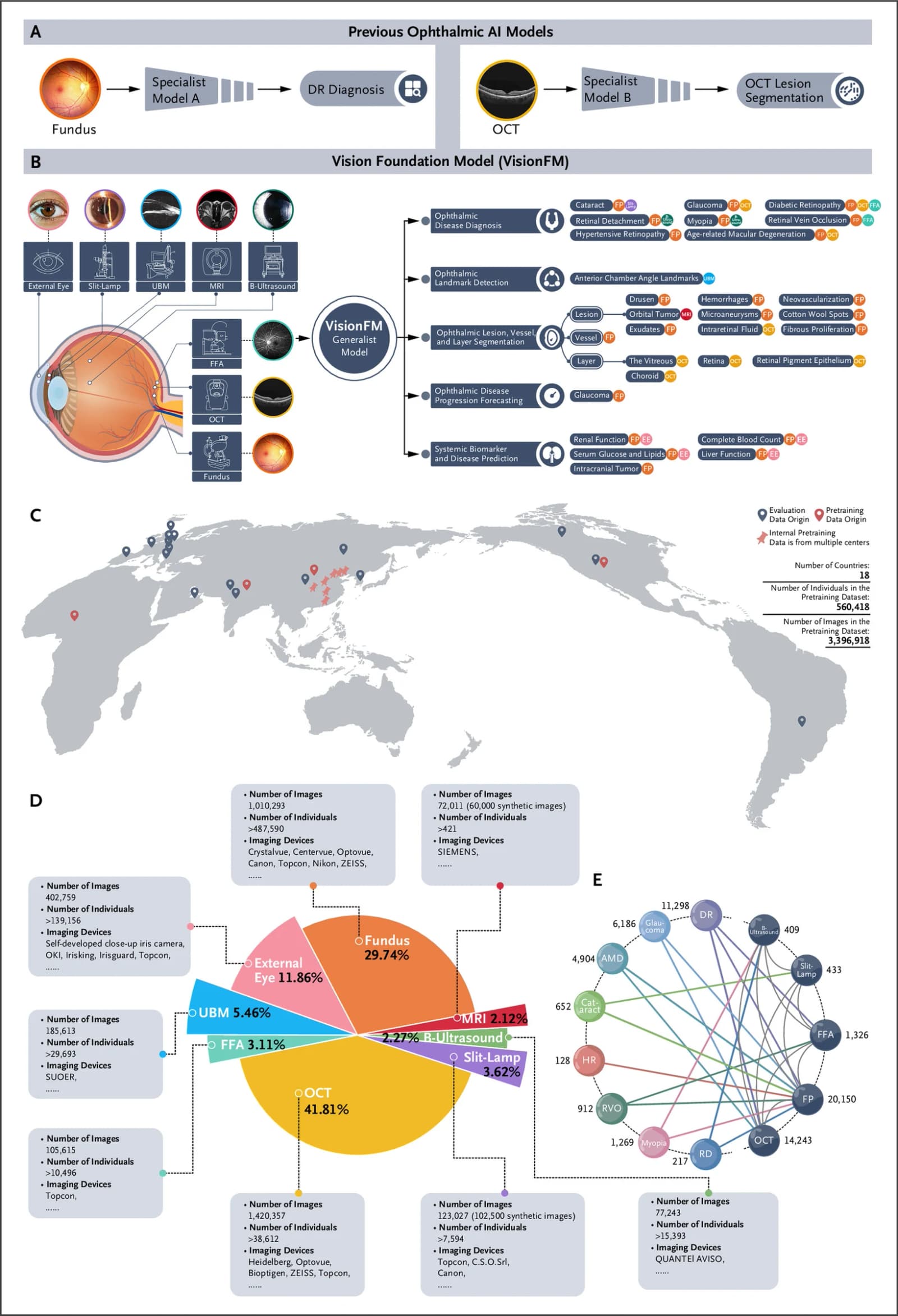
Eye-imaging model outperformed others in disease detection

VisionFM averaged 0.950 on a measure of distinguishing disease from no disease, outperforming comparison models across eight disease categories and five imaging methods.VisionFM averaged 0.950 on a measure of distinguishing disease from no disease, outperforming comparison models across eight disease categories and five imaging methods.

Figure from NEJM AI
Computational studyEye

Monday, October 26