Body movements helped predict health across 18 systems
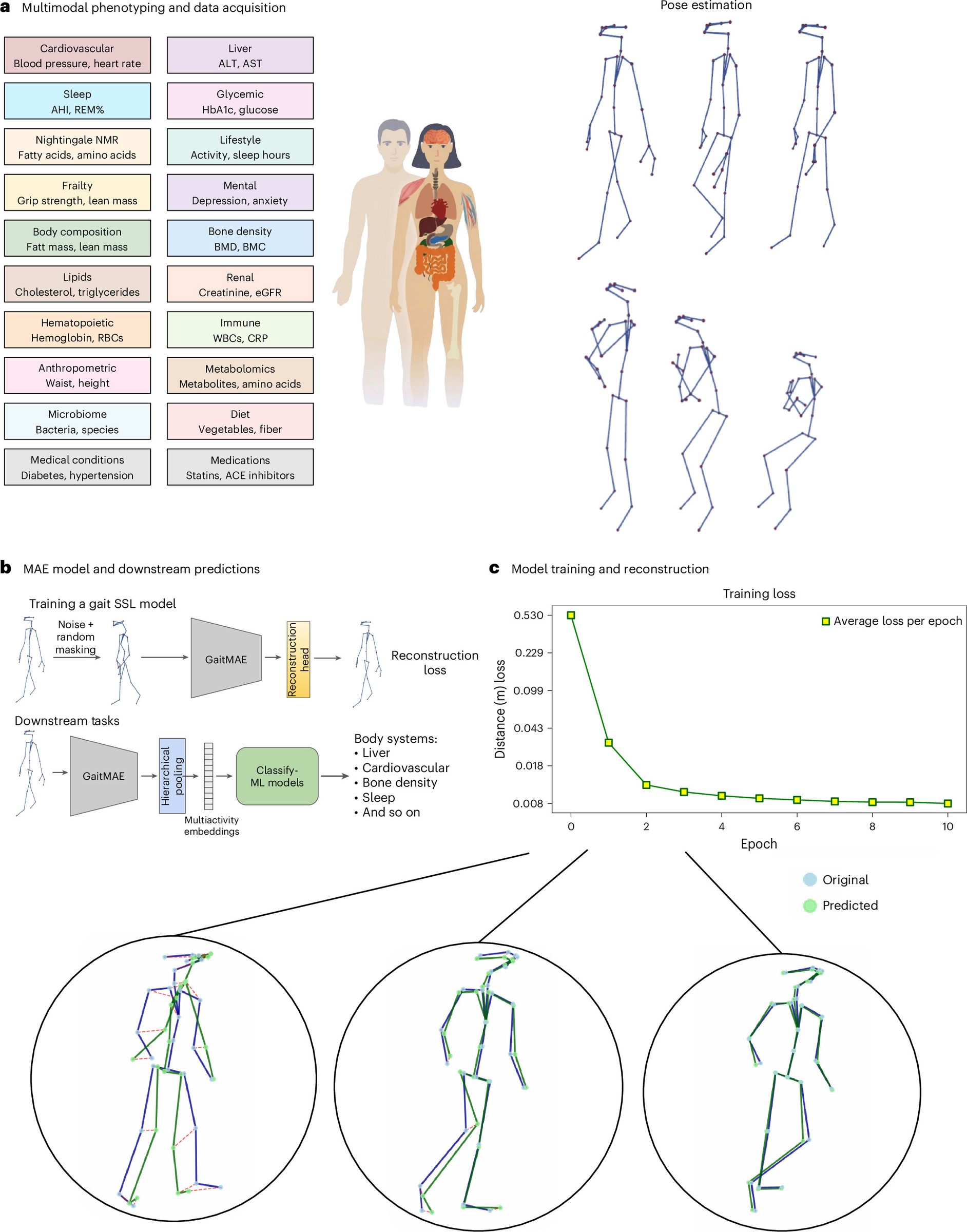
In an observational study of 3,328 adults, a model using joint movements predicted 1,887 of 3,210 tested health measures.
Our read
AI & data- Studied:
- Cross-sectional study of 3,328 deeply phenotyped adults
- What changed:
- Movement patterns improved health prediction across all 18 systems in males and 17 in females compared with the baseline model
- The catch:
- Benefits of gait-based screening were not measured
- Why it’s aging research:
- It builds or tests a tool for aging research.
Editor of record: Boris Djordjevic · AgingResearch.News
The movements of 3,328 adults were recorded with a single depth-sensing camera during five motor tasks in an observational study used to develop a prediction model. Rather than relying on measurements such as stride length, the model represented how joints moved together over time as sets of numbers.
These movement patterns predicted 1,887 of 3,210 tested health measures across 18 body systems. They outperformed conventional movement measurements in predicting age, body mass index—a measure of weight relative to height—and the area of fat around internal organs. Adding movement information to a model based on age, body mass index, internal fat and height improved prediction across all 18 systems in males and 17 in females. It also improved predictions of clinical diagnoses and medication use.
Why it matters
For frailty and other aspects of health relevant to aging, the findings support investigating movement analysis as part of routine clinical assessment.
Caveats
The observational analysis assessed predictions, not the benefits of gait-based screening. The abstract does not describe testing in an independent population, leaving performance in other groups unclear.

Comments
Be the first to comment.