Brain protein’s links to thinking varied across regions
In people below the cutoff for widespread amyloid buildup, an observational study found that some links to thinking abilities varied with brain connections.
Our read
Mechanisms- Studied:
- Preprint: cohort study of globally amyloid-negative individuals, 6 to 110 months
- What changed:
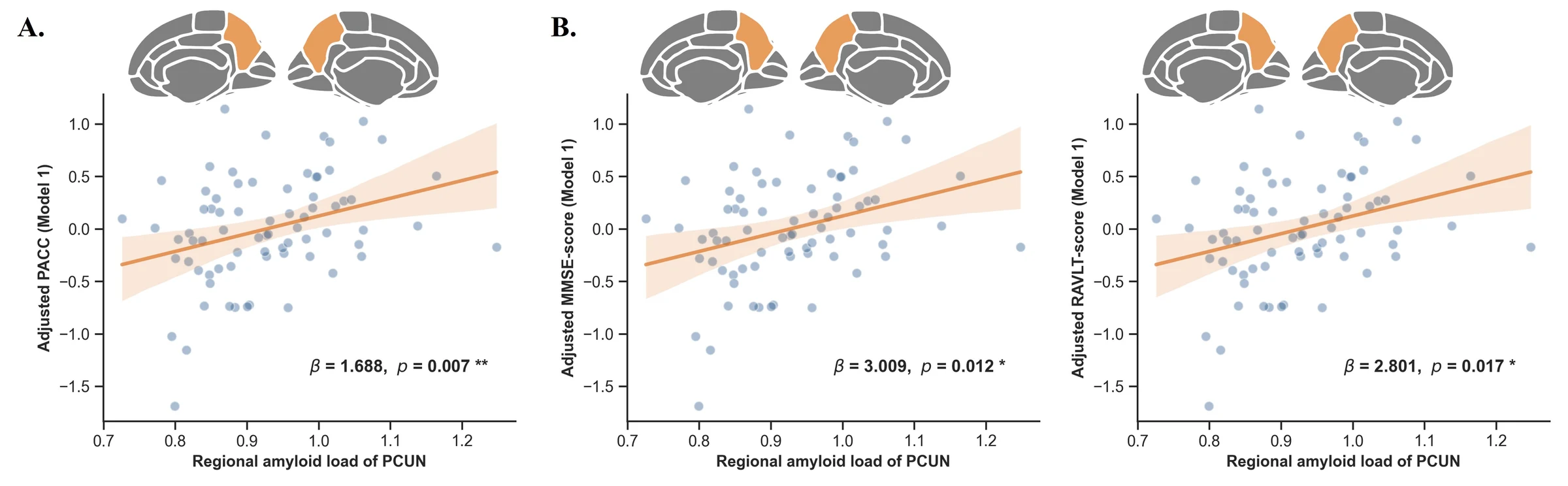
- Amyloid’s links to thinking varied across brain regions, depending on network connections in some regions but not the precuneus
- The catch:
- Thinking was measured using a cognitive composite score, a proxy for everyday cognitive functioning
- Why it’s aging research:
- A leading disease of aging, its risks or menopause.
Editor of record: Boris Djordjevic · AgingResearch.News
People below the threshold for widespread buildup of amyloid-beta, a protein that can accumulate in the brain, were examined in an observational analysis using Sino Longitudinal Study on Cognitive Decline data. Amyloid in the precuneus, a brain region, was associated with thinking abilities regardless of brain connection patterns. In several other regions, the associations mainly depended on how centrally each region sat within the brain’s structural connections.
In the separate Harvard Aging Brain Study, amyloid in several regions whose associations depended on brain connections predicted cognitive decline over three and eight years. Precuneus amyloid predicted later increases in overall brain amyloid.
Why it matters
For understanding cognitive decline with aging, the authors emphasize where amyloid accumulates and how those regions connect, rather than relying only on whole-brain cutoffs.
Caveats
The observational analyses linked regional amyloid with cognition but did not test whether changing amyloid levels altered thinking abilities. The work is a preprint and has not been peer-reviewed.
- Proteostasis
- Global amyloid burden
- Global amyloid progression
- Regional amyloid-beta burden
- Structural network centrality
- Humans
The paper
Nanjing Normal University; Nanjing University
Research Square, Nov 3, 2026, Open access, Preprint, not yet peer-reviewed


Comments
Be the first to comment.