Older adults followed varied paths after mild cognitive impairment
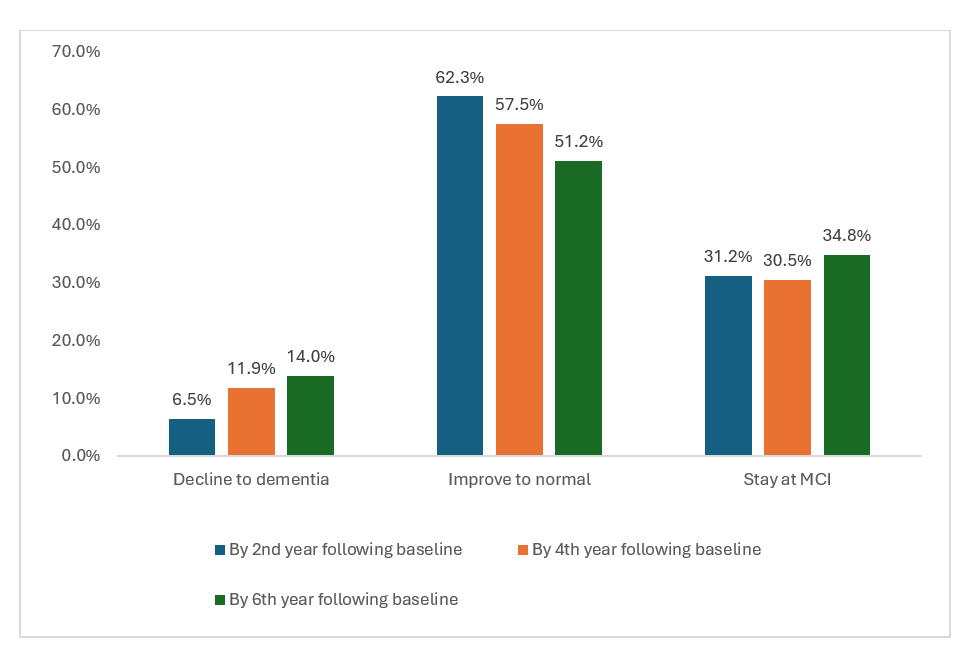
At two years, assessments classified 62.3% of observed participants as cognitively normal, 31.2% as mildly impaired and 6.5% as having dementia.
10,489 participants
Limit: Changes in screening classifications need not represent biological recovery
Edited by Boris Djordjevic · AgingResearch.News
Researchers studied 10,489 Health and Retirement Study participants who developed mild cognitive impairment, a decline in memory or thinking, after previously being classified as cognitively normal. Participants averaged 70.6 years old at their first impaired assessment; 56.6% were female. The retrospective observational cohort study used data from 1992 to 2022. Researchers followed participants for up to approximately 10 years, classifying cognition every two years using tests and reports from other people.
A statistical model estimated movement in both directions among normal cognition, mild impairment and dementia. Participants could return to earlier categories, remain impaired or progress to dementia. At assessments four to 10 years after the first mild impairment classification, the proportion classified as normal declined while the proportion classified as having dementia increased.
Why it matters
For understanding dementia risk in aging, the authors emphasized repeated assessments and further research into factors associated with maintaining thinking abilities.
Caveats
The retrospective observational design cannot establish what caused changes in the test- and proxy-based cognitive classifications. Returning to the normal category should not be interpreted as definitive biological recovery; the study is a preprint and has not been peer-reviewed.
From the paper
- Participants
The final analytic cohort included 10,489 respondents who contributed at least one observed cognitive transition during follow-up.
Quoted word for word from the full text on researchsquare.com.
- Mild cognitive impairment
- Dementia
- Langa-Weir cognitive classification
- Modified TICS
- Proxy cognitive assessments
- Humans
The paper
Paths of Aging Minds: Health Journeys of Older Adults with Mild Cognitive Impairment
Northeastern University
Research Square, Nov 1, 2026, Open access, Preprint, not peer-reviewed


Comments
Be the first to comment.