Rural Indians had fewer expected years in good cognitive health
At age 60, rural women and men had 2.2 and 3.1 fewer expected years in good cognitive health, respectively, than their urban counterparts.
Limit: Cognitive classification misses true cases, and residual measurement differences across groups could affect comparisons
Edited by Boris Djordjevic · AgingResearch.News
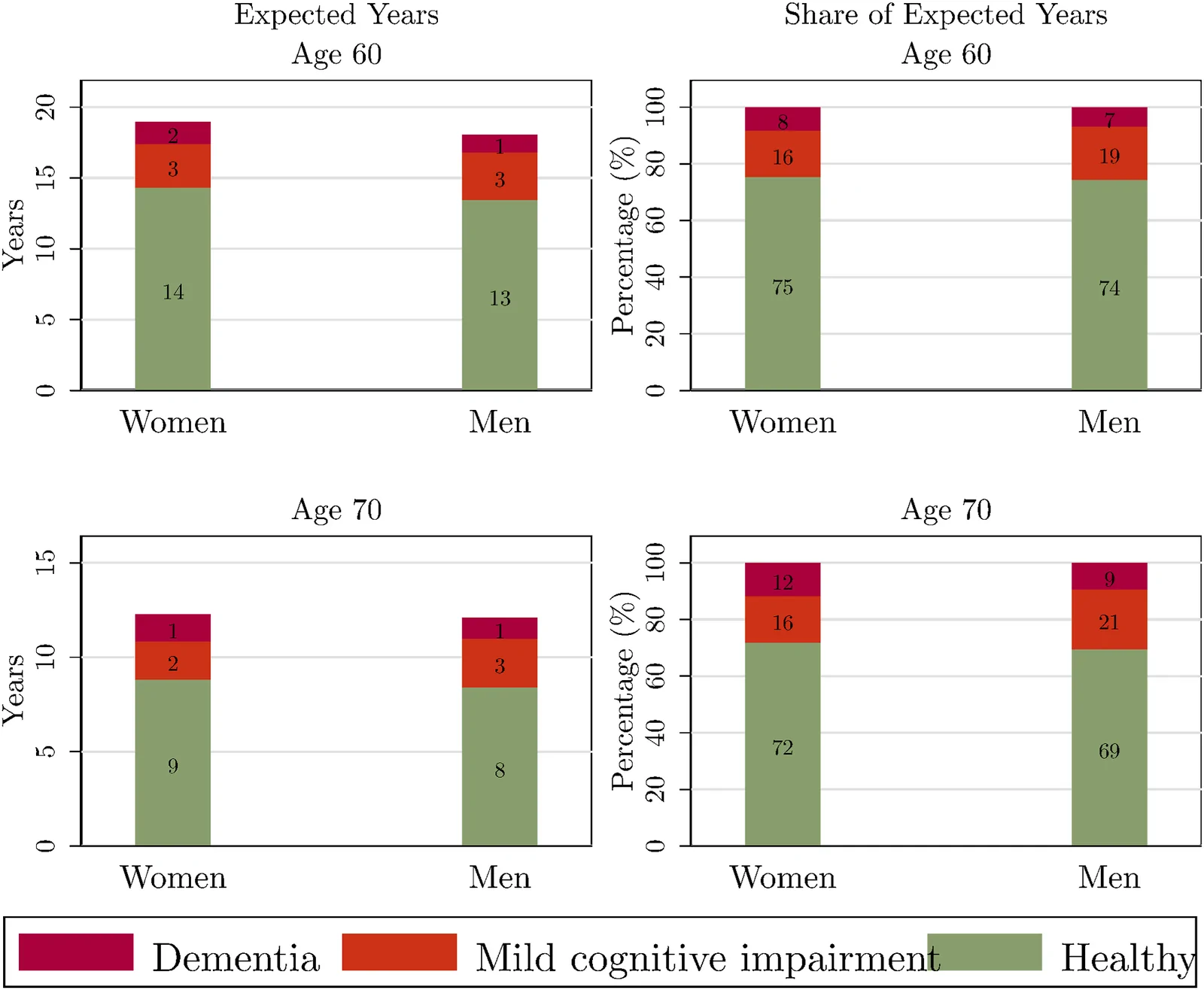
An observational analysis of older women and men in India estimated remaining years of good cognitive health at ages 60 and 70. Researchers combined estimates of survival at different ages with cognitive health data collected in 2017–2019. They estimated years without cognitive impairment—difficulties with thinking and memory—and years with mild impairment or dementia.
Among people who survived to 60, women had 0.86 more expected cognitively healthy years than men. Rural women and men had fewer such years than their urban counterparts. Women and men in Scheduled Castes or Scheduled Tribes had 3.7 and 5.3 fewer such years, respectively, than high-caste women and men. A statistical breakdown indicated that differences in mortality, rather than how common cognitive impairment was, primarily accounted for gaps between groups at age 60.
Why it matters
India’s rising life expectancy raises questions about the quality of added years. Cognitively healthy life expectancy offers a way to assess those years across social groups.
Caveats
These were population-level estimates from observational data, not measurements of how long individuals remained cognitively healthy. The analysis did not establish what caused the differences between groups.
From the paper
- Limitation
First, the Sullivan method combines period mortality with cross-sectional prevalence and assumes stable rates of onset, recovery, and mortality; it cannot estimate transitions between cognitive states, but simulation work shows only modest bias except under large and rapid change.
Quoted word for word from the full text on PubMed Central.
The paper
Cognitively healthy life expectancy of older women and men in India
Johns Hopkins University
SSM - Population Health, Oct 8, 2026, Open access


