Higher physical reserve linked to lower heart risk after breast cancer
Among breast cancer survivors, 10-year heart failure risk ranged from 0.80% to 3.61% across categories of a score combining lung function, grip strength and waist size.
183,283 participants
Limit: Subclinical disease may lower reserve before overt heart problems occur
An observational study followed 183,283 women in the UK Biobank, including 5,605 breast cancer survivors, for a median of 16.7 years. Researchers combined the volume of air forcefully breathed out in one second, grip strength and waist circumference into a physiological reserve score.
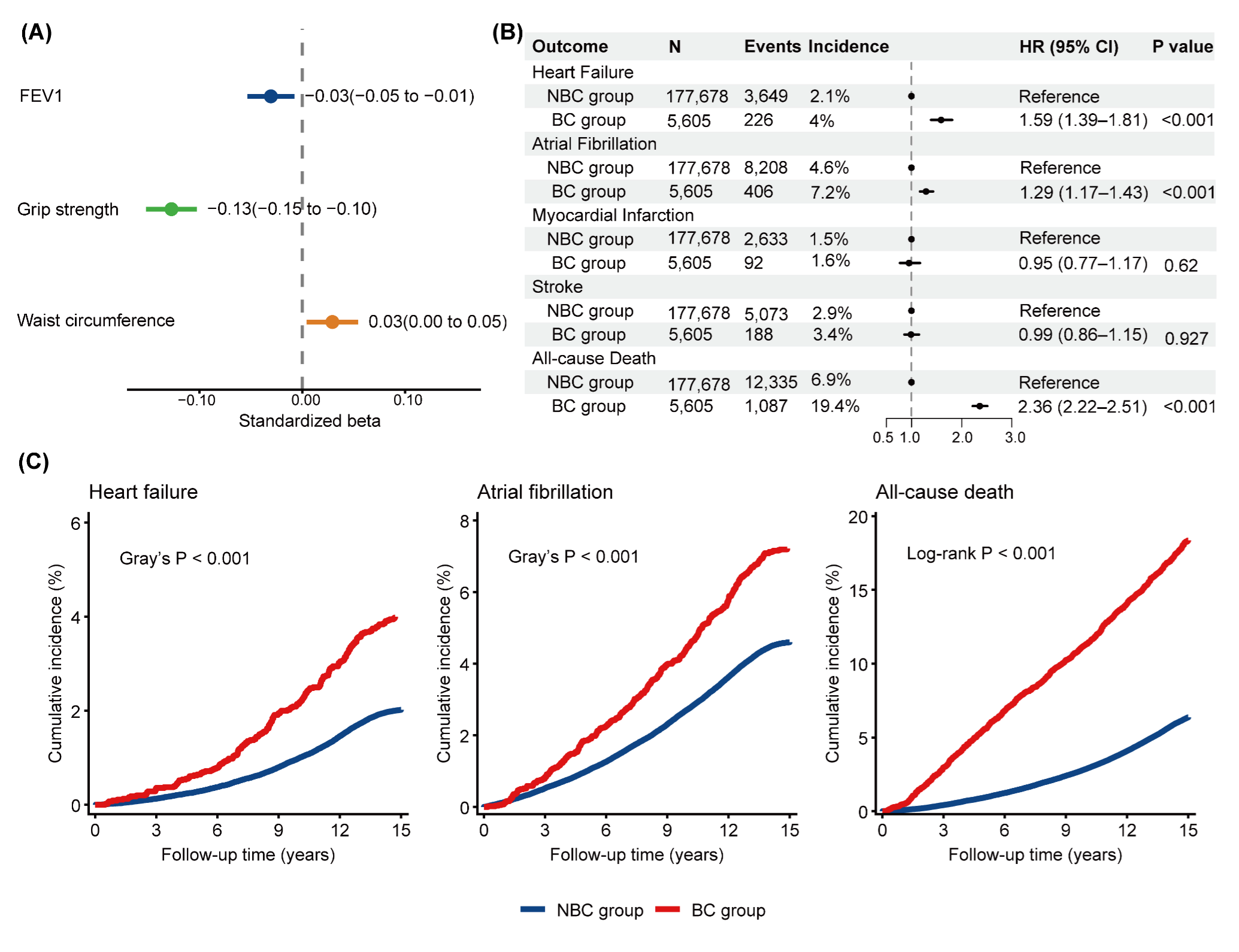
Among survivors, higher scores were associated with lower risks of heart failure, atrial fibrillation—an irregular heartbeat—and death from any cause. Survivors had higher risks of all three outcomes than women without breast cancer. Adding the score to conventional clinical factors improved prediction of heart failure risk.
Why it matters
Long-term cardiovascular risk matters for breast cancer survivors as they age. Simple functional and body measurements may complement conventional risk assessment.
Caveats
The observational design cannot show that improving these measures would lower risk. The study included only women, and the preprint has not been peer-reviewed.
From the paper
- Participants
We analyzed 183,283 women in the UK Biobank, including 5,605 breast cancer survivors.
- Follow-up
During a median follow-up of 16.7 years, breast cancer survivors had higher risks of heart failure (hazard ratio [HR] 1.59, 95% confidence interval [CI] 1.39–1.81), atrial fibrillation (HR 1.29, 95% CI 1.17–1.43), and all-cause mortality (HR 2.36, 95% CI 2.22–2.51) than women without breast cancer.
- Result
During a median follow-up of 16.7 years, breast cancer survivors had higher risks of heart failure (hazard ratio [HR] 1.59, 95% confidence interval [CI] 1.39–1.81), atrial fibrillation (HR 1.29, 95% CI 1.17–1.43), and all-cause mortality (HR 2.36, 95% CI 2.22–2.51) than women without breast cancer.
- Limitation
First, this was an observational study, and causal relationships between physiological reserve and cardiovascular outcomes cannot be established.
Quoted word for word from the full text on researchsquare.com.
The paper
First Affiliated Hospital of Dalian Medical University
Research Square, Oct 19, 2026, Open access, Preprint, not peer-reviewed


