Lighting Impacts on Gaze Behaviors in Older Adults during the Mobility Standardized Test in Virtual Reality
Non-randomised trial
Abstract
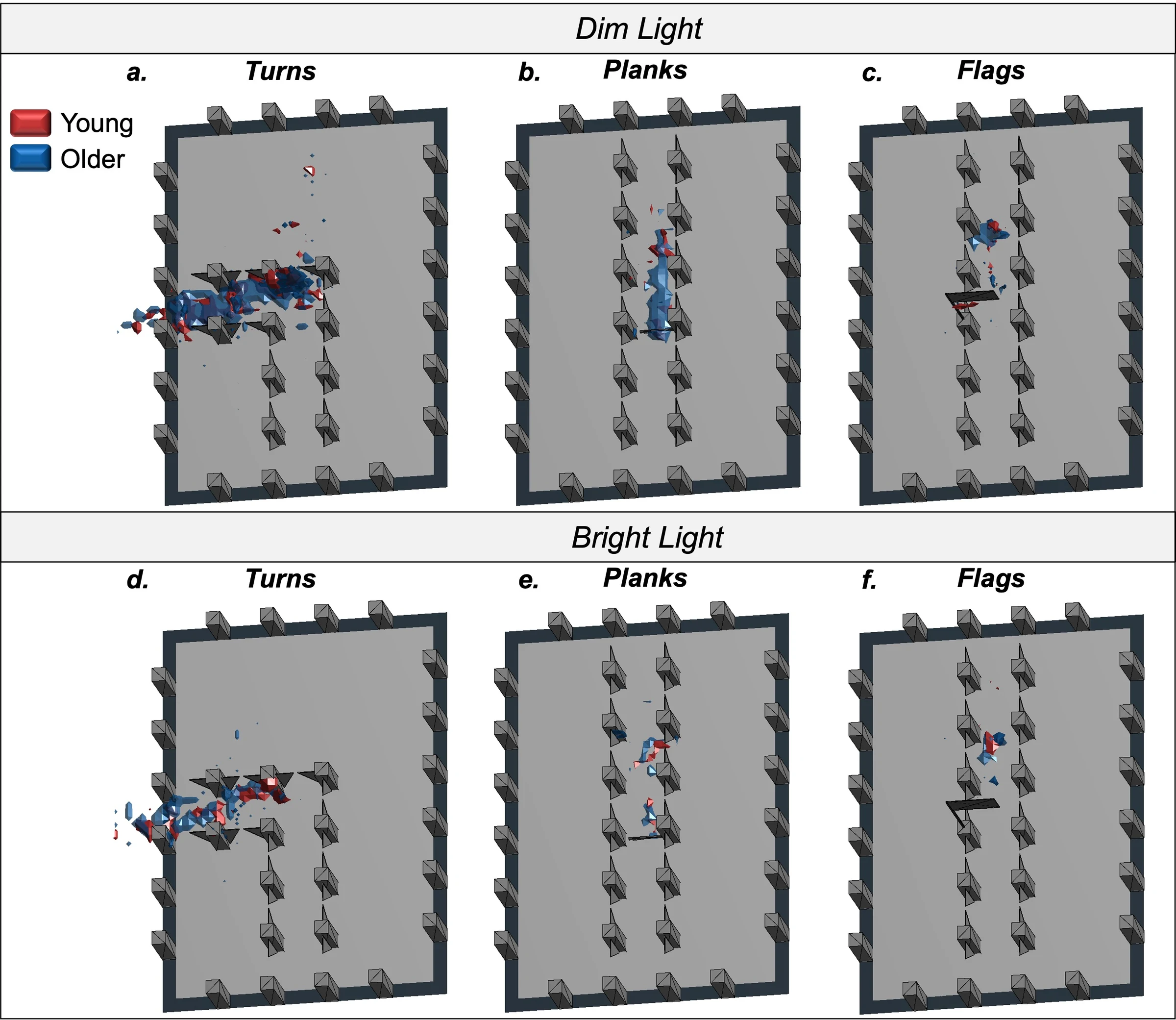
Changes in gaze coordination in older adults have been associated with worse mobility and previous research has investigated whether altering gaze behaviors could improve gait. However, most studies examining gaze behaviors in older adults have been conducted in well-lit laboratory settings. Reduced lighting is known to affect gait and increase fall risk, but the effect of lighting on gaze behaviors has not received much attention to date. In this study, we used a newly developed virtual reality navigation paradigm (Mobility Standardized Test or MOST) to assess gaze behaviors and the associated eye, head, and body movements while navigating through mazes in different light levels in young (n = 14) and older adults (n = 20). Both groups showed slower walking speed, gaze directed downward, reduced look-ahead distance, and more extensive visual scanning with the eyes and head in dim light. Older adults were more impacted in dim light, showing significantly slower speed, further increased downward gaze, and reduced head movements when scanning compared to the young adults. This study provides insight into how lighting impacts gaze behaviors in visually healthy young and older adults and establishes normative data for comparison with similar behavior in populations with vision loss.
From the paper
- Limitation
One limitation of using VR for evaluating gaze behavior is a potential lack of ecological validity.
Quoted word for word from the full text on researchsquare.com.
The paper
University of Pittsburgh
Research Square, 12 Oct 2026, Open access, Preprint, not peer-reviewed