Multidimensional Health Profiles and Cognitive Outcomes Among Adults with Stroke: A Longitudinal Study Using CHARLS
Abstract
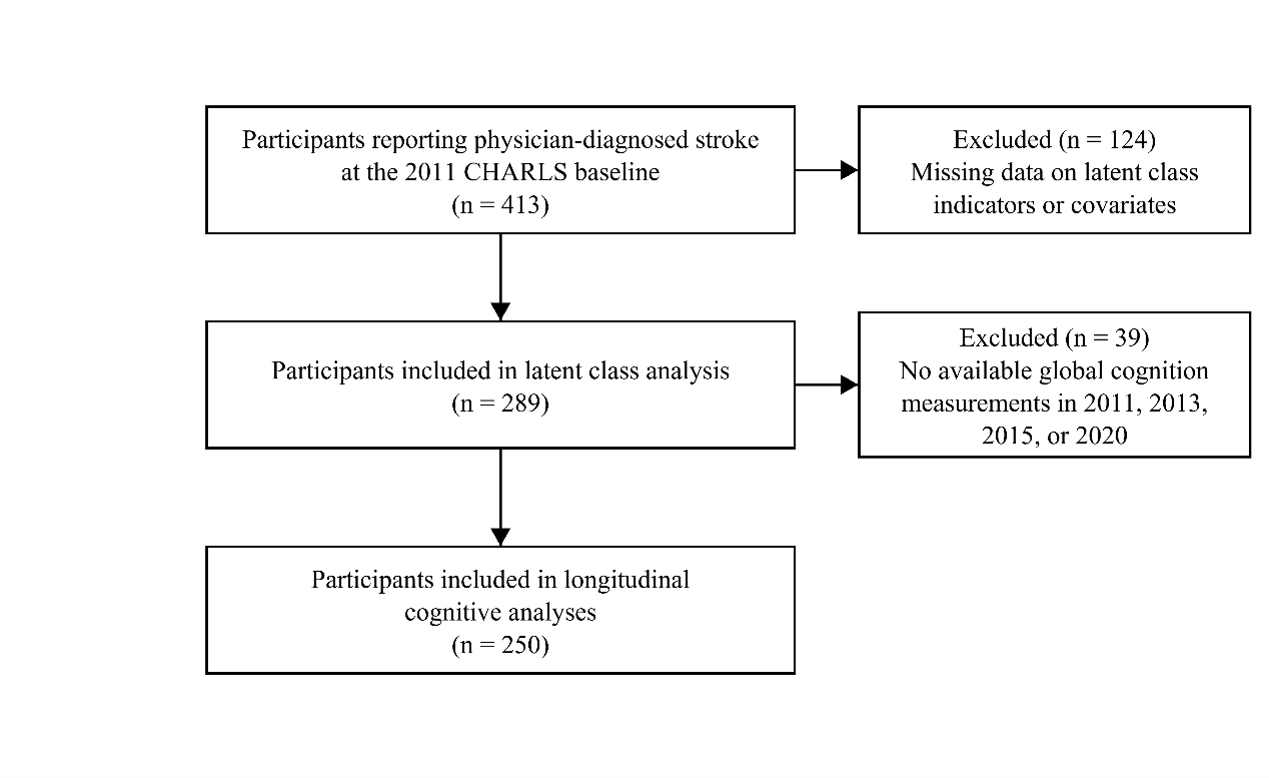
Background Stroke survivors often experience co-occurring functional, psychological, sleep, and sensory problems, but whether multidimensional health profiles are associated with cognitive performance and longitudinal cognitive change remains unclear. We aimed to identify multidimensional health profiles among adults with stroke and examine their associations with longitudinal cognitive outcomes. Methods We included 289 participants with self-reported physician-diagnosed stroke from the 2011 baseline of the China Health and Retirement Longitudinal Study (CHARLS), of whom 250 contributed data to the longitudinal cognitive analyses. Latent class analysis was used to identify multidimensional health profiles based on activities of daily living disability, instrumental activities of daily living disability, depressive symptoms, abnormal sleep duration, visual impairment, and hearing impairment. Global cognition, immediate recall, and delayed recall were assessed in 2011, 2013, 2015, and 2020. Linear mixed-effects models were used to examine differences in cognitive level and annual cognitive change across profiles, with adjustment for sociodemographic characteristics, health behaviors, and chronic conditions. Results Two profiles were identified: a low-burden profile (38.1%) and a high-burden profile (61.9%). The high-burden profile was characterized mainly by higher probabilities of activities of daily living and instrumental activities of daily living disability, together with depressive symptoms and abnormal sleep duration. After covariate adjustment, the high-burden profile was associated with lower global cognition (β = −1.19, 95% CI − 1.88 to − 0.50; P < 0.001) and immediate recall (β = −0.54, 95% CI − 0.87 to − 0.21; P = 0.001), whereas the difference in delayed recall was not statistically significant. Profile-by-time interactions were not significant for any cognitive outcome. In sensitivity analyses additionally adjusting for baseline cognitive performance, the high-burden profile remained associated with subsequent immediate and delayed recall, whereas the association with global cognition was attenuated. Conclusions Multidimensional health profiles were associated with cognitive performance among adults with stroke. The high-burden profile was associated with poorer cognition but not with a significantly different rate of longitudinal cognitive change.
From the paper
- Participants
We included 289 participants with self-reported physician-diagnosed stroke from the 2011 baseline of the China Health and Retirement Longitudinal Study (CHARLS), of whom 250 contributed data to the longitudinal cognitive analyses.
- Result
After covariate adjustment, the high-burden profile was associated with lower global cognition (β = −1.19, 95% CI − 1.88 to − 0.50; P < 0.001) and immediate recall (β = −0.54, 95% CI − 0.87 to − 0.21; P = 0.001), whereas the difference in delayed recall was not statistically significant.
Quoted word for word from the full text on researchsquare.com.
The paper
First Affiliated Hospital of Henan University of Traditional Chinese Medicine
Research Square, 14 Oct 2026, Open access, Preprint, not peer-reviewed