Serum Uric Acid Identifies a Kidney Filtration–Risk Phenotype in Diabetes-Enriched Non-Obese Metabolic Dysfunction-Associated Steatotic Liver Disease: A Multicentre Cohort Study
Multicentre
Abstract
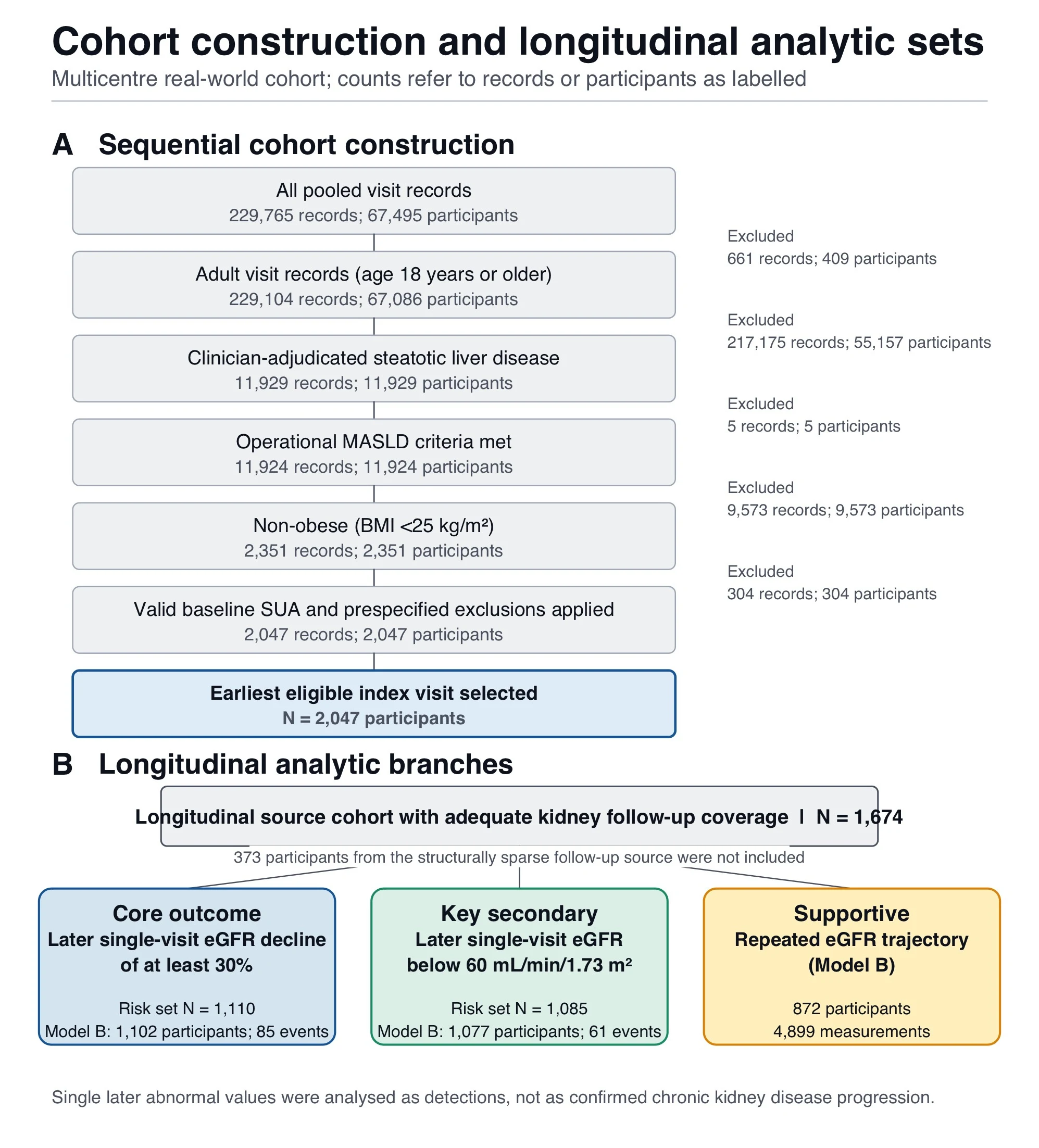
Background and hypothesis : Kidney risk varies in non-obese metabolic dysfunction-associated steatotic liver disease (MASLD). We tested whether baseline serum uric acid (SUA) identifies a phenotype prone to later loss of filtration. Methods : We included 2,047 adults with clinician-adjudicated MASLD and body mass index below 25 kg/m². SUA was standardised within sex. The core outcome was the first single-visit estimated glomerular filtration rate (eGFR) decrease of at least 30% after a 180-day landmark and within five years. Centre-stratified Cox models adjusted for prespecified clinical factors. Results : Type 2 diabetes was present in 1,910 participants (93.3%). Model B included 1,102 participants and 85 events. Each 1-SD higher SUA was associated with a later eGFR decrease of at least 30% (hazard ratio [HR] 1.46, 95% confidence interval [CI] 1.19–1.79; P < 0.001). Model-standardised risks at the mean and + 1 SD were 6.06% and 8.47% at three years, and 12.82% and 17.53% at five years. Results were concordant for later eGFR below 60 mL/min/1.73 m² (HR 1.37, 95% CI 1.07–1.74) and a 40% eGFR decrease (HR 1.48, 95% CI 1.11–1.98), and remained evident after multiple imputation and repeat-testing weighting. Albuminuria was not clearly associated (HR 1.19, 95% CI 0.98–1.44). The 730-day landmark estimate was attenuated (HR 1.22, 95% CI 0.89–1.67). Conclusions : Higher baseline SUA identified a kidney filtration–risk phenotype in diabetes-enriched non-obese MASLD. It should prompt closer renal surveillance, but does not establish causal injury, confirmed chronic kidney disease progression, or an indication for urate-lowering treatment.
From the paper
- Participants
Model B included 1,102 participants and 85 events over 2,672 person-years (31.8 per 1,000 person-years).
- Result
Rubin-pooled HRs were 1.34 (95% CI 1.08–1.67) for Model C and 1.39 (1.11–1.74) for Model D.
Quoted word for word from the full text on researchsquare.com.
- Serum uric acid
- Metabolic dysfunction-associated steatotic liver disease
- Albuminuria
- Estimated glomerular filtration rate
- Humans
The paper
Affiliated Hospital of Qingdao University
Research Square, 14 Oct 2026, Open access, Preprint, not peer-reviewed