Navitoclax linked to smaller heart scars in middle-aged mice
Scars were approximately 28% smaller in navitoclax-treated mice than in controls five weeks after heart injury.
Our read
Interventions- Studied:
- Preprint: experiments in 15-month-old male mice, five weeks, against vehicle-treated mice (Randomized, blinded)
- What changed:
- Scar size was 28% lower in navitoclax-treated mice than in vehicle-treated mice
- The catch:
- p16INK4a and p21CIP1 positivity indicates marker burden rather than definitive elimination of senescent cells
- Stake:
- An author works for Translational Sciences.
- In the record:
- One of 289 papers on navitoclax on record: 20 with results in people, 84 in animals.
Editor of record: Boris Djordjevic · AgingResearch.News
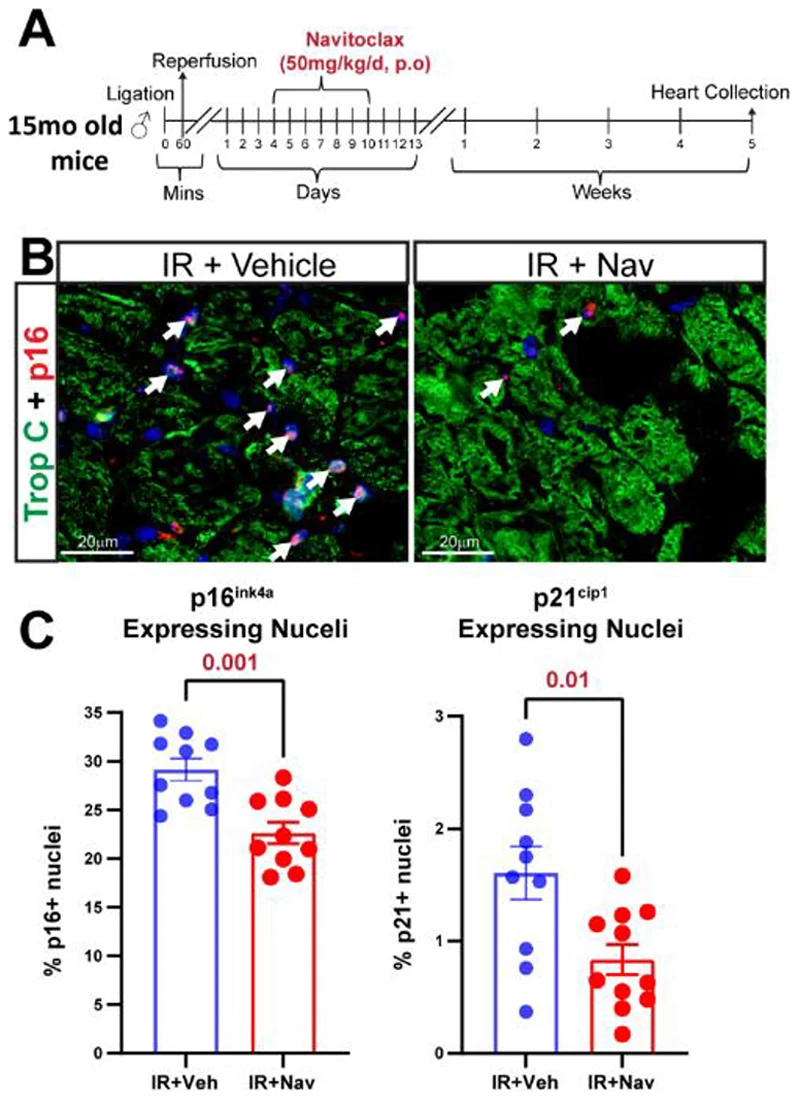
Fifteen-month-old male mice underwent an experiment in which researchers blocked a heart artery for 60 minutes, then restored blood flow. Researchers randomly assigned mice to navitoclax or a control liquid without the drug. Starting four days after injury, mice received navitoclax by mouth at 50 milligrams per kilogram of body weight daily for seven days.
Five weeks after injury, navitoclax reduced the share of cell nuclei bearing markers of senescence, a state in which cells stop dividing. Treatment was associated with smaller scars, less immune-cell accumulation, more small blood vessels near the injury and less heart-muscle cell enlargement. A separate analysis of existing maps of gene activity in human heart tissue after heart attacks found increased senescence-associated activity in damaged regions. Areas with high senescence-associated activity also showed more gene activity linked to scarring and inflammation.
Why it matters
Heart attacks predominantly affect older adults, and these findings support senescence as a candidate target for improving repair in aging hearts.
Caveats
Smaller scars in male mice do not by themselves show better heart function or longer survival. Navitoclax was not tested in people, and this preprint has not been peer-reviewed.
From the paper
- Absolute difference
The senescence programme score increased from 0.0735 ± 0.0055 in control myocardium to 0.1523 ± 0.0121 in infarct-zone myocardium, corresponding to an absolute increase of 0.0788 score units.
Results, Human ischaemic myocardium shows spatial enrichment of senescence-associated programmes
- Limitation
The mouse study included only male mice at one age and endpoint, and reduced p16INK4a and p21CIP1 positivity indicates reduced senescence-associated marker burden rather than definitive selective elimination of senescent cells.
Quoted word for word from the full text on Europe PMC.
The paper
Newcastle University
Research Square, Sep 8, 2026, Open access, CC BY, Preprint, not yet peer-reviewed

Comments
Be the first to comment.