Depressive symptoms linked to higher Parkinson’s risk
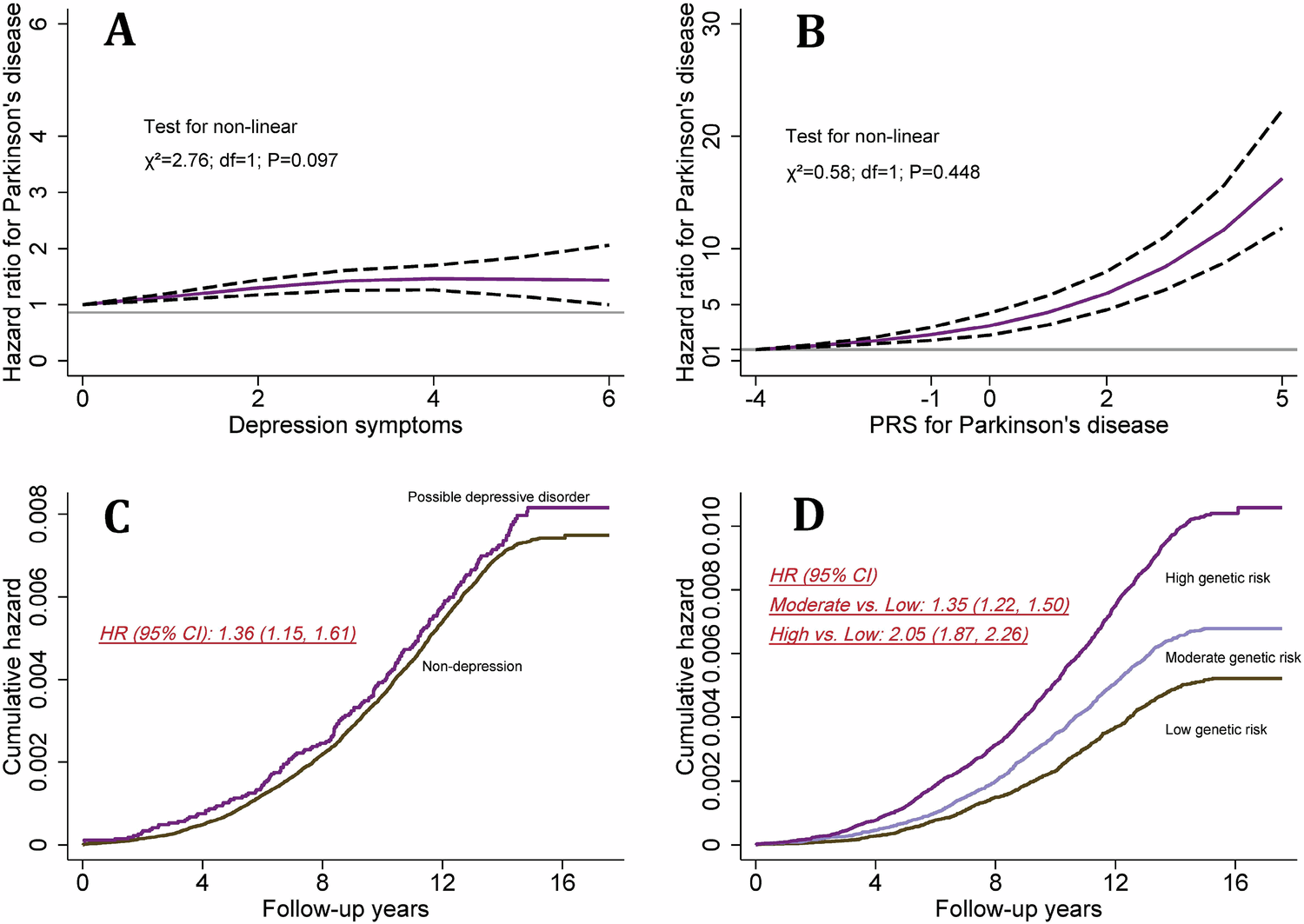
Participants with possible depressive disorder had a 36% higher relative risk of Parkinson’s than those without it.
Our read
Populations- Studied:
- Cohort study of 451,922 UK Biobank participants without Parkinson’s disease, median 14.6 years
- What changed:
- Parkinson’s disease risk was 36% higher among participants with possible depressive disorder than among those without
- The catch:
- Depressive symptoms can be an early sign of Parkinson’s disease rather than a cause
- In the record:
- The 4th paper on metabolomic signatures with results in people; 14 on record in all.
Editor of record: Boris Djordjevic · AgingResearch.News
Among 451,922 UK Biobank adults without Parkinson’s disease, depressive symptoms were linked to later diagnoses in a prospective study. Participants averaged 56.6 years old, and 54.0% were women. They answered two questions about mood and loss of interest over the previous two weeks.
Over a median 14.6 years, 3,108 participants (0.7%) developed Parkinson’s. Scores indicating possible depressive disorder were associated with higher risk after accounting for other measured factors. Higher symptom scores were also linked to higher risk. People with both possible depressive disorder and high genetic susceptibility had the highest risk. In 228,585 participants with blood measurements, a pattern incorporating fatty acids and lipoproteins—particles that carry fats in blood—accounted for 15% of the symptom–Parkinson’s association in a statistical model.
Why it matters
The work addresses how mood symptoms and blood chemistry relate to the development of Parkinson’s, an age-related disease.
Caveats
Early Parkinson’s that had not yet been diagnosed could have contributed to the depressive symptoms. The findings concern adults without Parkinson’s at entry, not people already diagnosed.
From the paper
- Participants
After excluding 50,431 participants with prevalent PD at study entry (n = 901), missing data on depressive symptoms at baseline (n = 35,093), or missing PRSPD information (n = 16,235), a total of 451,922 participants were included in the current analysis (Supplementary Fig. 1).
- Follow-up
During a median follow-up of 14.6 years (interquartile range: 13.8 to 15.3 years; totaling 3,240,608 person-years), 3108 (0.7%) incident cases of PD were identified, including 2914 among participants free of possible depressive disorder and 194 among those with possible depressive disorder.
Results, Association between depressive symptoms and incident Parkinson’s disease
- Result
Higher depressive symptoms score was related to a higher risk of PD (HR [95% CI]: 1.13 [1.10, 1.17] in the basic-adjusted model and 1.11 [1.07, 1.15] in the multi-adjusted model; Table 2).
Results, Association between depressive symptoms and incident Parkinson’s disease
Quoted word for word from the full text on nature.com.
The paper
Sichuan University; Karolinska Institutet
Translational Psychiatry, Aug 17, 2026, Open access
Comments
Be the first to comment.