Blood markers linked to poorer thinking in Parkinson’s disease
An observational study of 58 people with Parkinson’s disease linked Alzheimer’s-related blood markers to brain-scan differences and poorer thinking.
Our read
Biomarkers- Studied:
- Cross-sectional study of 58 people with Parkinson’s disease
- What changed:
- Overall thinking was poorer with higher p-tau217 levels in people with Parkinson’s disease
- The catch:
- Testing many associations without statistical correction increased the risk of chance findings
- In the record:
- The 5th paper on amyloid-beta 42/40 with results in people; 16 on record in all.
- Why it’s aging research:
- Biological age, frailty, function, multimorbidity or death.
Editor of record: Boris Djordjevic · AgingResearch.News
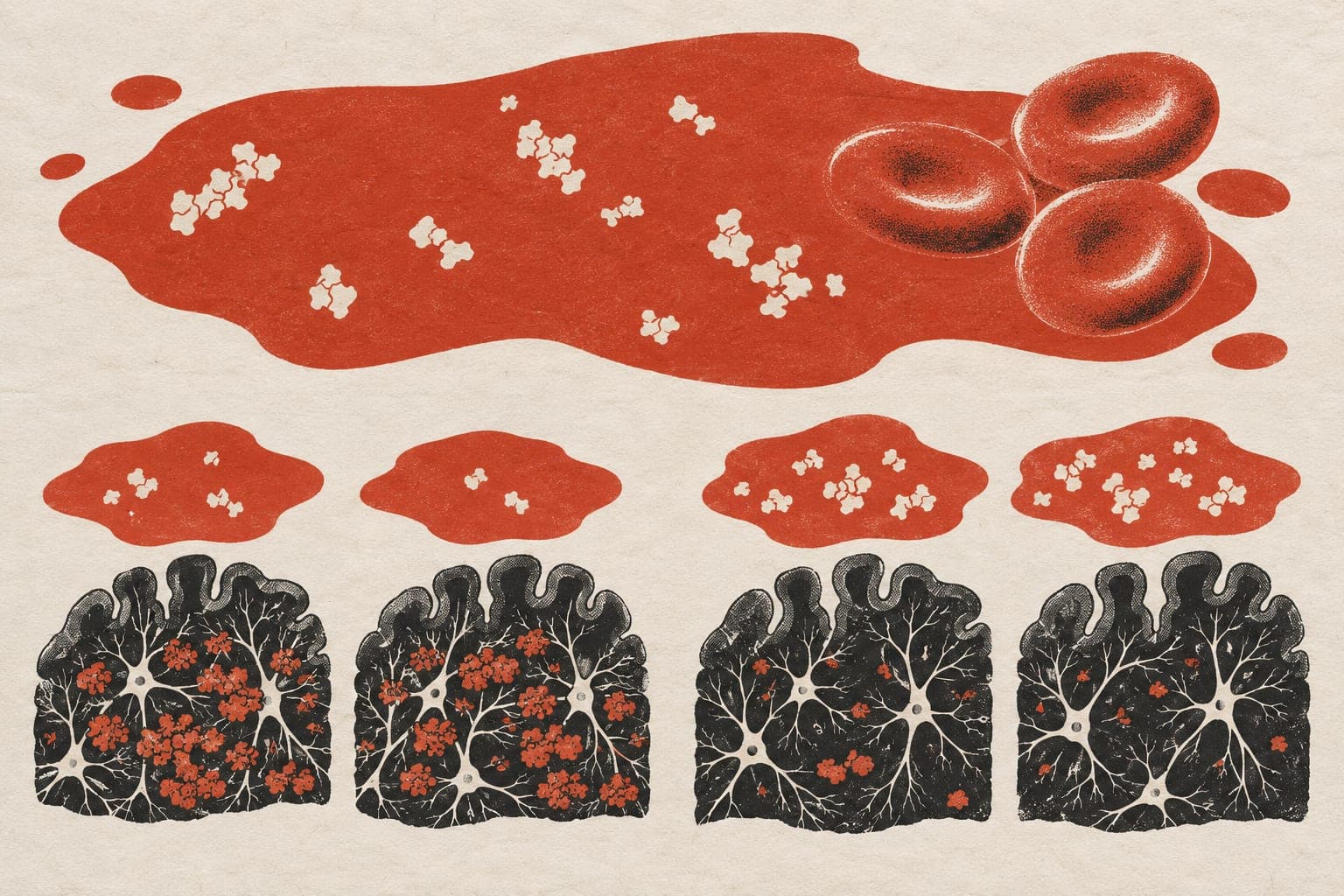
In an observational study, 58 people with Parkinson’s disease and 76 dementia-free adults aged 65 or older underwent brain scans, thinking tests and blood sampling. Researchers measured p-tau217, an Alzheimer’s-related form of tau protein, and the ratio of two forms of amyloid-beta protein, another Alzheimer’s marker.
In both groups, higher p-tau217 was associated with Alzheimer’s-like brain-scan patterns and poorer overall thinking. Among people with Parkinson’s, a lower amyloid-beta ratio was linked to reduced independence and difficulties understanding spatial relationships and social information. Among the older adults, a lower ratio was linked to greater brain shrinkage and poorer attention, spatial skills and memory. Overall, the Alzheimer’s-related markers showed stronger associations with brain structure and thinking than markers of nerve-cell damage and brain inflammation.
Why it matters
Alzheimer’s-related disease changes may contribute to cognitive decline in Parkinson’s disease. The authors suggest these blood markers may help characterize that decline.
Caveats
This exploratory observational analysis cannot establish cause and effect, and testing many associations without statistical correction increased the risk of chance findings. Parkinson’s participants with dementia had early-stage disease; the comparison group excluded dementia and significant coexisting illnesses.
The paper
University of Padua
Frontiers in Aging Neuroscience, Jun 10, 2026, Open access

Comments
Be the first to comment.