Chest X-ray model flags chronic obstructive pulmonary disease risk
Adding chest images to clinical scoring better distinguished future cases from non-cases, with scores of 0.73 versus 0.66 in ever-smokers and 0.70 versus 0.60 in never-smokers.
Our read
Biomarkers- Studied:
- Cohort study of 27,848 outpatients without diagnosed COPD or lung cancer, 6 years (Dose-response, independent replication, registered NCT03154346)
- What changed:
- COPD prediction improved by 0·08 on the AUC scale when chest X-ray analysis was added to the clinical risk score
- The catch:
- The model could flag existing undiagnosed COPD rather than future disease
Editor of record: Boris Djordjevic · AgingResearch.News
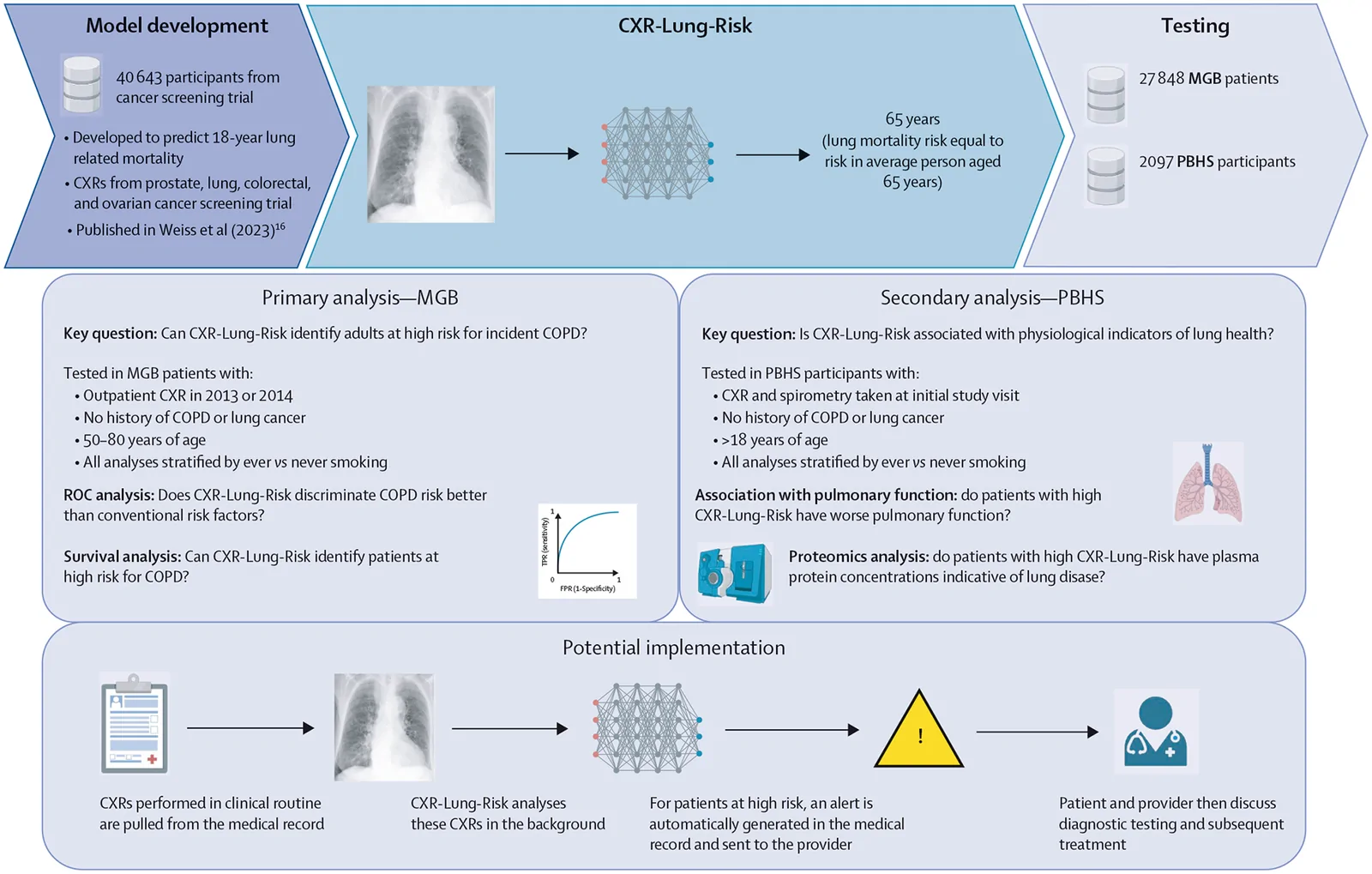
Among 27,848 outpatients aged 50–80, a chest X-ray model helped identify people at higher risk of chronic obstructive pulmonary disease (COPD), a disease that restricts airflow. The women and men had no known COPD, emphysema or lung cancer. This retrospective model validation study used routine X-rays taken at two Boston hospitals in 2013–14.
Researchers combined a deep-learning model with an existing clinical risk score. The model had originally been developed to predict deaths from lung disease. The combination better separated future COPD cases from non-cases. The comparison used the area under the receiver operating characteristic curve, a measure of this separation. Higher values mean better separation. Within six years, COPD developed in 12.4% of 12,550 ever-smokers and 3.8% of 15,298 never-smokers.
Why it matters
Earlier detection of chronic obstructive pulmonary disease is a challenge for care in midlife and older age. The authors suggest that high-risk patients might benefit from spirometry, a breathing test, and subsequent preventive care.
Caveats
The authors note that whether the model improves early detection needs testing in a prospective trial. The findings came from adults aged 50–80 at one Boston hospital system, most of whom were non-Hispanic White.
From the paper
- Participants
… we tested whether CXR-Lung-Risk was associated with pulmonary function and plasma protein abundance using data from 2097 individuals with a CXR image in PBHS (mean age 51·4 years [SD 17·0], 919 [43·8%] male, 1178 [56·2%] female; 1292 [61·6%] White; p 15).
- Result
… a graded association with incident COPD was observed across moderate (adjusted hazard ratio [aHR] 1·7 [95% CI 1·5–1·9]) and high (aHR 3·4 [2·9–3·9]) CXR-Lung-Risk categories compared with the low-risk category, after adjusting for risk factors and radiologist findings on the CXR report.
- Limitation
First, the primary analysis used patients having routine CXR at a single hospital system in Boston, and most were non-Hispanic White.
Quoted word for word from the full text on PubMed Central.
- Deep learning
- Chronic obstructive pulmonary disease
- Incident chronic obstructive pulmonary disease
- CXR-Lung-Risk
- LYZ
- Humans
The paper
Broad Institute; Brigham and Women's Hospital
The Lancet Digital Health, Sep 2025, Open access


Comments
Be the first to comment.