Blood fluid measure linked to worsening heart-kidney-metabolic disease
Hospitalized patients in the highest quarter of a blood fluid measure at admission had a 43% higher relative progression risk than those in the lowest quarter.
Registered ChiCTR2300077220
Limit: Worsening heart-kidney-metabolic disease could raise plasma volume, rather than result from it
Edited by Boris Djordjevic · AgingResearch.News
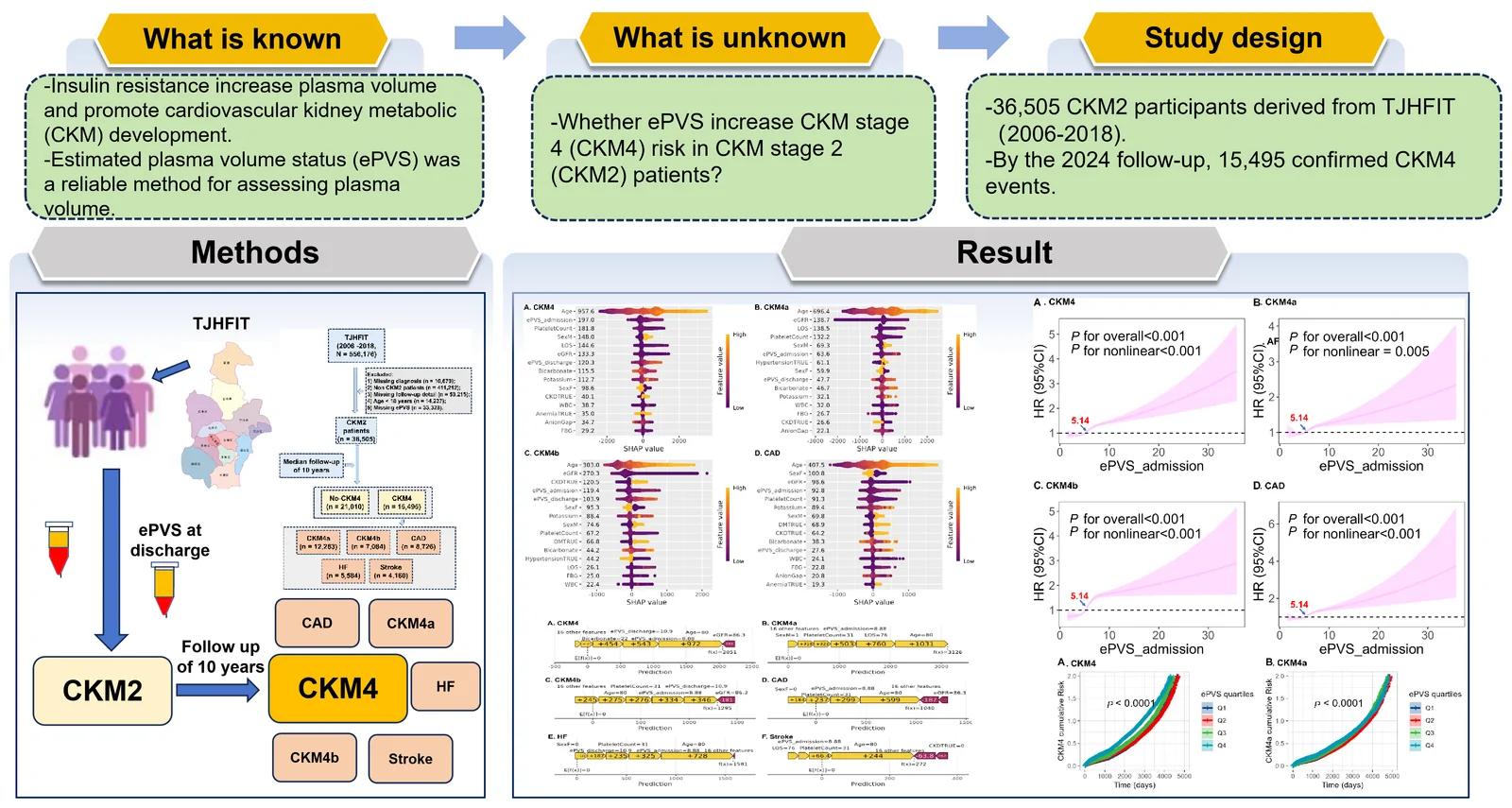
An observational cohort study followed 36,505 hospitalized patients in China's Tianjin region with stage 2 cardiovascular-kidney-metabolic syndrome for 10 years. This condition involves the heart, kidneys and how the body uses energy. Researchers assessed estimated plasma volume status, a measure of fluid levels in blood, at hospital admission and discharge.
During follow-up, 15,495 patients progressed to stage 4. The highest quarter of the admission measure was associated with a 43% higher relative risk of progression than the lowest quarter, after accounting for demographics, medical history, laboratory results and medications. Higher risk appeared in the upper two quarters at admission; the second quarter showed no statistically clear increase. The association was stronger in patients older than 60.
Why it matters
For older, high-risk people with this syndrome, the authors suggest the measure may offer a noninvasive way to assess the risk of progression.
Caveats
This observational study cannot establish that fluid levels caused progression. The findings concern hospitalized stage 2 patients in one region of China, and external validation is required before clinical use.
From the paper
- Participants
A total of 36,505 hospitalized CKM2 patients were included, covering 16,388 (45%) men with a median age of 61 years, and 15,495 ultimately developed CKM4 ( Table 1 ).
- Follow-up
The follow-up period ended when the patient developed CKM4 or by April 2024, and the median follow-up time was 10 years.
- Primary outcome
For the primary endpoint CKM4, admission ePVS demonstrated a threshold effect: compared to the Q1 reference, the Q2 stratum showed no statistical evidence of elevated risk (HR = 1.04, 95% CI: 0.99–1.09, P = 0.11), with significant excess risk restricted to the higher Q3 and Q4 strata ( P < 0.001).
Quoted word for word from the full text on frontiersin.org.
- Stage 2 cardiovascular-kidney-metabolic syndrome
- Cardiovascular-kidney-metabolic syndrome
- Heart failure
- Progression to stage 4 cardiovascular-kidney-metabolic syndrome
- Stage 4 cardiovascular-kidney-metabolic syndrome
- Humans
The paper
Tianjin University of Traditional Chinese Medicine
Frontiers in Endocrinology, Oct 15, 2026, Open access