Genetic and lifestyle links to colorectal cancer vary by age
Compared with low genetic risk, high risk was linked to hazard ratios—relative cancer rates—of 3.72 before age 55 and 2.01 at 75 or older.
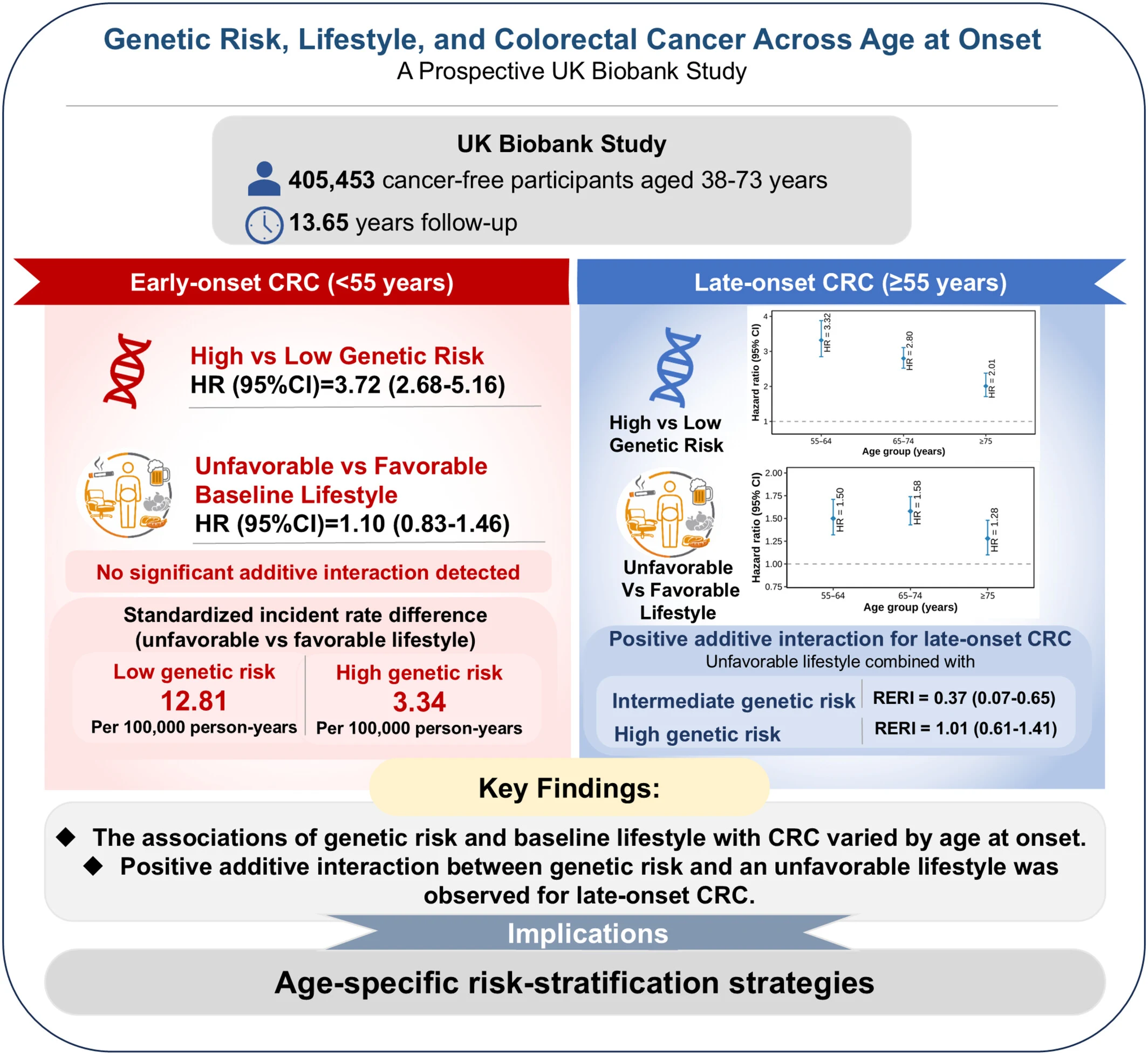
Limit: Lifestyle was measured only at baseline, missing changes during follow-up
Edited by Boris Djordjevic · AgingResearch.News
This prospective observational study followed 405,453 cancer-free UK Biobank participants aged 38–73 at entry. Researchers assessed genetic risk and a healthy lifestyle score based on eight modifiable factors. They identified 6,620 colorectal cancer cases during a median follow-up of 13.65 years.
The association with high genetic risk was stronger at younger ages. Compared with a favorable lifestyle, an unfavorable lifestyle was associated with hazard ratios of 1.10 before age 55, 1.50 at 55–64, 1.58 at 65–74 and 1.28 at 75 or older. For late-onset cancer, unfavorable lifestyle combined with intermediate or high genetic risk was associated with excess risk greater than the sum of their separate excess risks. The researchers detected no such interaction for early-onset cancer.
Why it matters
Colorectal cancer across adulthood raises a question about aging: whether inherited susceptibility and modifiable habits have the same relationship with disease at younger and older ages.
Caveats
This observational study cannot establish cause and effect. Participants were cancer-free and aged 38–73 at entry, limiting conclusions about people outside that population.
From the paper
- Participants
A total of 405,453 participants aged 38–73 years were included in the analysis.
- Follow-up
During a median follow-up of 13.65 years, 6620 CRC cases were identified.
- Result
For early-onset CRC, high meat intake was associated with a higher risk of early-onset CRC in the low genetic risk group (HR = 2.09, 95% CI: 1.13–3.86) (Table S9).
Results, 3.3 Joint Effect of Genetic Risk and Lifestyles on Early- and Late-Onset CRC
- Absolute difference
… the rate difference was 12.81 cases per 100,000 person-years in the low genetic risk group (32.88 vs. 20.07) and 3.34 cases per 100,000 person-years in the high genetic risk group (76.17 vs. 72.83) …
Results, 3.3 Joint Effect of Genetic Risk and Lifestyles on Early- and Late-Onset CRC
- Limitation
First, the cohort mainly consisted of white participants, which limits the generalizability of the findings to other ethnic groups.
Quoted word for word from the full text on onlinelibrary.wiley.com.
- Colorectal cancer
- Healthy lifestyle score
- Colorectal cancer incidence
- Late-onset colorectal cancer incidence
- Polygenic risk score
- Humans
The paper
Genetic Risk, Lifestyle, and Colorectal Cancer Across Age at Onset: A Prospective UK Biobank Study
Capital Medical University; University of Macau
Cancer Medicine, Oct 30, 2026
