Serine shortage promotes a nondividing state in spinal disc cells
Laboratory experiments found that reducing serine, a building block of proteins, also reduced production of the structural material surrounding spinal disc cells.
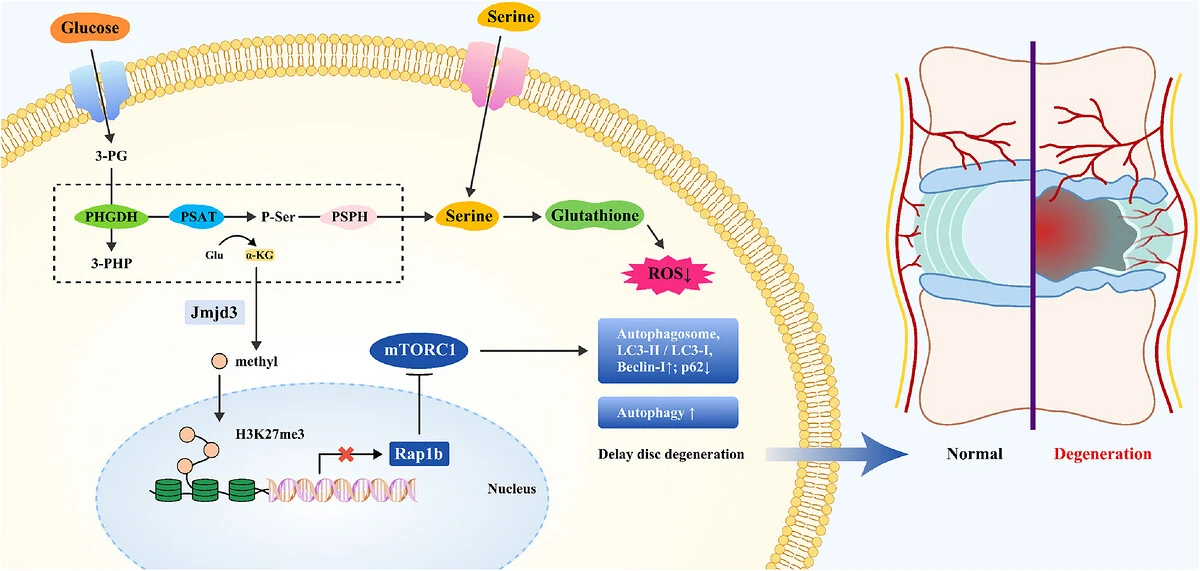
Limit: Serine concentrations used in culture may not reflect physiological levels
Edited by Boris Djordjevic · AgingResearch.News
In nucleus pulposus cells, which occupy the center of spinal discs, laboratory experiments tested the role of serine production. Senescent cells—cells that had stopped dividing—had less PHGDH, an enzyme needed to make serine. Analyses of human discs and aged rat tissues also found reduced PHGDH.
Reducing PHGDH or depriving cells of serine slowed cell division, induced senescence and reduced production of the material surrounding cells. Serine starvation also promoted programmed cell death. In animal experiments, increasing PHGDH production eased disc degeneration caused by puncture injuries. A serine-deficient diet worsened degeneration.
Why it matters
Disc degeneration is a major cause of low back pain. The authors propose that restoring PHGDH or serine availability may offer a strategy against age-related disc degeneration.
Caveats
The cell and animal experiments do not establish a benefit in people. The abstract does not identify the species used for the intervention experiments or report sample sizes.
From the paper
- Limitation
First, the human sample cohort was relatively small (n = 8 per group), which may limit statistical power and generalizability; validation in larger, age-matched cohorts is warranted.
Quoted word for word from the full text on advanced.onlinelibrary.wiley.com.


