Famine’s links to later-life disease varied by age and sex
Compared with no reported exposure, famine exposure was linked to 20%–29% higher odds of five chronic conditions and 10% higher odds of two others.
Limit: Adult-exposed participants and men were unusually robust survivors, potentially distorting age and sex differences
Edited by Boris Djordjevic · AgingResearch.News
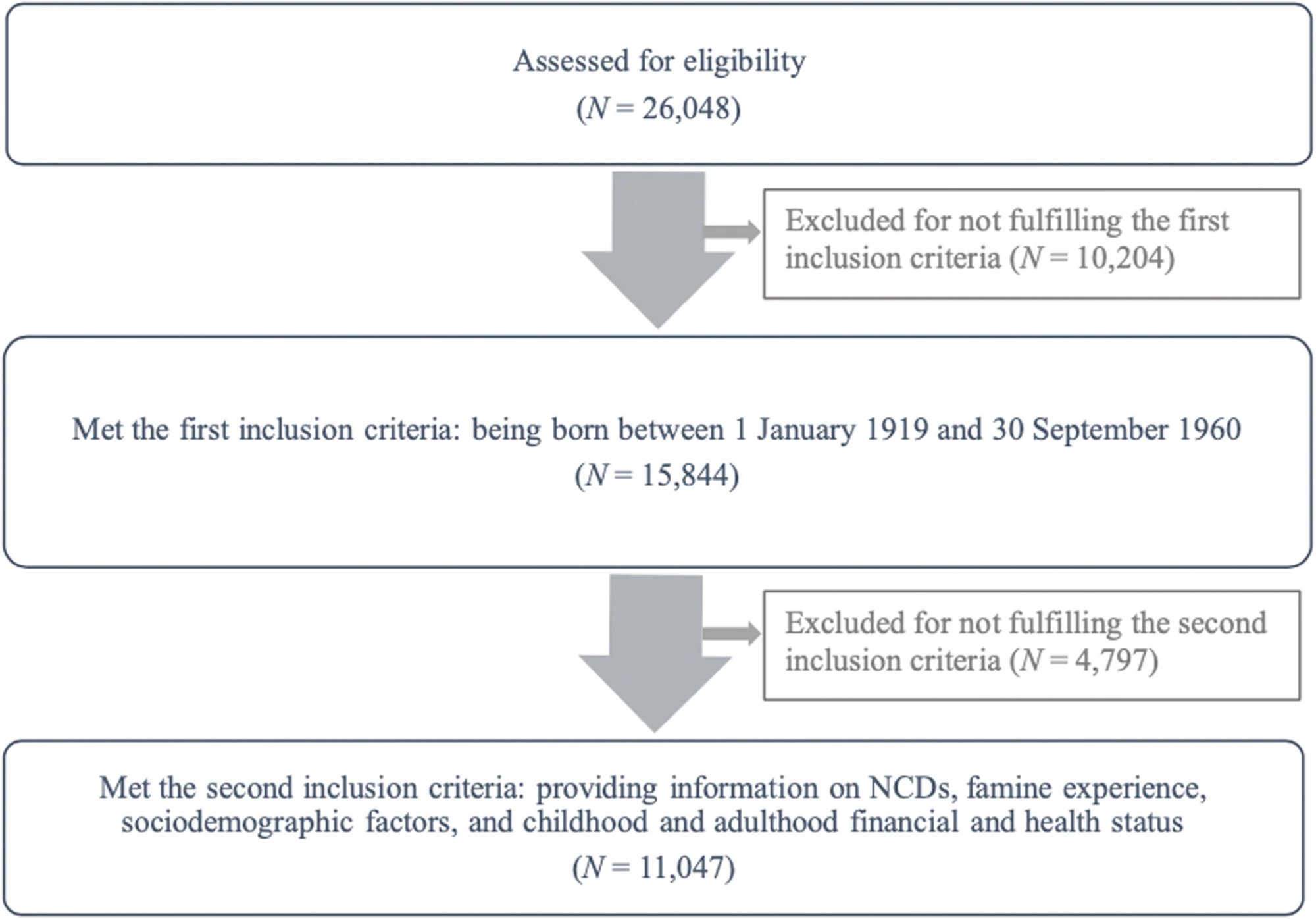
In an observational study of 11,047 adults aged 45 and older in China, researchers analyzed nationally representative survey data from 2011–2020. They assessed self-reported exposure to the 1959–1961 Chinese Famine and examined 14 chronic conditions.
Famine exposure was associated with 20%–29% higher odds of digestive disease, memory-related disease, arthritis, kidney disease and dyslipidemia, or abnormal blood fat levels. Heart disease and diabetes showed 10% higher odds. Exposure before birth or at ages 0–2 had the strongest links for eight conditions. Exposure at ages 3–5 had the strongest links for psychiatric and memory-related disease. Exposure in adulthood was associated with lower odds of various conditions. For abnormal blood fat levels, heart disease and stroke, associations were stronger in women than men.
Why it matters
Severe malnutrition raises questions about how early development relates to health decades later. The authors interpret the patterns as a balance between developmental harm and healthier people being more likely to survive famine.
Caveats
The observational design cannot establish cause and effect, and famine exposure was self-reported. The findings may not generalize beyond Chinese adults aged 45 and older.
From the paper
- Result
… and dyslipidemia (adjusted ORs ranged from 1.20, 95% CI [1.10, 1.30] to 1.29, 95% CI [1.21, 1.37]), and a 10% higher odds of heart disease and diabetes (adjusted ORs of 1.10, 95% CI [1.02, 1.18] and 1.10, 95% CI [1.01, 1.19]), respectively.
Results, 3.1 Disease-Specific Associations Between Famine Exposure and Later-Life NCDs
- Limitation
First, the assessment of NCDs relied on self-reported diagnoses rather than direct linkage to medical records (which is unavailable), which might be subject to recall bias and underreporting due to healthcare access disparities.
Quoted word for word from the full text on onlinelibrary.wiley.com.
The paper
East China University of Science and Technology; University of Lausanne
Maternal & Child Nutrition, Oct 2026