Overlapping chronic diseases linked to lower survival in Hungary
Eleven-year survival was 21.0% with type 2 diabetes, cardiovascular disease and chronic kidney disease, versus 54.2% with type 2 diabetes alone.
Edited by Boris Djordjevic · AgingResearch.News
An observational cohort study tracked 1,059,087 adults in Hungary aged 20 or older with recorded type 2 diabetes, heart and blood vessel disease or chronic kidney disease. Researchers used national health insurance records to identify diagnoses in 2011–2012 and followed survival from 2013 through 2023. The group’s mean age was 67.2 years; 54.6% were women.
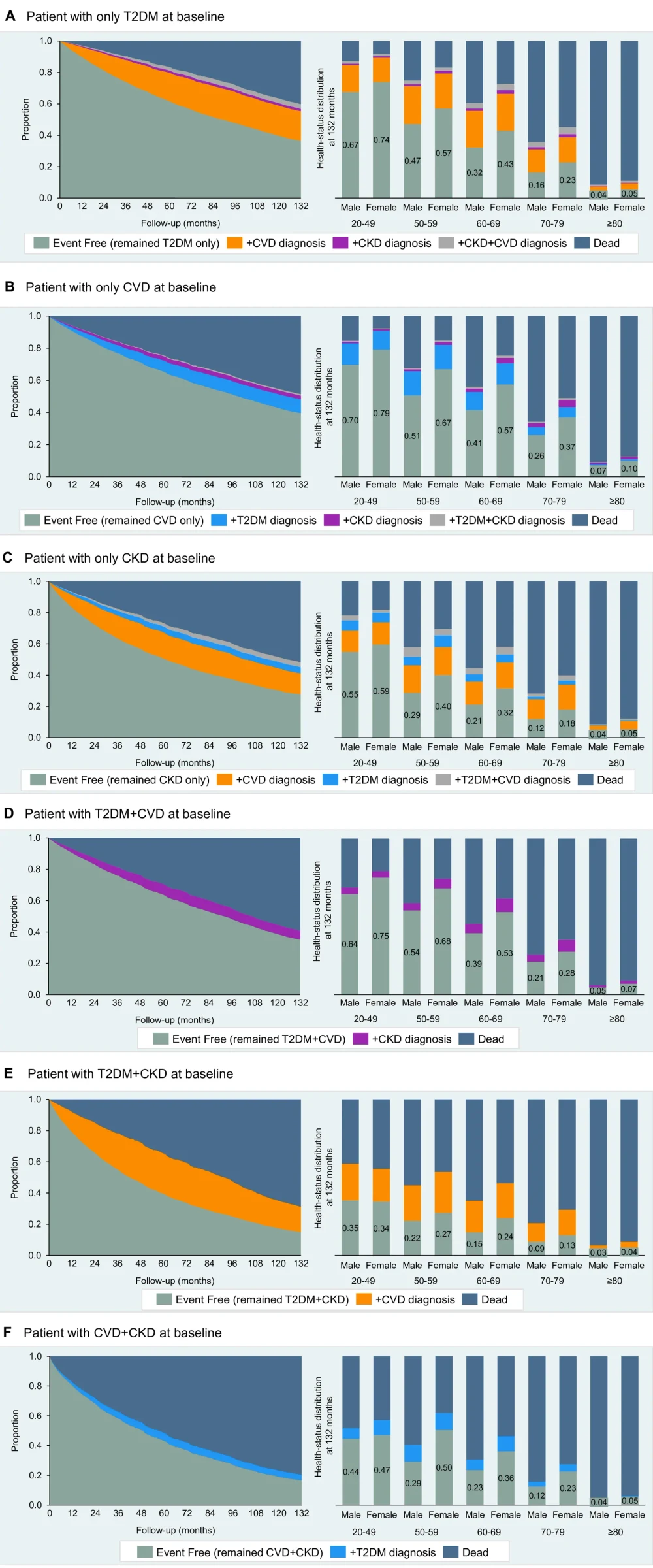
At the start, 20% had more than one of these conditions. After researchers adjusted survival figures for age and sex, 11-year survival was 54.2% with diabetes alone, 53.8% with heart and blood vessel disease alone and 44.3% with kidney disease alone. It was 21.0% among those with all three. Older age and male sex were also linked to higher death risk.
Why it matters
The study addresses how overlapping chronic diseases relate to survival in later life. The authors said the findings supported considering these conditions within a shared framework.
Caveats
This observational study could not establish cause and effect, and later diagnoses did not change the survival-analysis groups. The findings concern adults in Hungary with recorded diagnoses, not people under 20 or those without such records.
From the paper
- Participants
On 1 January 2013, a total of 1 059 087 patients aged ≥20 years had a diagnosis of CKD, T2DM or CVD in the NHIF database (mean age: 67.2 years; 54.6% female), corresponding to a point prevalence of 13.4% in the Hungarian population aged ≥20 years (as per CSO data).
- Follow-up
Survival analyses included 1 059 087 individuals who contributed 104 708 835 person-months at risk over the 132-month follow-up period (1 January 2013 to 31 December 2023), during which 511 208 deaths occurred.
- Result
… mortality risk was slightly higher for CVD only (HR 1.05, 95% CI 1.05 to 1.06) and progressively higher for CKD only (HR 1.35, 95% CI 1.32 to 1.38), T2DM+CVD (HR 1.41, 95% CI 1.40 to 1.42), T2DM+CKD (HR 1.68, 95% CI 1.63 to 1.72) and CVD+CKD (HR 1.84, 95% CI 1.81 to 1.87) …
- Limitation
First, this was an observational analysis of administrative claims data, and the markedly lower survival observed among patients with multiple coexisting conditions should not be interpreted as evidence that multimorbidity itself caused the excess mortality.
Quoted word for word from the full text on PubMed Central.
The paper
Semmelweis University; Novo Nordisk Hungaria Kft
BMJ Open, Oct 27, 2026, Open access


Comments
Be the first to comment.