Rates of some self-targeting antibodies level off in centenarians
Antibodies that block virus-fighting proteins occurred in 5.4% of 938 centenarians, compared with more than 6% of people over 80 in the general population.
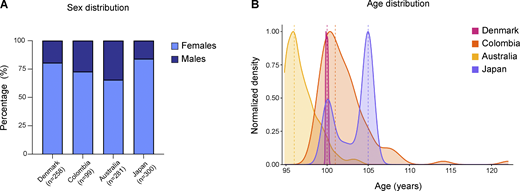
Multicenter
Limit: Antibody carriers may die before reaching centenarian age, creating an apparent plateau among survivors
Edited by Boris Djordjevic · AgingResearch.News
An observational study of 938 centenarians in Denmark, Colombia, Australia and Japan examined the prevalence of self-targeting antibodies. These antibodies neutralize type I interferons, proteins involved in the body’s defense against viruses. The cohorts included 258 people in Denmark, 99 in Colombia, 281 in Australia and 300 in Japan.
Researchers found these antibodies in 51 participants, or 5.4%. Their prevalence ranged from 3.3% in Japan to 9.1% in Colombia. The share leveled off compared with people aged 80 and older in the general population. The researchers concluded that these antibodies were not incompatible with exceptional longevity, despite the risk of life-threatening viral infections they confer.
Why it matters
Age-related increases in these antibodies raise questions about their role in survival into extreme old age. The authors suggested they may not favor exceptional longevity and may be linked to higher mortality.
Caveats
This observational comparison of antibody prevalence cannot establish an effect on mortality. The results concern centenarians from four countries.
From the paper
- Participants
Among 258 Danish centenarians, a total of 18 individuals (7.0%) harbored neutralizing auto-Abs against at least one IFN-I subtype (Fig. 2, A and B).
Results, Prevalence of neutralizing IFN-I auto-Abs in centenarians
- Result
The overall odds ratio (OR) for centenarian males versus centenarian females was 1.29 (95% confidence interval [CI], 0.63–2.50; P = 0.49), indicating no significant association between sex and the presence of neutralizing IFN-I auto-Abs.
Results, Prevalence of neutralizing IFN-I auto-Abs in centenarians stratified by sex
Quoted word for word from the full text on rupress.org.
The paper
Aarhus University
Journal of Human Immunity, Oct 27, 2026, Open access


