Tirzepatide linked to fewer chronic lung disease flare-ups
Compared with two diabetes drug classes, tirzepatide had flare-up hazard ratios, measures of relative risk over time, of 0.73 and 0.72.
6,727 participants
Limit: Missing COPD severity measurements leave likely confounding by how sick patients were
Edited by Boris Djordjevic · AgingResearch.News
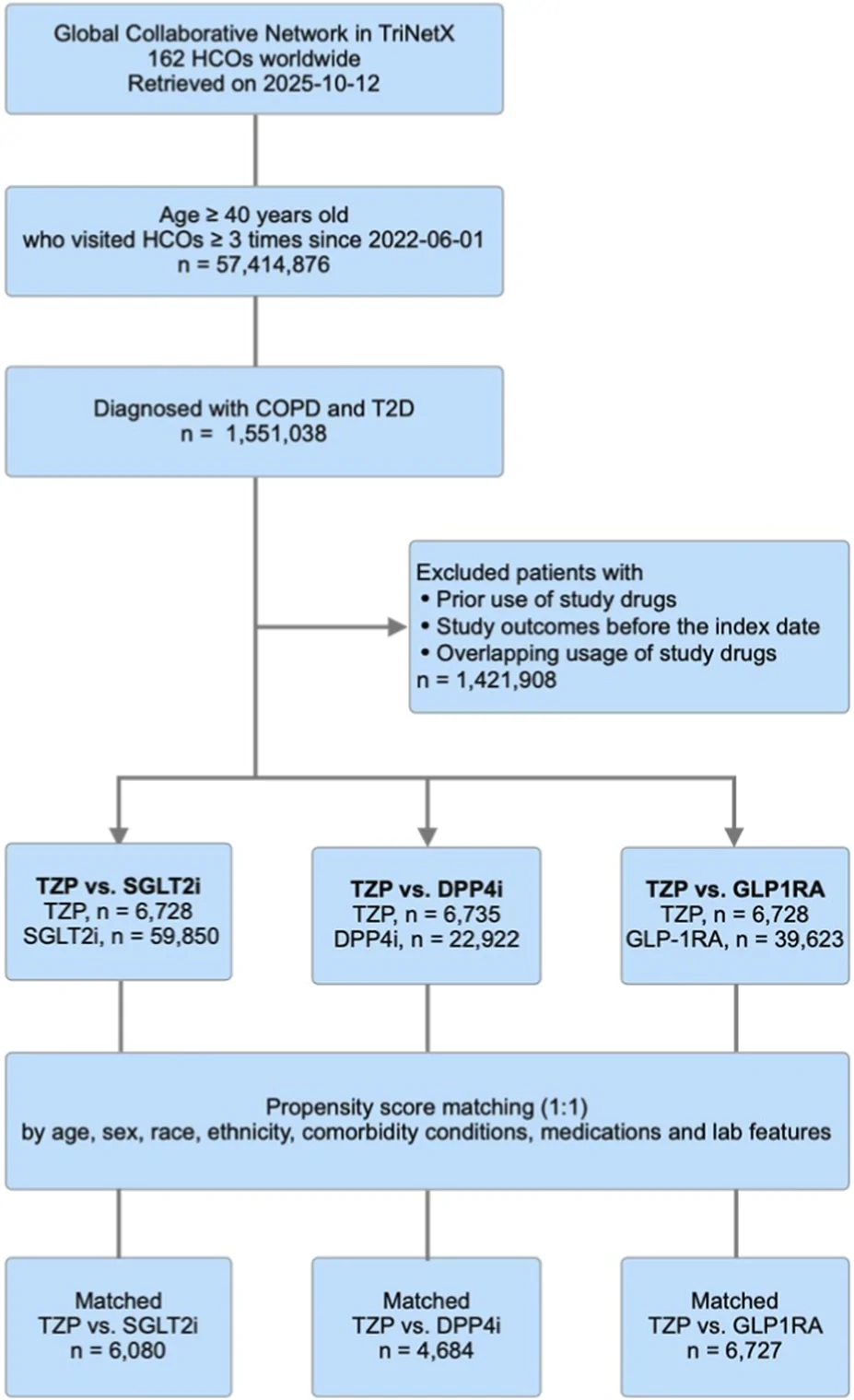
In adults with chronic obstructive pulmonary disease (COPD) and type 2 diabetes, researchers conducted a retrospective observational cohort study using the TriNetX global research network. They separately matched tirzepatide users with users of three other diabetes drug classes.
The comparisons included 6,080 patients per group for sodium-glucose cotransporter-2 inhibitors, 4,684 per group for dipeptidyl peptidase-4 inhibitors and 6,727 per group for other glucagon-like peptide-1 receptor agonists. Flare-up hazard ratios were 0.73 and 0.72 in the first two comparisons. Flare-up outcomes were similar in the third. Tirzepatide use was also linked to lower risks of acute respiratory failure and lower respiratory tract infection than the first two drug classes, and lower mortality than all three. Researchers assessed outcomes from day one through day 365 after the starting date for follow-up.
Why it matters
COPD and type 2 diabetes share inflammatory and metabolic pathways. That overlap raises the question of whether diabetes drug choice might also matter for lung health.
Caveats
Observational data cannot establish cause and effect, and median follow-up was shorter with tirzepatide: 232, 235 and 233 days in the respective comparisons, versus 365 days in each comparison group. The findings concern adults with both conditions and warrant confirmation in randomized trials.
From the paper
- Participants
Data were obtained from the TriNetX global Collaborative Network, which included 195,140,211 individuals as of 12 October 2025.
- Result
Compared with the SGLT2i group, TZP use was associated with a significantly lower risk of COPD exacerbation (114.6 vs. 147.0 events per 1000 person-years; HR, 0.73; 95% CI, 0.64–0.82; P < 0.0001; E-value 2.10 [95% LCL, 1.74]; Table 2 ).
- Limitation
First, as a retrospective observational analysis using real-world data, the potential for residual confounding cannot be fully excluded despite rigorous propensity score matching.
Quoted word for word from the full text on frontiersin.org.
The paper
Chi Mei Medical Center; National Sun Yat-sen University
Frontiers in Pharmacology, Oct 9, 2026, Open access