Liver scarring score linked to heart failure and rhythm disorders
Higher scores were linked to heart rhythm disorders and heart failure, with hazard ratios (relative rates over time) of 1.32 and 1.29, respectively.
Limit: Age and platelet count could explain part of the score’s link to cardiovascular risk
Edited by Boris Djordjevic · AgingResearch.News
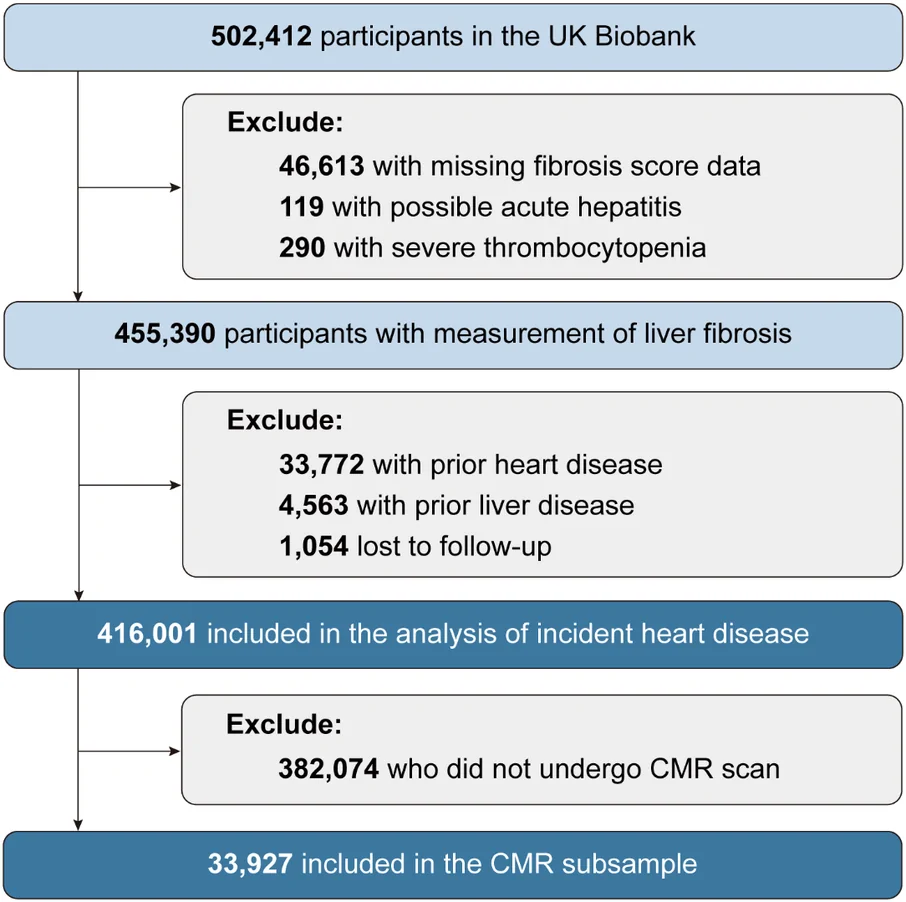
A prospective observational study followed 416,001 UK Biobank participants without known heart or liver disease at enrollment. Their mean age was 56.15 years, and 55.78% were women. Researchers used the Fibrosis-4 Index, a score based on age and blood tests used to assess advanced liver scarring.
Over a median 14.61 years, 57,207 participants (13.75%) developed heart disease. Higher scores were associated with heart rhythm disorders and heart failure. Among 33,927 participants who underwent heart scans a median 10.20 years after enrollment, higher scores were associated with larger heart chambers and a lower proportion of blood pumped out by the upper chambers. The researchers concluded that the score may help identify people at higher cardiovascular risk.
Why it matters
Heart failure is an age-related disease. The study addressed whether a score used to assess liver scarring may also help identify cardiovascular risk.
Caveats
The observational design and single heart scan could not establish causation or the order of changes. The score assessed liver scarring indirectly, and the study excluded people with known heart or liver disease at enrollment.
From the paper
- Participants
Among all 416,001 participants included in this study, 232,048 (55.78%) were women, and the mean (SD) age was 56.15 (8.09) years.
- Follow-up
Over a median follow-up of 14.61 years (interquartile range: 13.71–15.36 years), 57,207 participants (13.75%) developed heart disease.
- Primary outcome
However, unlike the primary analysis, continuous FIB-4 score was not significantly associated with concentric remodeling but rather was linked to a higher risk of eccentric hypertrophy (HR = 1.59, 95% CI 1.36–1.86) ( Table 3 and Supplementary Table S2 ).
- Limitation
Because age and platelet count are components of FIB-4 and are independently related to cardiovascular risk, mathematical coupling and residual age- or platelet-related confounding cannot be fully excluded.
Quoted word for word from the full text on frontiersin.org.
The paper
Tianjin University of Traditional Chinese Medicine; Karolinska Institutet
Frontiers in Cardiovascular Medicine, Oct 7, 2026, Open access