Plant-based diet quality linked to frailty in older adults
Higher overall plant-based diet scores, compared with lower scores, were linked to lower frailty odds, with odds ratios of 0.71 to 0.80.
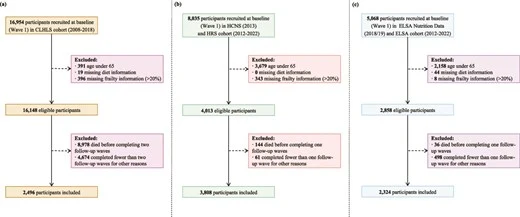
10,821 participants
Limit: Cohort-specific food-group data may measure diet quality differently across cohorts
Edited by Boris Djordjevic · AgingResearch.News
An observational study examined diet and frailty over time in 8,628 older adults from three aging cohorts. Researchers used food-group data to score overall, healthful and unhealthful plant-based dietary patterns. They assessed frailty by counting health deficits across several areas.
Higher overall plant-based diet scores were associated with lower frailty odds in all three cohorts. An odds ratio below one indicates lower odds. For unhealthful plant-based diet scores, odds ratios ranged from 1.24 to 1.41, indicating higher frailty odds. Healthful plant-based diet scores were associated with lower frailty only in the English Longitudinal Study of Ageing, with no association in the other two cohorts. In the Chinese Longitudinal Healthy Longevity Survey, differences between people's diets showed stronger associations than changes in a person's diet over time.
Why it matters
Frailty involves accumulating health deficits in later life. Distinguishing diet quality from overall plant-based eating may help clarify diet's relationship with healthy aging.
Caveats
The observational design cannot establish cause and effect. The findings concern older adults and do not establish whether these associations hold in younger people.
- Plant-based diet
- Healthful plant-based diet
- Unhealthful plant-based diet
- Nuts
- Multidomain deficit-accumulation frailty index
- Humans
The paper
Nanjing University of Finance and Economics
Age and Ageing, Aug 3, 2026