Denosumab linked to greater grip strength gains in women
At 12 months, grip strength rose 1.45 kg with denosumab versus 0.66 kg with zoledronic acid in postmenopausal women with osteoporosis.
3 years
Limit: Unmeasured comorbidities could partly explain the grip-strength difference
Edited by Boris Djordjevic · AgingResearch.News
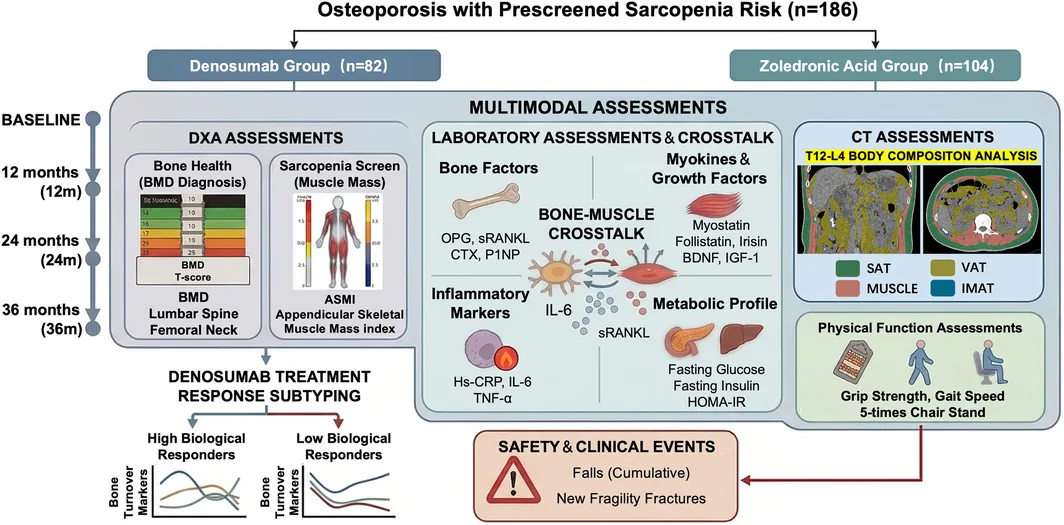
Researchers followed 186 postmenopausal women with osteoporosis and prescreened risk of sarcopenia, a condition involving low muscle strength and mass, in a prospective observational study. Of these, 82 received denosumab and 104 received zoledronic acid. Researchers assessed grip strength, walking speed, chair-stand performance, and muscle and bone scans over three years.
Denosumab use was associated with greater gains in grip strength and walking speed and larger reductions in the time needed to stand from a chair five times. At 36 months, grip strength had increased by 2.52 kg with denosumab versus 0.99 kg with zoledronic acid. The share meeting the study’s sarcopenia definition was 20.0% versus 46.0%, respectively.
Why it matters
Osteoporosis and sarcopenia often coexist in older adults. The findings support further testing of denosumab for people with both conditions.
Caveats
Treatment was not randomized, so the study cannot establish that denosumab caused the differences. It covered only postmenopausal women with osteoporosis and prescreened sarcopenia risk; the abstract provided no harms data.
From the paper
- Participants
The final cohort included 186 postmenopausal women, with 82 assigned to denosumab and 104 to zoledronic acid.
- Result
… the 12-month increase in the OPG/sRANKL ratio showed a pattern consistent with partial mediation of the association between treatment and subsequent improvement in grip strength, with an indirect effect of 0.566 (95% CI, 0.39–0.74), accounting for 37.0% of the total treatment effect.
- Events by group
A history of bisphosphonate intolerance or inadequate response was more frequent in the denosumab group than in the zoledronic acid group (26.8% vs. 14.4%, p = 0.042), and administration preference differed between groups (p = 0.001) …
- Limitation
The mediation analyses were exploratory and should be interpreted as hypothesis-generating rather than causal evidence for a biomarker-response pathway.
Quoted word for word from the full text on onlinelibrary.wiley.com.
The paper
Fudan University
Journal of Cachexia, Sarcopenia and Muscle, Oct 2026, Open access