Type 2 diabetes risk gaps by education widened across generations
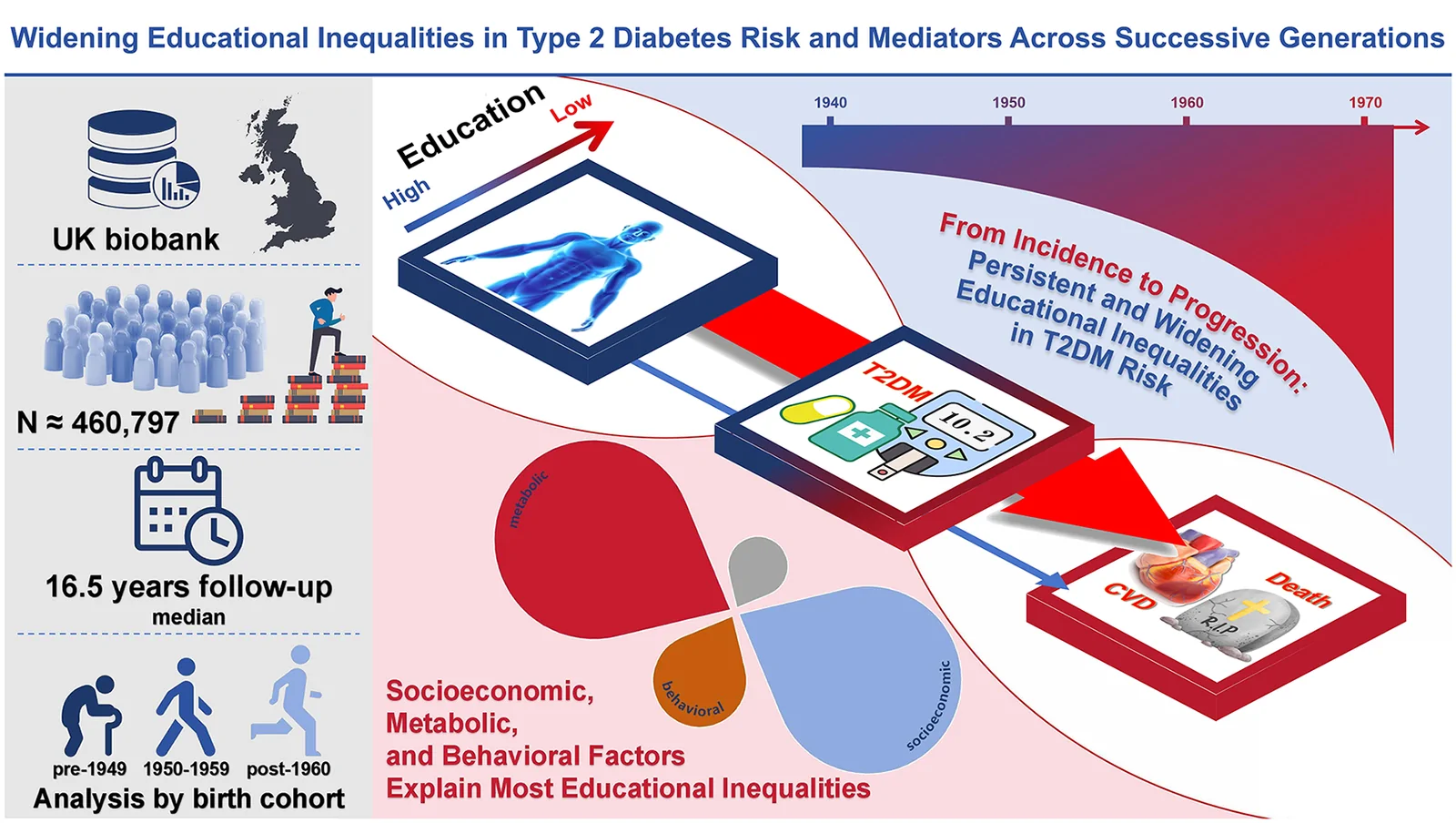
Primary schooling or less was linked to 1.92 times the type 2 diabetes rate seen with college education over a median 16.5 years.
Limit: Earlier birth cohorts included healthier survivors, potentially exaggerating the widening of educational inequalities
Edited by Boris Djordjevic · AgingResearch.News
The prospective observational study followed 460,797 UK Biobank participants who had no diabetes at enrollment. Over a median 16.5 years, 19,931 developed type 2 diabetes. Researchers compared educational inequalities across three birth cohorts: pre-1949, 1950–1959 and post-1960.
Primary schooling or less was associated with higher risks of developing diabetes, progressing to cardiovascular disease and dying than college education. Cardiovascular disease affects the heart and blood vessels. These educational gaps widened across successive birth cohorts. Statistical analyses estimated that social and economic circumstances, behaviors and metabolic factors—factors related to the body's chemical processes—accounted for substantial shares of the education-related gap in diabetes risk.
Why it matters
Following diabetes through cardiovascular disease and death addresses how education-related health inequalities may extend across a disease course relevant to healthy aging.
Caveats
This observational study could not establish that education or the proposed explanatory factors caused the differences. Participants were free of diabetes at enrollment, so the study did not examine people who already had diabetes when they joined.
From the paper
- Participants
The final analytical cohort included 460,797 participants free of diabetes at baseline, with a mean age of 56.34 (SD, 8.10) years; 205,485 (44.6%) were male.
- Follow-up
During a median follow-up of 16.5 years, we documented 19,931 incident T2DM cases after excluding participants with diabetes at baseline.
- Result
The association persisted before and after adjustment for confounders (HR and 95% CI: 2.32 [2.24–2.40] and 1.92 [1.85–1.99], after adjusting for age, sex, ethnicity, and T2DM PRS …
- Absolute difference
… the 10-year risk was 2.20% among participants with college education and 4.78% among those with primary school education or less in the overall population, corresponding to a standardized risk difference of 2.57 percentage points and 11,862 excess T2DM events.
- Limitation
First, data on educational attainment and lifestyle factors were derived from self-reported questionnaires, which may have introduced recall bias and measurement error.
Quoted word for word from the full text on frontiersin.org.
The paper
Capital Medical University
Frontiers in Public Health, Oct 6, 2026, Open access