Mismatched Alzheimer's tests linked to distinct risk patterns
An observational analysis of 594 and 475 cognitively normal adults found different blood-protein patterns depending on which Alzheimer's test was positive.
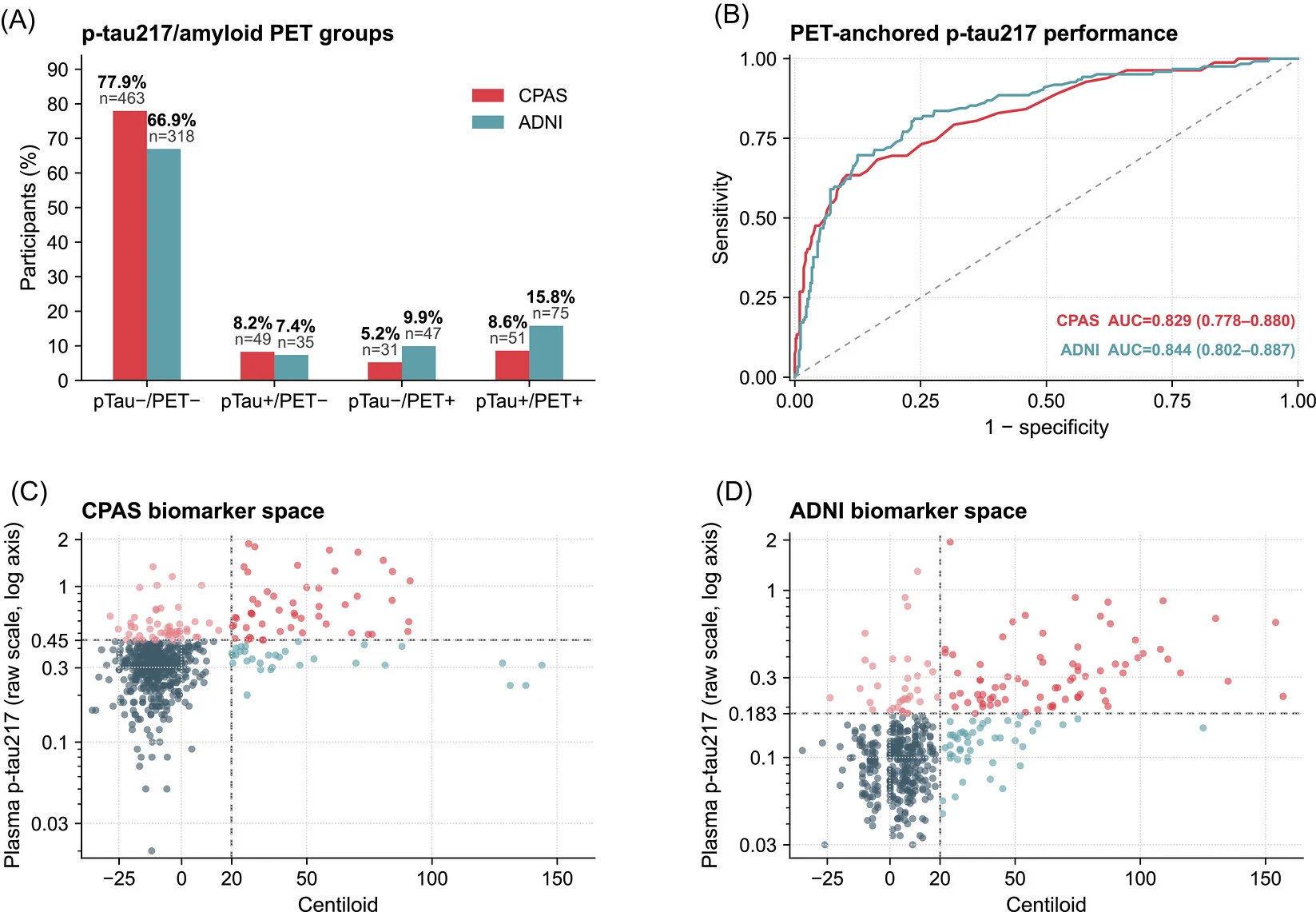
594 participants
Limit: Unmeasured inflammation and mixed pathology could contribute to the blood-positive, PET-negative biomarker pattern
Edited by Boris Djordjevic · AgingResearch.News
An observational study analyzed 594 cognitively normal adults from the Chinese Preclinical Alzheimer's Disease Study and 475 from the Alzheimer's Disease Neuroimaging Initiative. Researchers compared blood p-tau217, a modified form of the protein tau, with brain scans for amyloid, a protein that forms plaques.
The mismatched groups had different blood-protein patterns. People positive on both tests had the broadest range of abnormal biological measurements. In the second cohort, both blood-positive groups had higher risk of clinical worsening and faster decline in selected thinking skills. Both scan-positive groups accumulated amyloid faster. Faster amyloid buildup in the blood-positive, scan-negative group appeared only with less stringent blood-test cutoffs.
Why it matters
For adults without cognitive impairment, distinguishing these patterns may help assess Alzheimer's risk, guide monitoring and prioritize confirmatory amyloid testing.
Caveats
This observational study identified associations, not causes, and follow-up analyses came only from the 475-person cohort. Using these patterns to guide clinical decisions requires validation.
From the paper
- Participants
The CPAS cohort included 594 cognitively normal participants, and the ADNI cohort included 475 participants.
- Follow-up
Among 332 cognitively normal participants with diagnostic follow-up, 48 progressed to MCI or dementia over a mean follow-up of 3.06 years (standard deviation [SD], 2.79; median, 2.49 years; IQR, 0.40–6.06).
- Result
In Cox models adjusted for age, sex, education, and APOE ε4 carrier status, the p-tau+/PET− group was associated with higher clinical progression risk than p-tau−/PET− (hazard ratio [HR] = 4.44; 95% CI, 1.94–10.17; P < 0.001), as was p-tau+/PET+ (HR = 4.19; 95% CI, 1.99–8.80; P < 0.001).
Quoted word for word from the full text on alz-journals.onlinelibrary.wiley.com.
The paper
Shenzhen Qianhai Taikang Hospital
Alzheimer's & Dementia, Oct 2026