Blood test model may reduce Alzheimer’s brain-scan use
Among 630 participants with uncertain blood results, predicted brain-scan referrals fell from 35.9% with one marker to 24.3% with the two-stage model.
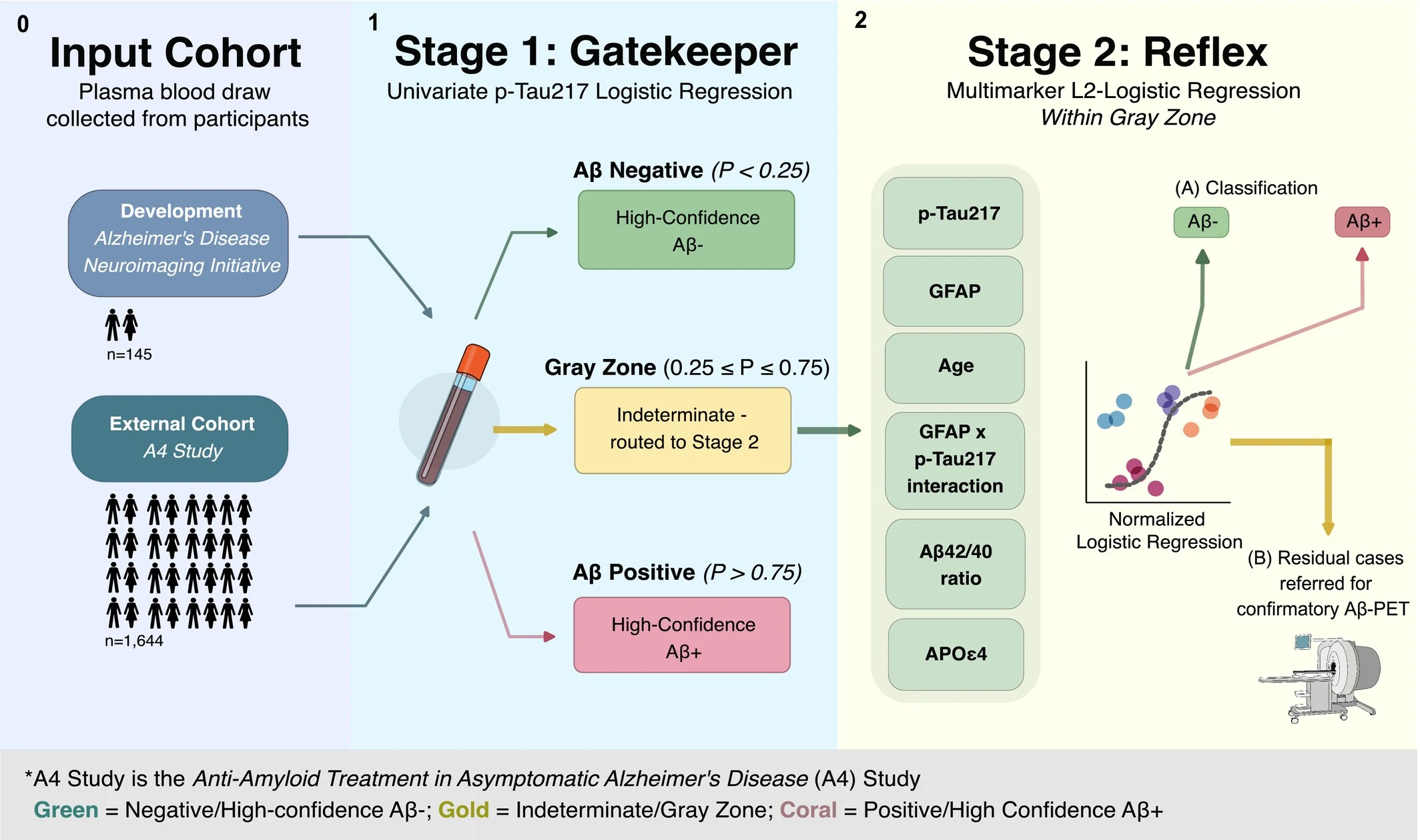
1,644 participants, independent replication
Limit: Renal function, which affects blood biomarker concentrations, was not accounted for
Edited by Boris Djordjevic · AgingResearch.News
Researchers developed a two-stage prediction model in an observational study of 145 participants with cognitive impairment, or problems with memory or thinking. They tested it in 1,644 participants without cognitive impairment. The first stage used blood levels of p-Tau217, a form of the tau protein. For uncertain results, the second combined several blood markers with genetic and demographic information. Researchers checked predictions against positron emission tomography (PET), brain scans used here to detect amyloid protein deposits.
Among the 630 participants with uncertain initial results in the second group, the model increased correct classification without PET from 41.4% to 56.2%. Modeled testing costs were 44%–52% lower than p-Tau217 screening followed by PET confirmation of uncertain results.
Why it matters
For Alzheimer’s disease, an age-related condition, the authors suggested the model may support memory-clinic assessment and selection of participants for prevention trials.
Caveats
This observational model-validation study estimated scan use and costs rather than testing whether the approach changed clinical care. The larger external validation group consisted of people without cognitive impairment.
From the paper
- Result
We found that discrimination inside the band rests mainly on three predictors: APOE ε4 carrier status (odds ratio per SD 3.14; 95% CI, 1.53–6.44; p = 0.002), p-Tau217 (2.34; 1.20–4.56; p = 0.013) and Aβ42/40 (0.32; 0.13–0.77; p = 0.011).
- Limitation
First, both cohorts are predominantly white (89% of ADNI and 94% of A4) and highly educated, so GRAD's performance in racially and ethnically diverse populations is unknown and may differ [53, 54].
Quoted word for word from the full text on onlinelibrary.wiley.com.
The paper
A Two-Stage Plasma Biomarker Algorithm Reduces Amyloid PET Use and the p-Tau217 Gray Zone
University of Connecticut
Annals of Clinical and Translational Neurology, Oct 19, 2026


