Fewer serious medical events with semaglutide in kidney trial
In the lowest kidney-function subgroup, serious medical events were reported in 56.4% receiving semaglutide versus 60.4% receiving placebo.
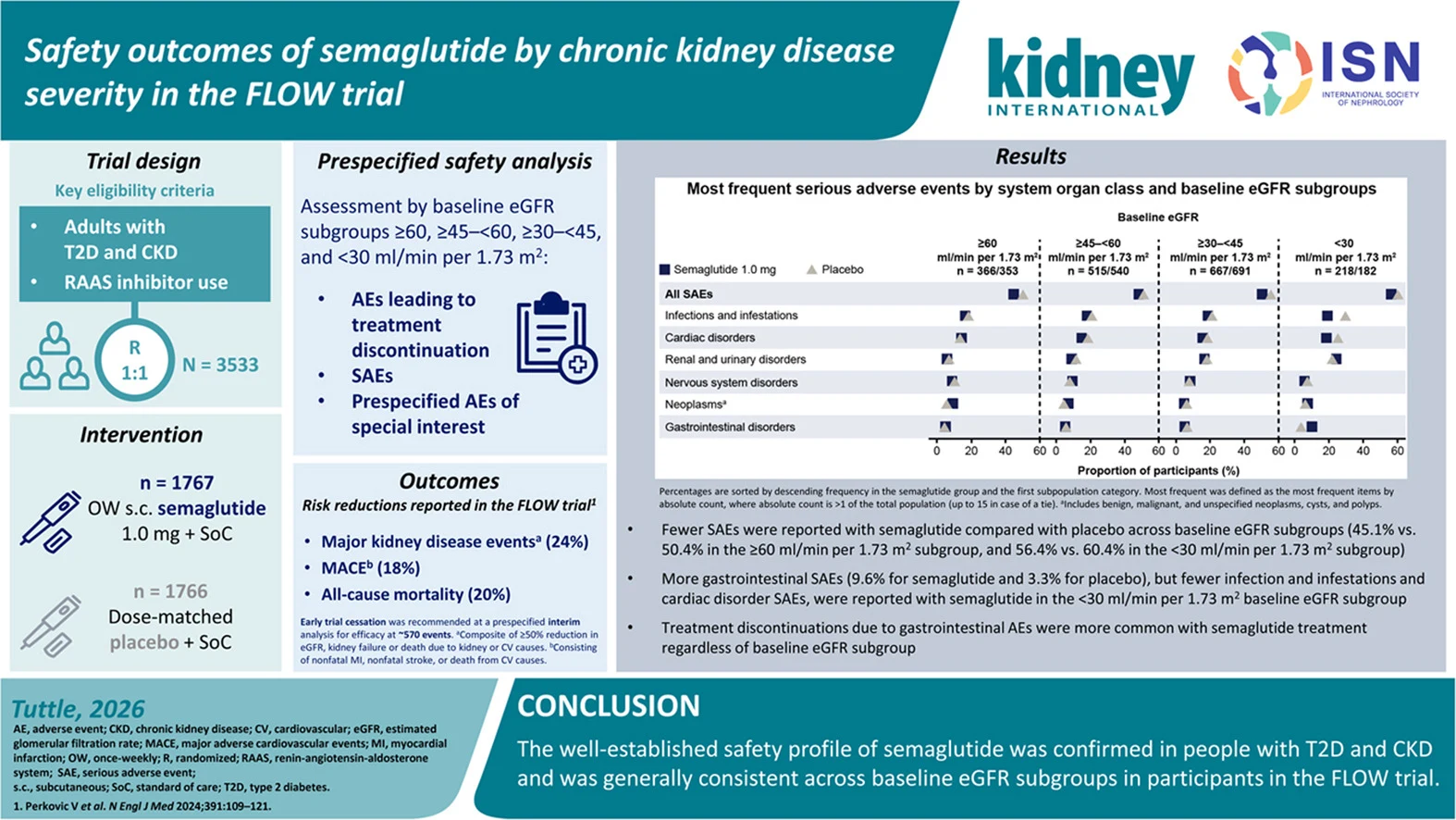
Double-blind, placebo-controlled, registered NCT03819153
Limit: Safety monitoring collected only selected types of adverse events
Edited by Boris Djordjevic · AgingResearch.News
In 3,533 people with type 2 diabetes and chronic kidney disease, a prespecified secondary analysis of the randomized FLOW trial assessed safety across levels of kidney function. Participants received semaglutide injections of 1.0 milligram once weekly or placebo.
Serious medical events were reported less frequently with semaglutide across kidney-function subgroups. In the highest kidney-function subgroup, rates were 45.1% with semaglutide and 50.4% with placebo. More participants stopped treatment because of adverse events in the lowest kidney-function subgroup: 18.8% with semaglutide and 18.7% with placebo, compared with 11.2% and 11.3%, respectively, in the highest subgroup. Stopping because of digestive side effects was more frequent with semaglutide: 4.5% versus 1.1% with placebo. The researchers identified no unexpected safety concerns across the kidney-function range studied.
Why it matters
For people aging with diabetes and chronic kidney disease, this analysis addressed a practical question: whether medication safety differed across levels of kidney function.
Caveats
This was a descriptive analysis that collected only selected types of safety events. Its findings do not establish safety in people without both conditions or outside the kidney-function range studied.
The paper
Safety outcomes of semaglutide by chronic kidney disease severity in the FLOW trial
University of Washington School of Medicine; AdventHealth Translational Research Institute
Kidney International, Oct 20, 2026


