AI chest scan measurements may help predict heart failure
Agreement on heart-chamber enlargement reached 98.8–99.2% between untimed and heartbeat-timed scans, versus 98.6–98.9% between paired heartbeat-timed scans.
5,749 participants
Limit: The study assessed prediction, not whether screening improved health outcomes
Stake: An author sits on the board of Toku.
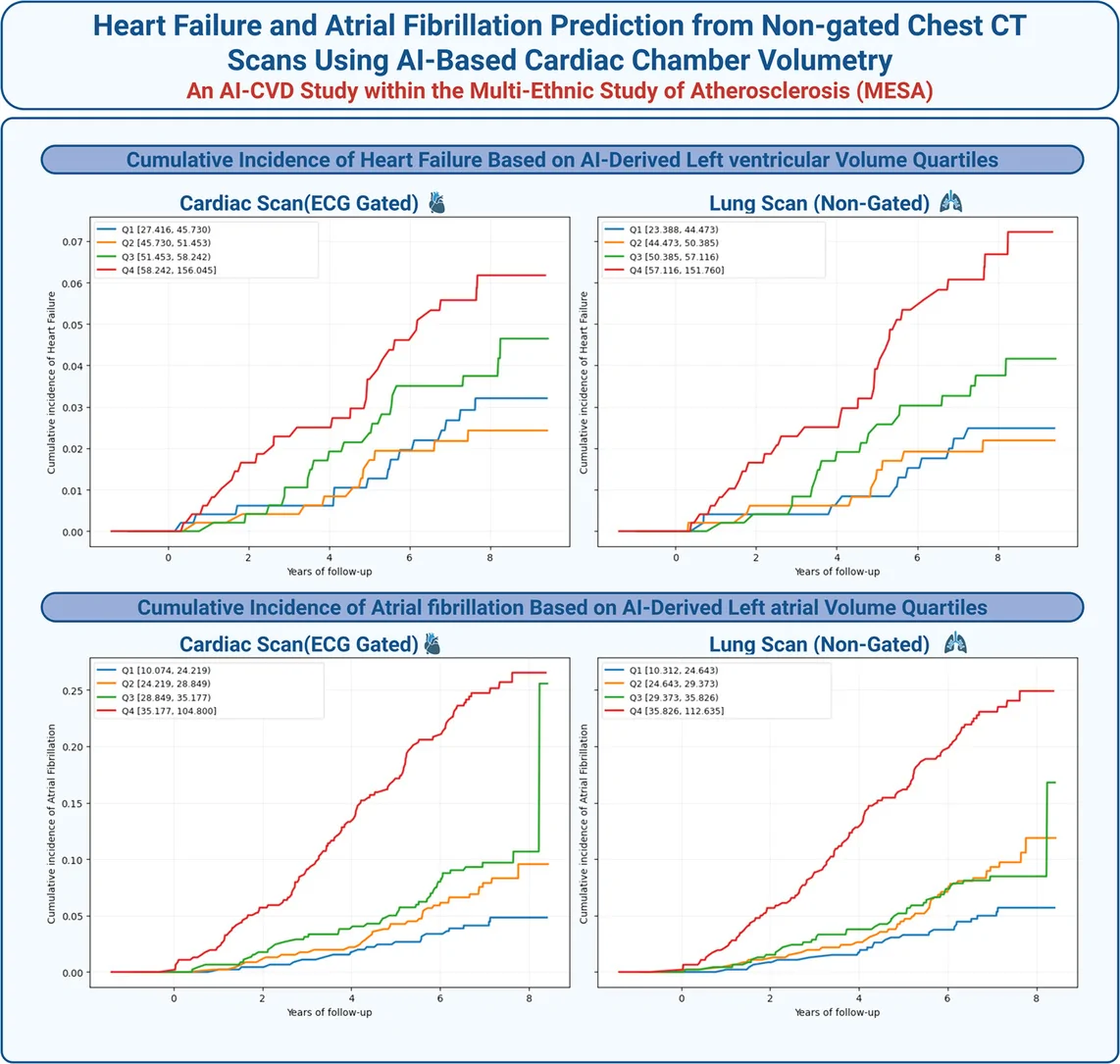
In an observational study of 2,053 participants in the Multi-Ethnic Study of Atherosclerosis, researchers compared artificial intelligence measurements of heart-chamber size from two types of chest scans. One type timed image collection to the heartbeat; the other did not. They also assessed scan-to-scan variation using heartbeat-timed scans taken two minutes apart in 5,749 participants.
The two scan types showed strong agreement in measuring heart chambers and identifying enlargement. They also performed similarly in predicting later heart failure and atrial fibrillation, an irregular heart rhythm. The researchers compared prediction scores after accounting for age and sex. They concluded that scans without heartbeat timing may support screening for the risk of these conditions.
Why it matters
The findings may broaden opportunities to assess heart failure and atrial fibrillation risk using chest scans obtained for other reasons.
Caveats
This observational study assessed prediction, not whether screening improved health outcomes. The abstract did not report participants’ ages, follow-up duration or absolute risks.
- Machine learning
- Heart failure
- Atrial fibrillation
- Cardiac chamber enlargement
- Cardiac chamber volume
- Humans
The paper
HeartLung.AI
American Journal of Preventive Cardiology, Jul 5, 2026, Open access